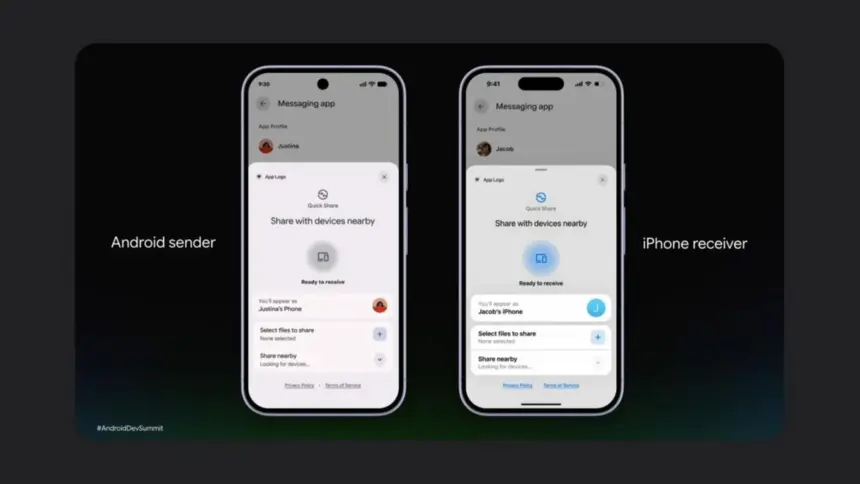
Google announced a new Quick Share SDK at its Android Dev Summit on 2 November 2026, giving third-party mobile developers the ability to embed peer-to-peer file transfers directly into Android and iOS applications. The software library is scheduled to arrive before the middle of 2027, removing the need to trigger full operating system menus.
Key points
- Google plans to roll out the toolkit across Apple and Android ecosystems during the opening six months of 2027.
- Developers can embed direct peer-to-peer transfers and Tap to Share inside apps, replacing the full-screen system share sheet with an in-app bottom sheet.
- Transfers use end-to-end encryption over local networks and Wi-Fi Direct, functioning offline without file compression or external server costs.
In-app peer-to-peer transfers
Under the current system, transferring a file using Quick Share on Android requires calling the operating system’s native share menu. That action launches a separate, full-screen interface that pulls the user away from the primary application.
With the new software kit, third-party developers can embed peer-to-peer file sharing and Tap to Share directly into their existing interface. Google presented the integration during an Android Dev Summit session outlining new developer libraries.
When triggered inside an updated app, Quick Share opens a compact bottom sheet rather than a system-level overlay. Users can view a preview of outgoing files and discover nearby recipient devices while remaining within their current workflow.
Networking and offline transfers
The kit manages local device discovery and radio connections automatically. On supported hardware, the SDK sets up Wi-Fi Direct channels and manages local hotspots to sustain high transfer rates with low latency.
Data security relies on hardware-level protection. Google said transfers feature end-to-end encryption “between both devices as the transfers happen between those local networks.”
Because the devices communicate directly over local radio frequencies, transfers work offline in environments without cellular coverage or internet access. The local connection allows users to send full-resolution images and uncompressed video clips, while saving app makers from operating costly backend server infrastructure to route files.
Cross-platform reach on iOS
Google confirmed that it will deliver a dedicated version of the library for Apple devices. The iOS SDK will let iPhone applications exchange files directly with nearby Android devices and other Apple hardware using the same local protocol.
Cross-platform file sharing has long suffered from ecosystem divisions, with Apple devices relying on AirDrop and Android hardware depending on Quick Share. Supplying iOS developers with a direct library allows cross-ecosystem exchanges without requiring external web services.
The move aligns with Google’s broader software tooling roadmap, which includes giving AI coding agents access to Android Studio and expanding ecosystem interoperability through its Connected Apps Platform.
Release schedule
Google scheduled the public release of the library for early 2027 across both mobile operating systems. The company also presented initial architectural details for Android 18 during the summit, pointing to wider local networking updates planned for the 2027 software cycle.