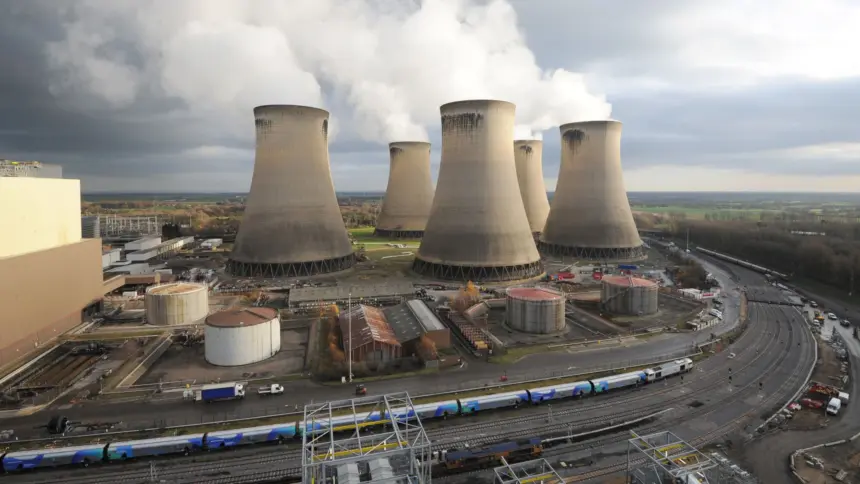
Asset manager Brookfield and energy generator Drax have agreed to build a £20 billion Drax AI data centre in North Yorkshire, Drax announced on Tuesday. The project will deploy at least 1 gigawatt of power on the Drax Power Station estate, with an initial 100 megawatts scheduled to open in early 2028.
Key points
- Brookfield, its neocloud platform Radiant, and Drax signed an agreement to develop an AI compute facility on the Drax Power Station estate.
- The first phase involves a £2.5 billion commitment to deliver up to 100 megawatts by the first quarter of 2028.
- Total capital expenditure across all stages could exceed £20 billion, covering facility construction and semiconductor purchases.
- Shares in Drax rose 8.2 per cent in London morning trading following the announcement.
A three-stage buildout in Yorkshire
Drax Group confirmed on Tuesday that it entered an agreement with Brookfield and Brookfield’s specialised cloud platform, Radiant, to develop the facility in northern England. The project will sit directly on the grounds of the Drax Power Station site in North Yorkshire.
Developers have structured the programme across three operational phases. Phase one targets up to 100 megawatts of operational capacity by the first quarter of 2028. Brookfield has earmarked £2.5 billion in initial capital to fund this opening stage.
A second phase intends to bring an additional 500 megawatts online between 2028 and 2031. After 2031, the partners plan to scale the installation beyond 1 gigawatt of total compute capacity, though Drax did not specify an exact completion date for that final expansion.

Brookfield estimates that total investment across the lifespan of the project could top £20 billion ($26.8 billion). That figure covers civil engineering, electrical works, cooling equipment, and the vast volumes of enterprise silicon required to populate the racks. Similar multi-gigawatt AI compute campuses under development internationally have seen budgets swell because advanced processor clusters often cost more than the physical buildings housing them.
Market reaction and the role of Radiant
Investors responded immediately to the announcement. London-listed shares in Drax climbed 8.2 per cent during early morning trading on Tuesday, making the power generator one of the strongest performers on the London market.
Brookfield is channelling the operational side of the compute development through Radiant, its dedicated neocloud business. Neocloud providers specialise in renting out high-density GPU clusters tailored specifically for deep learning, competing directly with legacy public cloud providers for AI customer workloads.
By placing Radiant on the ground in Yorkshire, Brookfield gains a physical anchor for its European computing presence. The asset manager has spent recent years buying up both energy assets and digital infrastructure, aiming to control both sides of the power generation and compute equation.

Why power station land matters for AI
Securing high-voltage power connections has become the primary bottleneck for developers building large-scale computing clusters. While operators can buy servers quickly, linking a 500-megawatt or 1-gigawatt installation to a regional grid often takes years of regulatory review and network reinforcement.
Europe has felt this squeeze sharply. High retail power tariffs, strict planning frameworks, and congested distribution networks have forced operators to look for non-traditional locations. Power grid limitations are already triggering political resistance across the continent, where Norway data centres face freeze calls over industrial supply concerns.
Building directly on an active generation estate avoids several of these distribution bottlenecks. Drax operates existing high-capacity grid connections and high-voltage transmission lines built to dispatch power from its biomass units. Siting data halls on that same private land allows compute operators to negotiate direct access to high-volume power supplies without waiting for lengthy substation builds elsewhere.
Drax and Brookfield must now progress planning permissions and engineering design works ahead of the scheduled 2028 phase-one launch.