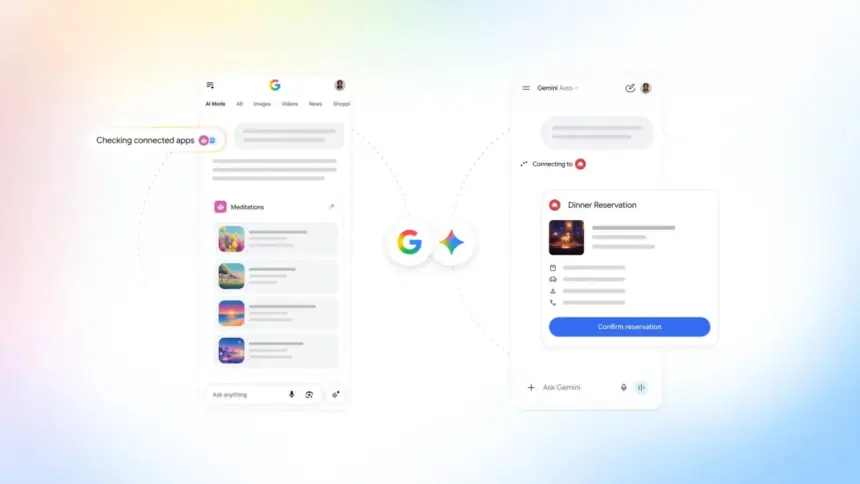
Google launched its Connected Apps Platform on 28 October 2026, opening a developer preview that lets outside companies link their software directly to Gemini and Google Search. The system allows users to execute actions inside third-party services from a chat window or search box without opening separate applications.
Key points
- The Connected Apps Platform allows developers to register, test, and distribute third-party integrations across Gemini and Search.
- Integrations rely on cloud-hosted or Android Model Context Protocol servers connected via Google’s AppFunctions application programming interfaces.
- More than 50 third-party services running in Gemini will expand to Google Search in the coming weeks.
- The developer preview is open in beta to waitlisted software teams in the United States.
Opening up the assistant interface
Google launched connected apps earlier in 2026, offering tightly controlled integrations with selected partners. The company is now formalising that work into a public framework. Through the new platform, outside engineering teams can build single integrations that function inside both the standalone Gemini assistant and the standard Google Search experience.
The system lets users carry out specific tasks through prompt-based instructions. Rather than switching between tabs or separate mobile applications, a user can summon a service to complete a booking, generate a design, or compile a media queue. For example, users can ask Gemini to plan an event flyer using Canva or compile a playlist through YouTube Music directly from a prompt.
To support the rollout, Google introduced the Google Connected Console. The web portal serves as the administrative hub where developers register their tools, verify brand credentials, and test query handling before release. The console also provides operational reporting, tracking incoming user requests, error rates, and system latency in real time.

Teams that build an integration can specify their distribution preferences. The console allows creators to deploy their service to Search alone, the Gemini app alone, or both platforms simultaneously. Google manages account authentication and identity verification to ensure logos and links reflect genuine business accounts.
How the technical architecture works
Connecting software to Google’s assistant surface requires standard technical components. Developers must set up a cloud-hosted server using the Model Context Protocol (MCP), or an Android MCP server running on device. They then wire their backend logic to Google’s systems by making use of the AppFunctions APIs.
Model Context Protocol has gained traction as an open standard for connecting large language models to external data repositories and operational tools. By basing the architecture on MCP, Google aims to reduce the engineering overhead needed to expose app functions to conversational models. Developers define tools and resources on their MCP server, and Google’s models decide when a user prompt requires calling those functions.
Once connected, the model translates natural language instructions into concrete API calls. A user query containing an explicit request, or an implicit need matching a connected service, prompts Gemini to pass structured parameters to the partner server. The third-party server completes the task and passes back a structured response that Google presents in the conversation.

Google has redesigned parts of its consumer interface to accommodate the growing collection of integrations. The Gemini application now features a new Customize page where users can view connected extensions, link their personal accounts, and adjust permissions. Users can also call services directly in prompts by typing an “@” symbol followed by the service name.
Expanding from Gemini into Google Search
Until now, third-party software integration developed at unequal speeds across Google’s consumer products. The company built over 50 Connected Apps available in Gemini, combining external partners with Google’s own tools. The standalone assistant already works with services including Adobe, Dropbox, Experian, Localiza, OpenTable, Peloton, and Ticketmaster, alongside Google Workspace, Google Photos, and Google Home.
By contrast, Google Search launched with a much narrower group of supported integrations. To date, Search users have been limited to a handful of services, including Instacart, Canva, YouTube Music, Yahoo Fantasy Football, and Sleeper Fantasy Football. The company confirmed that the broader list of Gemini integrations will begin arriving in Search over the next few weeks.
Google also announced that meditation service Calm has joined the programme as a new partner. The Calm integration will launch across both Gemini and Search, allowing users to start mindfulness sessions and guided exercises directly from conversational queries. Google has not specified a precise date for Calm’s deployment.
The move aligns with broader efforts to insert interactive tools and commercial services into core search results. Google has tested commercial formats across its conversational search features, as seen when Google AI Mode ads expand to 10 more countries with multi-turn formats. Connected apps provide another channel to surface functional web applications where users already seek answers.
The wider race for agent ecosystems
Google is not the only company trying to turn conversational software into an operating layer for web services. Competing AI developers have launched similar efforts to bridge external databases and functional software. OpenAI built comparable connector systems that let users link workplace files and productivity services to ChatGPT, while Meta has experimented with third-party tools inside its own assistants.
The strategic stakes centre on software discovery and distribution. For two decades, search engines directed users to websites, where users completed actions independently. As conversational models handle multi-step tasks, tech companies want users to complete those tasks without leaving the assistant interface. If consumers adopt this model, ranking inside conversational agents could become as critical for online businesses as conventional search engine optimisation.
Opening discovery to outside services also introduces technical and safety hurdles. Platforms must prevent rogue integrations from exfiltrating personal data or executing unauthorized actions on behalf of users. Google handles this by requiring authenticated accounts and giving users explicit toggle controls to disconnect services whenever they choose.
The expansion also reflects changes in how search engines index and interact with online platforms. As conversational services ingest more dynamic data sources, search providers have broadened their reach into walled gardens, similar to how public Discord messages to appear on Google and search engines expanded indexable community discussions. Connected apps extend that reach from static indexing to active execution.
Availability and next steps
Google opened the developer preview of the Connected Apps Platform as a closed beta for teams based in the United States. Software engineers and companies can request access through Google’s developer portal at developers.google.com/connected-apps.
The company said it will admit applicants to the preview in phases over the coming months. Google plans to expand the platform to developers in other regions after evaluating operational feedback and system performance during the initial trial.