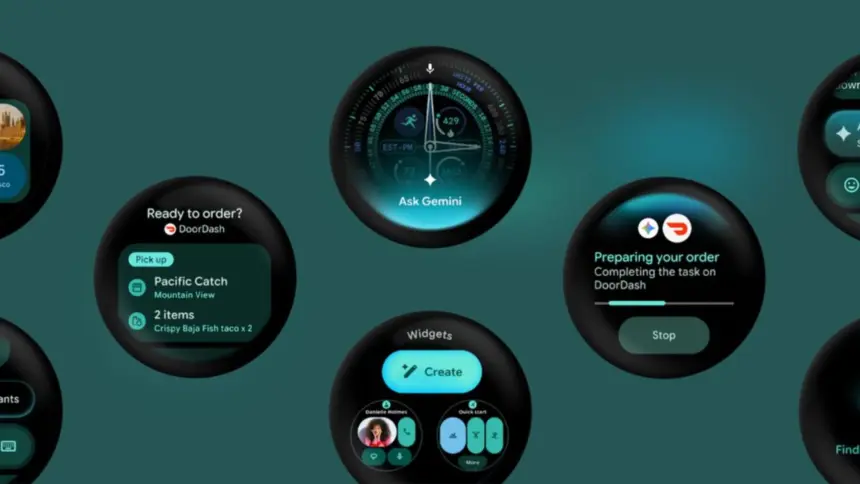
Google launched a developer preview for Wear OS 7.1 on 26 October 2026, revealing plans to introduce a persistent system status bar across smartwatch apps. The update, based on Android 17, brings standard mobile interface conventions to circular displays to show system indicators alongside the current time inside running applications.
Key points
- A canary emulator for Wear OS 7.1 introduces a standardised system status bar at the top of circular smartwatch screens.
- The status bar hides during active scrolling and full-screen dialogues, reappearing after two seconds of idle time.
- Google confirmed the status bar is an early preview and will launch in a later platform release rather than the stable 7.1 build.
- The software is built on Android 17, carrying API level 37.2-beta1 with build ID CP41.260831.001.E8.
What the status bar does
Smartwatch applications on Wear OS currently manage their own status and time elements, creating visual inconsistency between software from different developers. The new test build replaces these individual designs with a single system-level bar anchored to the top of the display.
According to Google‘s developer documentation, the bar provides uniform clock typography, standardised indicator placement, and an underlying backplate across every supported screen. Rather than showing live connectivity or battery icons, the early canary build renders a placeholder star icon to demonstrate layout behaviour.
The interface is designed to stay out of the way during active use. In Google’s implementation guidelines, the status bar hides automatically whenever a user scrolls through a list. If the user stops interacting with the screen for about two seconds, the time and indicators fade back into view.
How developer tools manage the interface
Google has embedded the status bar controls directly into Jetpack Compose for Wear OS, the primary modern toolkit used to build smartwatch interfaces. Applications targeting API level 35 or higher and compiled against Compose for Wear OS version 1.8.0-alpha02 or newer will opt in to the system status bar by default.
Under this setup, the framework’s AppScaffold component automatically suppresses the traditional in-app TimeText clock to prevent duplicate time readouts. Another component, ScreenScaffold, calculates the necessary window insets at the top edge of the screen so that application content does not collide with the system indicators.
Developers can still take over the entire display when necessary. Full-screen components such as alert dialogues, date pickers, time pickers, and steppers hide the bar automatically. Developers building dedicated immersive views can invoke StatusBarSuppression to remove the overlay entirely.
Android 17 foundations and release timing
The canary release marks the first public confirmation of Wear OS 7.1. Technical build details show the platform runs on API level 37.2-beta1, derived from Android 17, internally code-named “CinnamonBun”. The emulator carries the specific build identifier CP41.260831.001.E8.
Wear OS developers can access the released emulator via Android Studio to test layout compatibility. However, smartwatch owners will not see the status bar immediately upon updating to the next general release.
Google stated in its release notes that the status bar “won’t be included in the upcoming Wear OS 7.1 stable emulator” and is restricted to the canary image to gather developer feedback. The company plans to roll out the status bar in a subsequent Wear OS platform update once testing concludes.