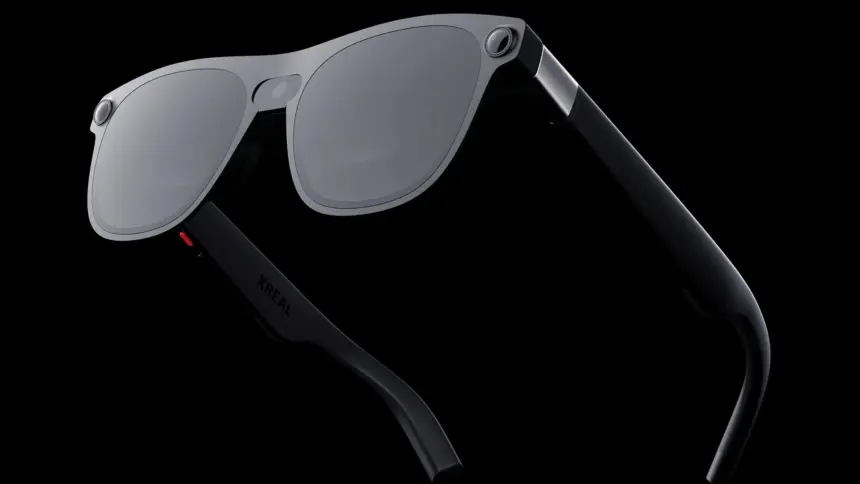
Hardware maker Xreal has opened pre-orders for the Xreal Aura smart glasses, marking the first consumer spectacles powered by Google’s Android XR operating system. The wearable device goes on sale at a promotional launch price of $1,099 ahead of shipments in mid-November 2026.
Key points
- Xreal opened pre-orders on 29 October 2026, offering a launch discount against the standard $1,279 retail price.
- The glasses run Google’s Android XR software and use Qualcomm‘s Snapdragon Reality Elite platform housed inside a pocket compute puck.
- Dual Sony Micro-OLED displays project a 1200p virtual workspace with a 70-degree field of view and refresh rates up to 120Hz.
- Google Gemini assistant provides multimodal input, allowing users to query physical objects and manage applications with voice and hand tracking.
Hardware design and display specifications
The device splits its components across two parts to avoid placing excess weight on the user’s face. The glasses frame weighs under 95 grams, housing twin Sony Micro-OLED panels, four microphones, onboard tracking sensors, and built-in speakers tuned by Bose. A cable connects the frames to an external computing puck, which contains the system battery, processors, and dedicated touch controls.
Visual output relies on panels running at 1,920 by 1,200 pixels per eye, offering a 70-degree diagonal field of view. The displays reach peak brightness levels of 1,050 nits and support variable refresh rates up to 120Hz. To handle outdoor daylight and dark rooms, the outer lenses include electrochromic dimming with five selectable transparency levels.
Internal processing splits between the spectacles and the tethered module. An Xreal X1S chip inside the frame manages sensor tracking and display pipelines, while Qualcomm’s Snapdragon Reality Elite processor inside the puck handles general computing tasks, wireless connectivity, and graphics rendering.

Android XR software and Gemini tools
Google previewed its collaboration with Xreal at Google I/O in May 2026, positioning the Android XR platform as an open alternative to proprietary spatial computing ecosystems. The Aura hardware represents the first wired glasses to ship with the operating system installed.
Android XR adapts standard smartphone features into floating spatial windows that stay anchored in physical space. Google bundled deep links to core consumer applications. Google Photos can convert standard two-dimensional images into synthetic three-dimensional spatial stills and project panoramic shots across a 360-degree viewing sphere.
Google Maps adds three-dimensional terrain views and interactive Street View modes. YouTube supports both 360-degree spherical streams and VR180 spatial video formats directly through the built-in interface.
System interactions centre on Google’s Gemini artificial intelligence models. Rather than relying solely on manual menus, users can ask Gemini to identify objects in their room, extract text from physical documents, or coordinate scheduling across workspace software. Inputs accept hand gestures through optical tracking cameras, voice commands, frame touch controls, and external Bluetooth accessories including keyboards, mice, and gaming controllers.

Software catalog and gaming at launch
Xreal confirmed that more than 150 dedicated spatial computing experiences will run on the platform at launch. Media partners and gaming studios built custom interfaces tailored to the 70-degree visual window.
Sports broadcasters created interactive viewing hubs, including an NBA application for Android XR and a dedicated NASCAR XR dashboard that projects live timing data alongside video feeds. Games confirmed for day one include Fallout: Factions, the space adventure Project Hail Mary: Journey Among the Stars, and the physics title Oh My Galaxy.
Medical and educational tools also feature in the catalogue, led by clinical training package XR HoloMedicine and music learning programme Simply Piano XR. Users can also run standard two-dimensional Android applications downloaded from the Google Play Store as flat virtual panels arranged around their workspace.
Pricing, configurations and retail competition
Xreal sells the base configuration with 12GB of RAM and 256GB of internal storage for an introductory price of $1,099 on Xreal’s online store, representing a $180 discount on its standard $1,279 price. A higher-tier model with 16GB of RAM and 512GB of storage lists for $1,499, discounted to $1,299 during pre-orders. Customers can also place orders through retailers including Best Buy.
The pricing reflects a market segment aimed at developers and early technology adopters rather than mass-market buyers. Apple popularised spatial computing headsets with the Vision Pro in 2024, but bulky enclosed visors drew criticism over neck strain and physical isolation during extended work sessions.
Smart glasses manufacturers are pursuing lighter hardware. Snap offers its standalone Specs AR glasses for developers at $2,195, though that device features shorter battery life and a larger plastic frame. Meta has announced plans to release consumer augmented reality glasses priced at $1,299, but that hardware will not arrive until spring 2027.
Xreal aims to sidestep weight trade-offs by offloading batteries and primary silicon into the external puck, keeping the glasses under 95 grams while matching the software breadth of larger headsets.
What happens next
Xreal plans to begin shipping pre-order units to customers across North America and select international markets in mid-November 2026. Google has scheduled further Android XR developer releases for early 2027, when hardware partners are expected to expand spatial application support across additional enterprise productivity tools.