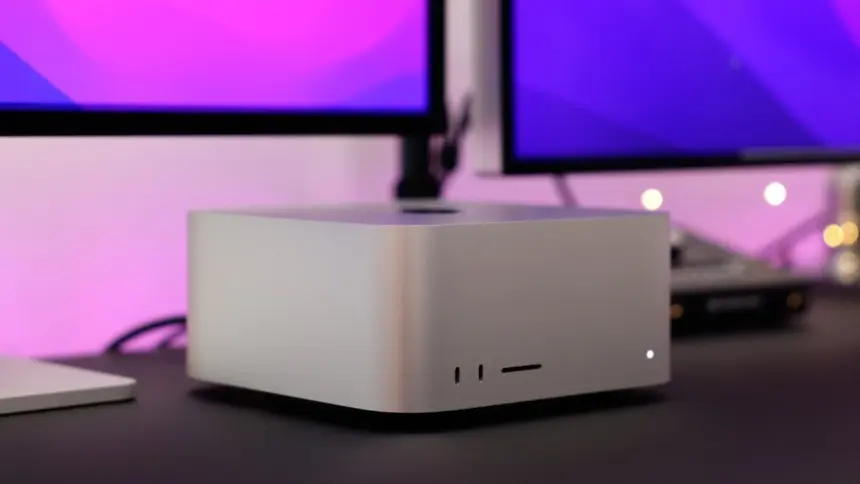
Apple has opened orders for the Mac Studio M5 Ultra equipped with 512GB of unified memory, fulfilling a pledge made during the computer’s August unveiling and targeting artificial intelligence researchers who run demanding language models on local hardware.
Key points
- The 512GB memory option costs $15,500 on its own, pushing the entry price of the workstation to $22,299.
- The massive memory tier is restricted to the top-spec M5 Ultra chip with a 36-core CPU and an 80-core GPU.
- Deliveries for the new configuration begin between late November and early December.
- A fully loaded build with 16TB of internal solid-state storage tops out at $29,799.
The cost of half a terabyte on a desktop
Buyers visiting Apple’s online store can now configure the desktop with the maximum memory specification. When Apple unveiled the refreshed M5 Max and M5 Ultra desktop line in August 2026, it noted that half a terabyte of unified memory would follow before the end of October.
Selecting 512GB requires choosing the top-tier M5 Ultra processor, which pairs a 36-core central processor with an 80-core graphics processor. That base system, equipped with 96GB of unified memory and 1TB of storage, starts at $6,799 in the United States.
Adding the 512GB memory package costs an extra $15,500. With 1TB of standard internal storage, the machine costs $22,299. Customers who increase the internal flash storage to the maximum 16TB will pay $29,799 through the Mac Studio configurator. Apple estimates that initial shipments will reach customers between late November and early December.

By comparison, the less expensive M5 Max processor remains capped at 128GB of memory. Those who need memory pools larger than 128GB must purchase the dual-die Ultra silicon.
Why local memory matters for artificial intelligence
The price tag reflects a shifting market for workstation hardware driven by machine learning engineers. Large language models and multimodal networks require massive memory pools to hold billions of neural network weights during inference and fine-tuning.
Traditional x86 workstations rely on dedicated graphics cards from manufacturers such as Nvidia. While professional graphics cards offer high processing throughput, fitting large models onto them requires multiple cards linked together. High-end server accelerators command steep enterprise premiums and draw substantial electrical power, making desk-side operation difficult in ordinary office environments.
Apple Silicon takes a different technical route. The architecture shares a single unified pool of high-bandwidth memory between the central processing units, the graphics processing cores and the neural engine. When a computer contains 512GB of unified memory, nearly the entire pool is available to the GPU cores for model weights.

That unified pool allows machine learning engineers to load immense model checkpoints entirely into memory without splitting tensor calculations across distinct accelerator boards over bus lines. For researchers testing open-weight models locally, a compact desktop drawing hundreds of watts replaces a noisy, power-hungry rack enclosure.
Meta and the open-weight model push
The practical utility of Apple’s largest memory tier became clear earlier this month when Meta unveiled its Muse Spark Open system. Meta described the release as the most capable U.S. open-weight model to date
when introducing the weights.
Rather than confining the software to cluster hardware in remote data centres, Meta worked directly with Apple engineers to ensure the model could execute locally. Meta confirmed that the architecture can run across a desktop setup comprising two Mac Studio computers equipped with 512GB of memory using Apple’s open-source MLX array framework. Meta chief executive Mark Zuckerberg publicly thanked Apple chief executive John Ternus for the joint engineering effort.
The collaboration highlights how serious hardware vendors have become about developer mindshare in machine learning. By delivering software frameworks like MLX that compile directly for Apple Silicon graphics cores, Apple has turned its Mac Studio line into an appealing testbed for research teams who want to avoid recurring cloud compute bills.
Hardware options and repair support
The arrival of the top-tier memory option completes the rollout of the Mac Studio range for this cycle. While the initial August launch satisfied audio engineers, video editors and standard software developers, the delayed memory tier was aimed squarely at artificial intelligence specialists and scientific computing labs.
Customers seeking desktop machines configured with 512GB of RAM will find that the memory remains soldered directly into the processor package. Because unified memory cannot be expanded or upgraded after purchase, buyers must commit to their chosen capacity at the time of order.
Apple has also extended its self-service repair coverage to the new product line. Official replacement parts and repair manuals for the M5 Max and M5 Ultra computers are now available to customers in the United States, Canada and Europe, allowing technicians to service power supplies, cooling modules and logic boards independently.
Initial orders placed this week are scheduled to arrive with commercial buyers and research laboratories starting in late November.