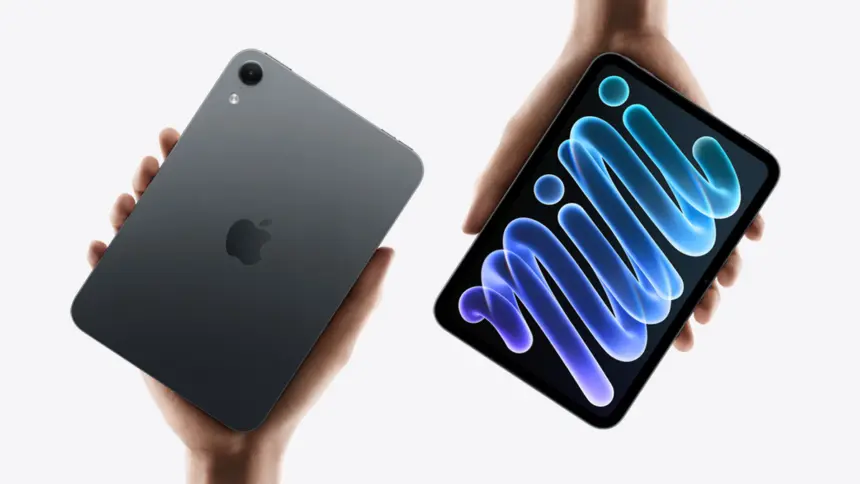
The first reviews of Apple’s redesigned OLED iPad mini arrived on Tuesday, with critics praising its A20 Pro processor, thinner waterproof frame and brighter panel. Despite those hardware gains, reviewers questioned its higher $699 starting price and the decision to cap the 8.5-inch display at a 60Hz refresh rate.
Key points
- Apple’s eighth-generation iPad mini introduces an 8.5-inch OLED screen, an IP67 water-resistance rating and a slim 5.4mm aluminium chassis.
- The tablet runs on Apple’s 2nm A20 Pro processor with 12GB of unified memory, matching or beating M4 iPad Air graphics scores in early benchmarks.
- Reviewers criticised the lack of 120Hz ProMotion and the $100 price increase, which pushes the entry-level 128GB model to $699.
- The device arrives in shops on Friday, 6 November, in starlight and midnight colour options.
A redesigned chassis and acoustic display
The new iPad mini represents the most extensive physical overhaul of Apple’s smallest tablet since 2021. Measuring 5.4mm thick, the chassis is nearly a millimetre thinner than the 6.3mm seventh-generation model and weighs 255 grams, down from 293 grams. Cellular editions add just 8 grams to that total.
Apple achieved part of that reduction by eliminating traditional speaker grilles. Audio now vibrates directly through the front glass panel using an internal mechanism the company calls an Acoustic Display. The setup combines dual display-driven woofers with tweeters tucked into the aluminium frame. Gizmodo reported that while deep bass frequencies produce noticeable vibration against the user’s palms, the system delivers fuller stereo separation and avoids muffled sound when holding the tablet in landscape orientation.
Removing the external speaker apertures also allowed Apple to secure an IP67 rating for dust and water resistance, marking a first for any iPad. The specification guarantees survival in up to one metre of freshwater for 30 minutes. The Verge noted the rating makes the tablet far more practical for reading in the bath, working in kitchens or taking notes on industrial sites.
Apple shifted the 12-megapixel Center Stage front camera from the short portrait side to the long landscape edge, matching the layout used on recent full-sized iPads. Biometric security remains limited to a Touch ID sensor embedded in the top power button, with Face ID still reserved for the Pro tablet line.
A20 Pro performance and silicon tiers
Under the display, the tablet runs Apple’s 2nm A20 Pro processor, the same generation of mobile silicon introduced in the iPhone 18 Pro and iPhone Duo. The baseline 128GB and 256GB iPad mini configurations feature a five-core CPU paired with a seven-core graphics processor and a 16-core Neural Engine. Buyers who spend $999 or more on the 512GB iPad mini receive an unbinned six-core CPU and a dual 16-core Neural Engine designed for heavier on-device machine learning workloads.
All configurations ship with 12GB of RAM, an increase that gives the small tablet the same memory floor as the entry iPad Pro. In Geekbench 7 testing conducted by Gizmodo, the A20 Pro outpaced the larger M4 iPad Air in single-core workloads and trailed its multi-threaded score by only 15 percent. In graphical benchmarks, the tablet beat the M4 iPad Air by roughly 15 percent in Metal compute tasks and 25 percent in 3DMark Steel Nomad Lite.
Reviewers ran demanding titles including Resident Evil 4, Control and Assassin’s Creed Mirage, noting consistent frame rates and rapid load times. Gizmodo cautioned that sustained gaming sessions generated thermal throttling when testing the tablet inside Apple’s protective Smart Folio case, though bare-metal performance remained stable.
Wireless connectivity also moves to in-house silicon. The tablet includes Apple’s N1 networking chip, adding support for Wi-Fi 7, Bluetooth 6 and Thread smart home protocols. Cellular versions use the C2 baseband modem, which delivered download speeds above 500Mbps on 5G networks during testing by Engadget.
Screen quality, nano-texture and the 60Hz debate
The headlining feature of the hardware refresh is the 8.5-inch Super Retina XDR screen, which swaps out the previous 8.3-inch LCD for an OLED panel with a 2,000,000:1 contrast ratio. Bezels are 24 percent narrower, permitting the larger screen diagonal without expanding the device footprint. Standard dynamic range brightness reaches 600 nits, while high dynamic range content peaks at 1,200 nits. The screen can also dim down to 1 nit for reading in dark rooms.
Unlike the tandem panel on the iPad Pro or the reference displays seen on the touchscreen MacBook Pro, the mini uses a single-layer OLED stack. Reviewers broadly praised the deep blacks and saturated colours during video playback, but unanimously questioned Apple’s decision to lock the refresh rate at 60Hz.
Apple defended the omission by arguing that OLED’s faster pixel response time smooths motion blur during navigation. Critics disagreed. 9to5Mac and The Verge reported that while scrolling feels crisper than on the prior LCD model, drawing with an Apple Pencil or reading text while panning still exhibits visible judder compared to Apple’s 120Hz ProMotion screens.
For an extra $100 on 256GB and 512GB models, Apple offers an etched nano-texture glass option to disperse ambient glare. Testing showed the matte surface eliminated harsh reflections in bright offices and daylight. Both The Verge and Gizmodo cautioned that the micro-etched finish slightly reduces peak contrast and creates a faint shimmer on solid white backgrounds, meaning buyers who work indoors may prefer the standard glossy glass.
Pricing, software and the small tablet market
Software performance on iPadOS 27 divided reviewers. Creative applications built for single-window input scaled comfortably. Canva’s newly released Affinity suite for iPad, accessible via the Affinity suite app, ran smoothly without interface crowding. Photo editing in Adobe Lightroom and digital sketching using the Apple Pencil Pro also drew praise.
Multitasking proved more awkward. Reviewers found that side-by-side windowing on the 8.5-inch canvas felt cramped, with menu items occasionally overlapping system icons or accidental touches triggering Spotlight search. The mini also lacks a first-party keyboard with a trackpad, leaving buyers to pair third-party Bluetooth keyboards.
The central hurdle across all reviews was price. The iPad mini 2026 starts at $699 for 128GB of storage. That represents a $100 increase over the mid-2026 retail price of the A17 Pro model, and sits only $50 below the 11-inch M4 iPad Air. A fully specified 512GB cellular edition with nano-texture glass costs $1,249.
With an OLED iPad Air and M6 iPad Pro expected in early 2027, the mini occupies an unusual niche: an ultra-compact, professional-grade tablet with high durability, priced well above entry-level consumer hardware. Apple opens global retail sales for the tablet on 6 November.