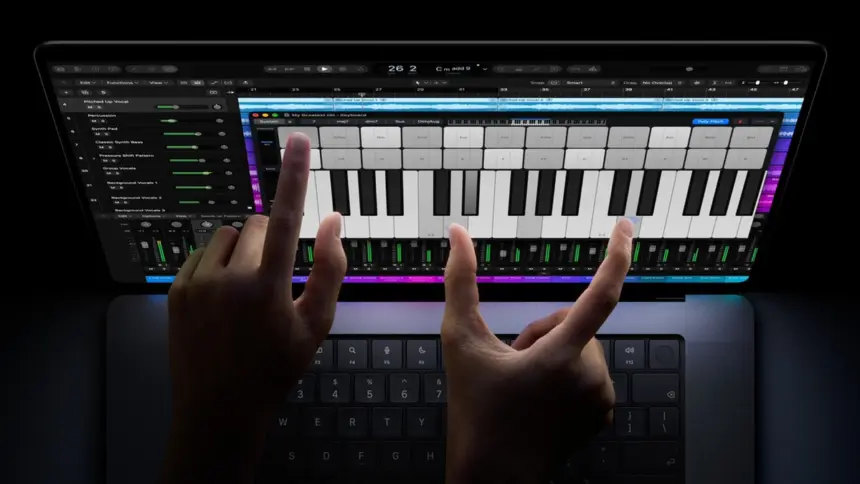
Apple announced its first touchscreen MacBook Pro on Wednesday at an event in Los Angeles, adding finger input to its flagship laptop alongside a tandem OLED display and M5-series processors. The laptop starts at $2,899, runs an adaptive macOS interface that expands buttons when touched, and ships to customers on 6 November.
Key points
- Apple unveiled 14-inch and 16-inch models of the touchscreen MacBook Pro powered by M5 Pro and M5 Max silicon.
- The tandem PROLED XDR display integrates touch sensors directly into the panel to cut latency and screen thickness.
- macOS dynamically enlarges menus, window controls and the Dynamic Island when fingers approach the screen.
- Prices start at $2,899 for the 14-inch laptop and $3,399 for the 16-inch model, with pre-orders open now.
Adaptive controls reshape macOS for touch
Apple presented the laptop at its Pro and Tell media event on 28 October, introducing an altered operating system designed to handle finger input without abandoning the pointer. Instead of replacing the desktop layout with large tablet tiles, macOS 27 leaves standard interface elements at their normal dimensions until a hand nears the glass.
When a finger touches the display, menu items expand to widen target zones. The traffic-light buttons on window corners grow larger before registering a tap, and swiping upward from the bottom bezel exposes a hidden application Dock. Apple said the operating system automatically translates screen presses into mouse clicks, allowing legacy Mac software to accept taps without dedicated developer updates.
The screen notch found on older models has been replaced by the Dynamic Island, which debuted on the iPhone in 2022. On the laptop, the pill-shaped cutout hosts Spotlight search, Live Activities and Siri AI. Tapping the area pulls it down into an expanded widget that hovers over open windows, letting users manipulate background tasks or dictate queries directly on the glass.

Basic navigation mirrors standard trackpad gestures. Users can swipe through web pages, pinch to zoom inside documents, drag slides across presentation decks, or double-tap title bars to expand windows to full size. Apple said creative applications such as Logic Pro and DaVinci Resolve now support touch-based colour grading and sound mixing, with updates planned for Adobe Lightroom, Blender, Cinema 4D and Microsoft 365 later this year.
Tandem OLED hardware and a stiffened hinge
The laptop uses what Apple calls a PROLED XDR display, built with a tandem OLED structure capable of 1,000 nits sustained full-screen brightness and 2,000 nits peak brightness for both standard and high dynamic range content. Contrast stands at 10,000,000:1, with an adaptive refresh rate spanning 10Hz to 120Hz and an optional nano-texture glass coating to reduce glare.
Unlike touch-enabled Windows machines that sandwich a digitiser layer over the panel, Apple fused the capacitive sensors into the display glass itself. The company said this construction lowers touch latency and reduces overall lid thickness. The 14-inch chassis measures 0.59 inches thick, while the 16-inch version measures 0.63 inches.
Weight has also dropped. The 14-inch model weighs 3 pounds, which is half a pound lighter than the outgoing equivalent without touch. The 16-inch configuration weighs 4 pounds, saving 0.7 pounds. To counter the screen bounce common on clamshell touchscreens, Apple re-engineered the display hinge with extra damping to keep the screen upright when poked, though media demonstrations showed minor movement remained under firmer taps.

Under the casing, Apple installed its M5 Pro and M5 Max processors. Memory options start at 24GB of unified memory and reach 128GB on the M5 Max, alongside storage capacities ranging from 1TB to 16TB. Apple said the M5 Max configuration contains enough memory bandwidth and compute headroom to execute large language models with hundreds of billions of parameters entirely on the machine. Battery life reaches a stated maximum of 22 hours on the 14-inch frame and 24 hours on the 16-inch frame, with fast charging providing a 50 percent top-up in 30 minutes.
Reversing a 16-year corporate doctrine
The release marks an abrupt philosophical reversal for Apple. In 2010, Steve Jobs rejected touch laptops as ergonomically terrible, arguing that vertical touch surfaces cause severe arm fatigue. Two years later, Tim Cook compared hybrid computers to combining a toaster and a refrigerator, contending that forced convergence failed to satisfy customers.
As recently as 2018, Craig Federighi, Apple’s senior vice president of software engineering, dismissed touchscreens on notebooks by calling screen poking exhausting during prolonged sit-down sessions. The company previously tried to satisfy touch input with the Touch Bar in 2016, an OLED strip above the keyboard that drew widespread user criticism before Apple removed it entirely in 2023.
Explaining the shift, Greg Joswiak, Apple’s senior vice president of worldwide marketing, told Wired that expectations had changed among younger professionals who grew up tapping portable screens. Company leadership concluded that touch input could augment keyboards and trackpads rather than replace them. John Ternus, Apple’s chief executive, told attendees at the Los Angeles launch that users had to touch the display to believe its responsiveness.
Pricing, enterprise demand and availability
Hardware pricing puts the machines at the upper tier of Apple’s laptop range. The base 14-inch touchscreen MacBook Pro with an M5 Pro chip costs $2,899, rising to $4,499 for the M5 Max edition. The 16-inch variant starts at $3,399 with the M5 Pro and climbs to $4,799 with the M5 Max. Education discounts lower base figures to $2,749 and $3,199 respectively.
Market analysts see the launch as an effort to capture commercial buyers who previously chose Windows convertibles. Data from research group IDC indicates that enterprise procurement accounts for 66 percent of all touchscreen laptop sales worldwide, with market share projected to hit 20 percent of all shipped notebooks by 2030. Francisco Jeronimo, vice president for worldwide devices at IDC, noted in an analysis that Apple’s entry settles lingering industry doubts over whether laptop touchscreens represent an enduring commercial category.
The machines are available to pre-order immediately through Apple’s retail website and third-party electronics retailers, with in-store availability and retail deliveries beginning on Friday, 6 November.