Apple Audio Intelligence features, including tools that let wearers rewind recent speech and summarise meetings, have rolled out to developers in the iOS 27.3 and watchOS 27 betas. The release brings ambient audio processing to the Apple Watch Series 12 and Apple Watch Ultra 4 ahead of a public beta.
Key points
- Developers can test Live Rewind and Siri Recap, two conversation tools first previewed in September.
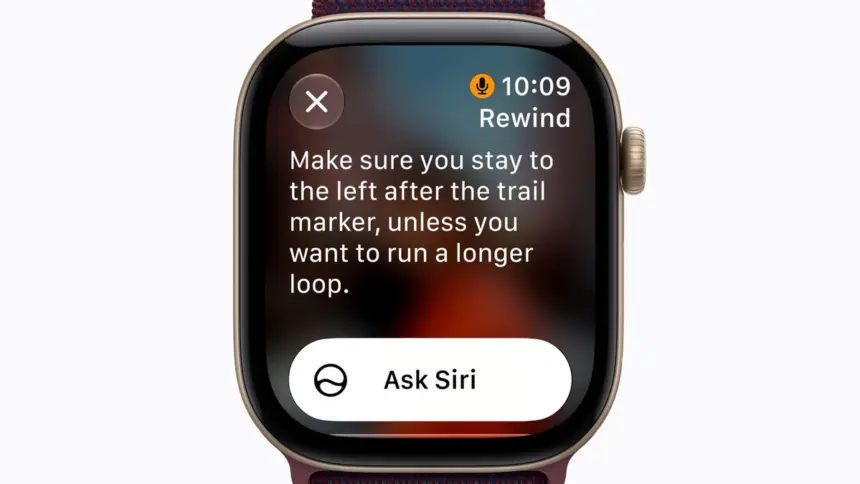
- Live Rewind displays the last 15 seconds of speech on screen following a double-press of the Digital Crown.
- Siri Recap generates short summaries of meetings while discarding raw voice recordings.
- The tools require an Apple Watch Series 12 or Ultra 4 paired with an iPhone 16 or newer, excluding the iPhone 16e.
How Live Rewind and Siri Recap work
Apple first announced the audio package during its September 9, 2026 Apple Watch Series 12 announcement. The software expands on existing sound recognition options by adding two tools designed to parse human conversation.
Live Rewind targets moments when a wearer misses a spoken detail, such as an airport announcement, spoken directions or a name in a presentation. Pressing the Digital Crown twice prompts the watch to display a text snippet of what was said over the preceding 15 seconds.
The snippet stays on screen briefly before vanishing permanently after about 30 seconds, unless the user chooses to save it to the Siri app. Wearers can also tap an option below the text to ask Siri questions about unfamiliar terms mentioned in the snippet.

Siri Recap serves a different purpose by compiling high-level notes from extended discussions. Rather than transcribing speech word for word, the system generates a title, a short summary sentence and bullet points covering key facts like dates, deadlines and prices.
According to Apple’s support guide, the software can run manually or on automated schedules linked to specific times and locations, such as during office hours. Users can disable the feature instantly through the watch Control Center.
Privacy safeguards and ambient recording
Wearable devices that listen to ambient sound have drawn public scrutiny over bystander privacy. Apple has built several physical and visual cues into the watch software to indicate when conversation processing takes place.
Triggering Live Rewind sounds an audible chime from the watch speaker, even when the device is set to silent or when the wearer has headphones connected. The display also shows a full-screen animation alongside a visible microphone indicator to alert people nearby that speech was retrieved.

Siri Recap takes steps to prevent eavesdropping and data hoarding. The system does not attempt to identify individual speakers and explicitly omits sensitive records such as bank account numbers, government identifiers and authentication codes.
Unsaved recaps delete themselves after seven days. Wearers receive notifications on their watch and phone each evening and morning asking them to review recorded recaps. From there, users can edit the text, delete it, or export notes directly to Apple Notes or the Journal app.
The hardware and cloud pipeline
Running continuous audio processing without draining the battery relies on a coordinated pipeline between the watch, the phone and remote servers. The Apple Watch S11 chip handles the first stage through a dedicated hardware component called the Secure Exclave.
A lightweight machine learning model on the S11 chip monitors sound levels to detect whether the wearer is participating in an active conversation. The raw sound stays inside an isolated rolling buffer that continuously overwrites older audio. Neither watchOS, third-party apps, nor Apple engineers can inspect this buffer.
When Siri Recap runs, the watch encrypts the audio and sends it over a local wireless link to the paired iPhone. On-device speech recognition on the handset converts the voice stream to text, and a local language model strips filler words to cut the transcript length by more than half.
The phone deletes the raw audio immediately after transcription. It then encrypts the condensed text and transmits it to Apple’s Private Cloud Compute cluster. Foundation models on those cloud servers generate the title and summary bullet points before sending the finished text back to the phone.
Apple says the cloud servers erase the text and intermediate summaries as soon as the response returns to the device. Any notes synced between a user’s devices through iCloud use end-to-end encryption, meaning Apple does not hold the keys to read them.
Compatibility rules and regional limits
Apple Audio Intelligence carries strict hardware and regional restrictions during its initial rollout. The conversation features work exclusively on the Apple Watch Series 12 and Apple Watch Ultra 4. Earlier watches lack the S11 architecture needed to manage the isolated audio buffer.
Users must also pair the watch with a handset capable of running Apple Intelligence. Compatible models include the iPhone 16 family and later devices, though Apple has excluded the entry-level iPhone 16e from using the conversation tools.
Software availability mirrors earlier Apple AI rollouts. Developers testing the software must use watchOS 27 and iOS 27.3. The testing arrives as Apple expands its wider AI software footprint, with the Apple Intelligence China rollout also preparing for beta trials.
English is the only supported language at launch. Apple confirmed that Live Rewind and Siri Recap will not be available in the European Union during the initial release, and server-side model processing remains subject to daily usage caps.
Apple has also set age restrictions on the tools. Accounts registered to users under 13 cannot access the conversation features, while users between 13 and 17 require explicit approval from a parent or guardian through family sharing settings.
Apple plans to expand testing to public beta participants later in the software cycle before releasing iOS 27.3 and watchOS 27 to all users.