Sixteen months after landmark EU repairability rules took effect across Europe, consumer groups and repair technicians report that fixing a damaged smartphone remains frustratingly expensive and technically difficult for the average owner.
Key points
- European Union Ecodesign requirements introduced in June 2025 mandate seven years of spare parts availability for smartphones and tablets.
- High replacement component prices often exceed 30% of a handset’s original price, well above the 20% threshold consumers are willing to spend.
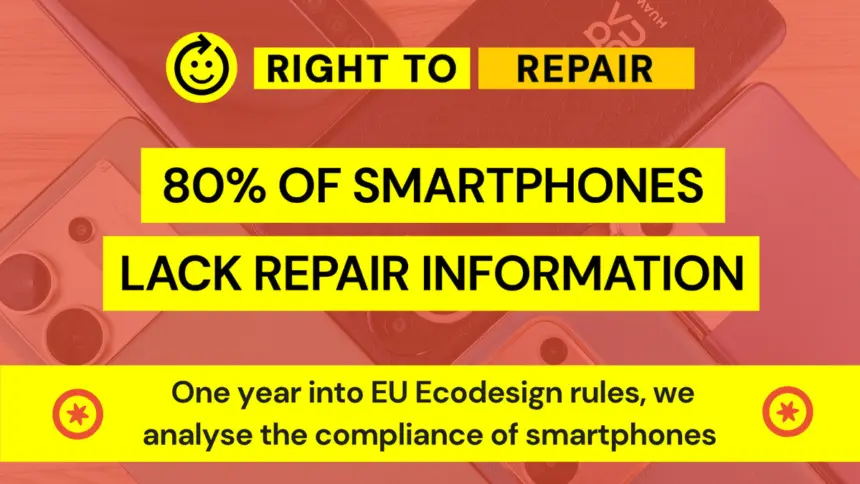
- Audits found that 80% of phone models listed in the EU database still lack compliant pricing or repair manuals, especially from budget brands.
- Laptops show voluntary design improvements, but wider commercial repair uptake remains stalled without direct financial subsidies.
The European Commission introduced strict Ecodesign requirements in June 2025, ordering manufacturers of smartphones and slates to provide critical components, repair manuals and diagnostic software. Under the directive, vendors must stock replacement displays, batteries and camera modules for at least seven years after pulling a model from the market. Suppliers must dispatch those parts within five business days during the first five years, extending to ten days for the final two years. Regulators also required batteries to withstand repeated charging cycles and introduced A-to-E repair ratings on retail energy labels.
Brussels intended the framework to curb electronic waste and push consumer electronics towards longer operational lifespans. Devices sold across the European Union now carry standardised repair indices, and software locks that penalised third-party part swaps have begun to ease. Yet independent assessments conducted in mid-2026 reveal that while leading brands publish repair documentation, practical fixes remain financially impractical for most device owners.
Why replacement screens still cost too much
The central barrier to widespread consumer repair is not component scarcity, but unit pricing. Consumer advocacy group BEUC carried out an investigation into European repair markets in June 2026, tracking replacement part costs across top smartphone models. The group discovered that replacement displays for premium flagship handsets routinely exceed €400 before labour charges, taxes or shipping fees are added to the bill.

For many owners, a €400 display assembly accounts for roughly 30% of the device’s original retail price. That proportion puts repairs outside normal spending habits. In its own impact assessment, the European Commission found that consumers typically abandon repairs when the cost exceeds 20% of the initial purchase price. When professional workshop labour is included, total repair invoices often approach half the residual market value of a two-year-old handset.
Silvia Barlassina, ecodesign project coordinator at BEUC, pointed out that the Union’s energy labels do not account for component pricing when assigning scores. The existing A-to-E index measures tool accessibility, fastener types and disassembly steps, but ignores the price tags attached to official replacement screens and batteries. As a consequence, a handset can achieve a favourable repairability grade despite requiring prohibitively expensive spares.
Price disparities between conventional electronics vendors and modular specialists highlight the gap. Samsung’s official out-of-warranty service network in Ireland charges a recommended €267 for an out-of-warranty screen and battery replacement on a Galaxy S26 Ultra. By contrast, Dutch manufacturer Fairphone sells replacement displays for its Fairphone 6 for €89.95 and batteries for €39.95, designed for installation with standard domestic screwdrivers.
Glue and compliance gaps hinder self-repair
Physical handset architecture also continues to discourage casual owners from opening their equipment. While Ecodesign rules penalised permanent adhesives around battery compartments, they did not outlaw glued glass covers. Most consumer phones still rely on industrial adhesive seals to deliver water and dust resistance ratings.

Thomas Opsomer, an EU policy specialist at repair advocacy organisation iFixit, noted that loosening those seals requires heat plates or specialised suction rigs that ordinary consumers do not own. An iFixit teardown of the iPhone 18 Pro demonstrated that accessing internal trays still requires lifting the glass display panel. In lab testing, technicians damaged plastic display bezels on three out of four test units during initial opening procedures.
Software transparency presents an equally stubborn problem outside top-tier product lines. In a September 2026 investigation, campaign group Right to Repair Europe and iFixit audited 2,334 smartphone model listings on the European Product Registry for Energy Labelling. The audit discovered that 80% of registered phone models failed to publish fully compliant repair documentation, spare parts lists or public component prices.
Opsomer said that while Apple, Samsung and Google have expanded self-repair portals, budget vendors selling entry-level handsets across southern and eastern Europe frequently ignore documentation rules. Because low-cost phones carry lower resale values, their owners suffer disproportionately when component prices remain hidden or inflated.
One clear regulatory success has been the dismantling of parts pairing barriers. In previous model generations, proprietary serial numbers embedded in displays and camera chips disabled Face ID or camera features when swapped without factory calibration software. EU rules forced vendors to supply calibration tools to independent shops and end users, eliminating a major technical obstacle for third-party repairers.
Laptops adopt modular parts without direct mandates
The June 2025 Ecodesign rules applied strictly to smartphones and tablets, leaving personal computers exempt. Despite the regulatory omission, laptop manufacturers have voluntarily incorporated modular construction into their latest business and consumer machines.
Lenovo worked alongside independent repair organisations to overhaul its commercial line, earning a provisional 10/10 repairability score for the ThinkPad T14 Gen 7. The notebook features drop-in USB-C ports, swappable memory modules, slotted storage drives and clear internal QR codes linking to free service guides. Technicians can detach the keyboard and battery using standard Phillips screws.
Even Apple altered its notebook engineering, scoring 6/10 from iFixit for the MacBook Neo. That result marked the company’s highest repair rating for a portable computer in fourteen years. Apple replaced the stretch-release adhesive strips found in older MacBooks with a screw-secured battery chassis, though it continues to solder processors, RAM and flash storage directly to the main logic board.
Market analysts attribute these hardware changes to shifting enterprise procurement demands and rising retail costs. Francisco Jeronimo, vice-president for client devices at market intelligence firm IDC, explained that rising semiconductor prices have pushed consumer replacement cycles out to 3.5 to 4.5 years. Enterprise fleets demand serviceable hardware that retains resale value when returned after three-year lease agreements.
Financial subsidies form the next test
Longer ownership cycles have not automatically driven consumers into independent repair workshops. IDC survey data gathered across European markets showed that shoppers still rank battery capacity, network speeds, purchase price and exterior build quality far above repair access when choosing a new handset.
To close the cost gap, the European Union passed a supplementary Right to Repair Directive that member states had to write into national law by July 2026. The directive requires national governments to implement at least one concrete measure promoting independent servicing. Policy options include state-backed repair vouchers, tax reductions on labour, or municipal tool-lending hubs.
National capitals have until July 2029 to report their chosen mechanisms to the European Commission, though countries such as Austria and France have already launched voucher schemes that subsidise up to 50% of workshop labour bills. Consumer groups maintain that until these financial cushions operate across the entire single market, expensive original parts will continue to prompt owners to recycle broken handsets rather than fix them.