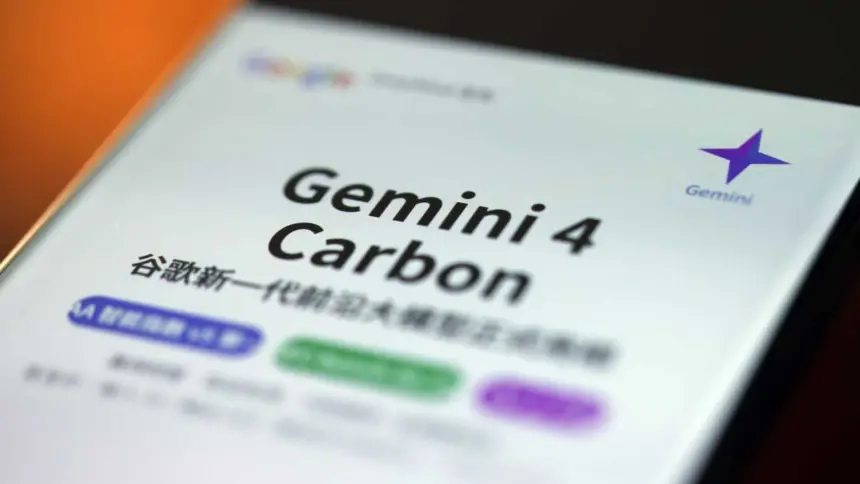
Google released its flagship Gemini 4 Carbon frontier model last week, taking the top position on independent artificial intelligence benchmark charts while demonstrating a sharp reduction in factual errors. The release edges past Anthropic’s Claude Opus 5.5 on overall reasoning tests and introduces a restricted distribution pipeline aimed primarily at security teams.
Key points
- Gemini 4 Carbon scored 59 points on the Artificial Analysis Intelligence Index V5, beating Claude Opus 5.5 by one point and OpenAI’s GPT-6 Astra by two.
- The model achieved a record score of 54 on the AA-Omniscience test, halving unsupported statements compared to the earlier Gemini 4 Argon release.
- Google is restricting initial deployment to vetted cybersecurity defenders through its Fairwind programme before widening commercial access.
- Operating costs sit at $7.76 per benchmark task, undercutting Anthropic’s top models while remaining costlier than open-weight alternatives.
Intelligence scores and benchmark performance
The new model landed at the summit of the latest Artificial Analysis Intelligence Index V5, a benchmark suite that evaluates complex reasoning, task completion, and multi-step logic. Gemini 4 Carbon reached an overall score of 59 points in its high-compute configuration. That result pushes it narrowly ahead of Claude Opus 5.5, which recorded 58 points, and OpenAI’s GPT-6 Astra at 57 points.
The benchmark shifts confirm steady gains among leading laboratories following several quiet months for Google’s foundation research teams. Behind the top three, Meta’s Muse Wonder Full trails at 50 points, while Claude Fable 5.1 posted 49 points. In Google’s announcement of the new Gemini 4 model, the company highlighted victories across four of the nine individual evaluations within the suite.
The model also established an early lead among premium commercial systems on Arena.ai’s Pareto leaderboard, which tracks how well systems balance performance against operating expenses. Gemini 4 Carbon currently defines the upper performance boundary, although open-weight releases such as GLM 5.3-Flash and DeepSeek V4 Pro continue to dominate lower-cost tiers.

Tackling model hallucinations
Beyond raw problem-solving, Google focused engineering resources on reducing incorrect statements. Gemini 4 Carbon posted a score of 54 on the AA-Omniscience v1.1 evaluation, which tracks factual recall and penalises manufactured details on a scale ranging from -100 to +100. While a score of 54 shows that frontier models still struggle with dependable memory, it represents the highest mark recorded on the index so far.
Google reported that Carbon generates unsupported claims half as often as Gemini 4 Argon, an intermediate release published two weeks earlier. Rather than inventing missing evidence or attempting to guess user intent, the system declines requests when relevant data is unavailable. The company said this change reduces model overreach by 26 per cent.
The defensive behaviour extends to security prompts. During internal evaluations against the Gray Swan Indirect Prompt Injection benchmark, the model blocked every attempt to bypass safety guardrails through hidden instructions. When ambiguous instructions appear, the model defaults to asking for clarification and providing source citations instead of executing unverified steps.
Where the model falls short
Gemini 4 Carbon does not lead across all software disciplines. Independent testing from Artificial Analysis revealed that it trails Anthropic’s Claude Code paired with Claude Opus 5.5 in dedicated software engineering tasks. Programmers seeking automated refactoring and complex repository maintenance still see higher completion rates from Anthropic’s specialised tools.

The model also fell behind competitors on certain long-form analytical assignments. Evaluations of general knowledge work placed it behind xAI’s Grok 4.7, Meta’s Muse Wonder, and Moonshot AI’s Kimi K3.1 Pro. The mixed outcome highlights a fragmented frontier, where individual systems demonstrate distinct strengths across coding, writing, and logical inference.
Pricing also presents trade-offs for corporate software architects. On the Intelligence Index test, Gemini 4 Carbon costs $7.76 per task. That makes it slightly cheaper to run than Google’s own Gemini 3.8 Flash high configuration, and well below the $12.99 per task required by Claude Fable 5.1. It also undercuts Claude Opus 5.5 and Claude Sonnet 5.5.
It remains significantly more expensive than smaller commercial offerings. OpenAI’s GPT-5 Astra and GPT-6.1 Sol run at fractions of Carbon’s operational cost. Meanwhile, open-weight alternatives such as DeepSeek V4.1 Flash 1017 operate at roughly one-thirteenth of the price, even if their benchmark performance registers substantially lower at 32 points.
Security focus and the Fairwind rollout
Google chose a guarded launch path for the system, reflecting broader scrutiny from state regulators over advanced model capabilities. In its official release, the company stated: “We’re taking a deliberate approach to rollout and are actively engaged in the U.S. government’s voluntary process for pre-release model testing.”
Initial access runs exclusively through its Fairwind Program, a collaborative initiative that pairs researchers with defensive cybersecurity specialists. The company plans to use early feedback from system administrators and threat analysts to harden model boundaries against exploitation. Earlier FrontWord reporting tracked how Gemini 4 Carbon launches with focus on code and cyber defence, establishing safety mechanisms before public API endpoints open.
Corporate technology buyers have approached new foundation models with caution following mixed workplace returns. According to Gartner research, only three in 100 businesses currently realise measurable efficiency gains and budget reductions through artificial intelligence deployment. Unpredictable outputs and factual errors make calculating a return on investment difficult for executive teams.
Google intends to expand API access to vetted commercial partners over the coming weeks as defensive testing concludes, with general developer availability scheduled to follow.