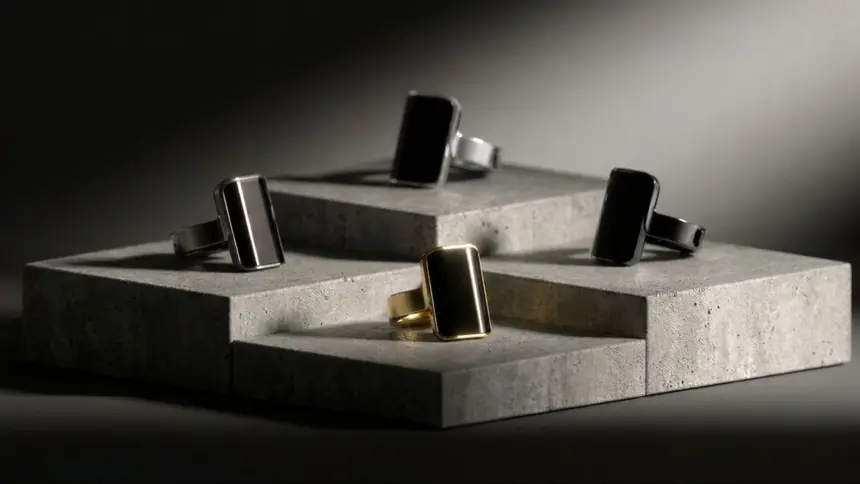
Hardware startup Aina launched the Aina smart ring on 5 November 2026, introducing a titanium wearable with an OLED screen and physical joystick designed to approve autonomous AI agent tasks. Pre-orders opened at $399 ahead of a planned retail price of $499, with shipping scheduled for January 2027.
Key points
- The titanium ring includes an OLED display, a four-directional mechanical shifter, a microphone, and an 18-hour battery.
- Wearers can approve or reject automated agent actions, manage telephone calls, and control media without waking a phone.
- Pre-orders opened at an early-bird price of $399, with global deliveries scheduled to begin in January 2027.
What hardware and controls does the Aina smart ring feature?
The device is built from titanium and features an OLED display alongside what Aina calls the Shifter, a mechanical controller built into the band. The shifter captures thumb movements in four directions, allowing users to scroll through prompts and accept or dismiss actions without taking out their smartphone.
Aina also placed a microphone and a miniature speaker inside the band. Wearers can press and hold the centre button to talk to connected software agents, dictate notes to their computer, or trigger dictation using Wispr Flow or the startup’s dictation engine. Incoming telephone calls can be taken directly on the finger by bringing the hand up to the ear.
The company specifies an 18-hour battery life on a single charge. Because the device has not yet undergone independent testing, real-world battery performance will depend heavily on the frequency of screen activations, voice queries, and mechanical navigation.
How do Aina Cues and the Context Aware OS work?
The wearable runs on what the startup calls its Context Aware Operating System. The software connects to iOS and Mac devices to track schedules, locations, and application habits. Using these signals, the system attempts to predict what the user might need next and surfaces three options on the smart ring display.
These prompts, named Aina Cues, automate recurring tasks. For instance, the ring can surface an Uber booking shortcut around a person’s regular commute time, or offer to draft an email to colleagues if calendar data indicates the wearer is running late for an appointment. Users can also configure custom cues using natural language instructions.
Rather than running large language models locally on the finger, the device relies on external computing infrastructure. Aina’s privacy policy states that calendar access is optional and permission-based, while naming Anthropic as an AI inference provider for its services. Wearers can also connect external autonomous agents such as Muse, Instinct, and Dots to run online tasks through virtual browsers.
The argument for agent approvals
Apoorv Shankar, Aina’s founder and the former vice president of hardware at health tracking company Ultrahuman, argued that existing hardware interfaces fail to accommodate proactive software. As automated tools handle multi-step workflows in the background, Shankar said the primary human role will shift from typing instructions to approving suggested actions.

“Hardware interfaces beyond the phone will be built for voice and quick approvals,” Shankar said. In his view, having to unlock a smartphone to confirm routine tasks creates an unnecessary bottleneck that slows down automated assistance.
The wearable enters a sector where several dedicated artificial intelligence gadgets have struggled. Devices from startups such as Humane and Rabbit faced severe criticism when they attempted to replace the smartphone. Aina instead positions the AI smart ring as an accessory to existing operating systems.
While existing smart rings such as the Pebble Index 01 and Sandbar Stream focus primarily on voice recording and audio notes, Aina attempts to differentiate its hardware through visual feedback and physical inputs. In addition to handling voice tasks, the device operates as a context-aware remote control. When paired with a Mac running a video call, it surfaces shortcuts to toggle the camera or mute the microphone, and can also manage media playback or connected televisions.
When will the Aina smart ring ship?
Aina was founded in May 2025 as a human-computer interaction research laboratory. The company adopted the Project Mirage moniker to showcase three experimental interface concepts at CES 2026, before introducing Dune in April, an adaptive three-key desktop keypad that altered shortcuts according to the active Mac application.
Usage data from hundreds of early Dune customers informed the design of the ring. Aina, which employs roughly 40 staff across offices in San Francisco and Bangalore, raised a $5.5 million seed round in July 2026 before starting a closed pilot testing programme in early October.
Pre-orders opened on Thursday 5 November 2026 following the private pilot. Aina said further application and agent integration details will follow as the company prepares for global distribution.