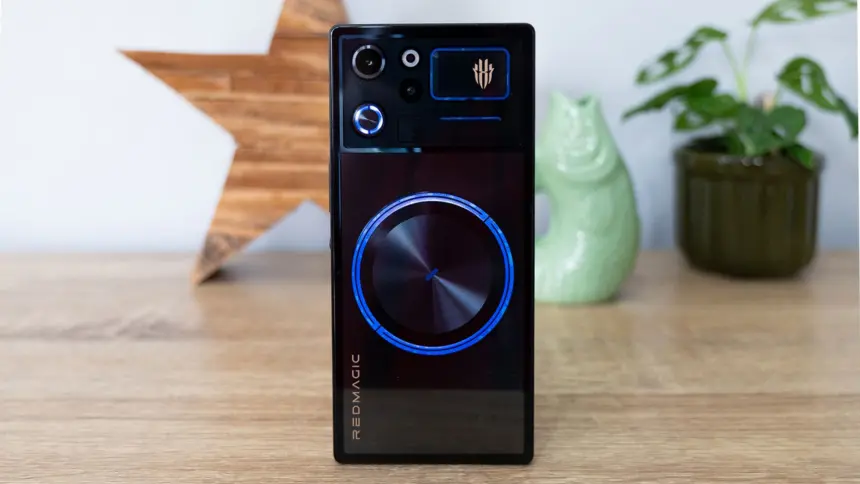
Nubia has officially launched the RedMagic 12 Pro across global markets, bringing an 8,400mAh battery and Qualcomm‘s new Snapdragon 8 Elite Extreme Gen 6 processor to buyers in the UK, Europe and the United States on Tuesday. The updated gaming smartphone introduces illuminated liquid cooling and a 185Hz display, alongside a substantial price increase.
Key points
- The RedMagic 12 Pro features Qualcomm’s Snapdragon 8 Elite Extreme Gen 6 chip, an active 25,500-rpm fan and an upgraded dual-loop liquid cooling system.
- An 8,400mAh battery powers a 6.85-inch, 185Hz OLED display with an under-display front camera.
- Starting prices rise to £799 in the UK and $949 in the US, with open sales scheduled for 18 November 2026.
- Software support remains limited to two years of Android platform upgrades and three years of security patches.
Cooling upgrades and illuminated loops
Thermal management sits at the centre of the RedMagic 12 Pro design. Nubia has retained the transparent internal cooling channel introduced on earlier models but increased the pumping pressure of the liquid loop to 130 kilopascals. That represents an 85 percent pressure increase over the previous generation, designed to circulate fluid more rapidly across the central processor.
The company also placed customisable RGB light-emitting diodes directly beneath the transparent liquid channel. Users can set the lighting to pulse during incoming calls, match game audio, or display set notification alerts. The fluid itself remains fluorescent blue, which means colours like red and orange appear as tinted bubbles drifting across a blue backdrop, while green illumination shifts toward turquoise.
Additional RGB strips sit along the touch-sensitive shoulder triggers and beneath the rear camera array. These external lighting zones do not contend with coloured coolant, producing standard tones that contrast with the internal loop. To move heat away from the silicon, the liquid channel operates alongside a vapour chamber, liquid metal thermal interface material and an internal centrifugal fan spinning at up to 25,500 revolutions per minute.

Top-tier silicon and early benchmarks
Under the chassis, the handset runs Qualcomm’s Snapdragon 8 Elite Extreme Gen 6 processor. The silicon reaches peak clock speeds of 5.01GHz and pairs with an Adreno 850 graphics processing unit and a proprietary RedMagic R5 gaming co-processor. Memory options include 12GB or 16GB of LPDDR5T RAM, coupled with 256GB, 512GB or 1TB of UFS 4.1 Pro storage.
Early Geekbench testing conducted by ZDNet showed the device producing multi-core scores that nearly doubled those of Google’s Tensor-powered Pixel flagships. Single-core performance proved competitive against top mobile hardware, trailing only the A-series silicon found in Apple’s top devices, according to Geekbench browser records.
Hardware transitions on new Qualcomm architectures can bring software growing pains, much like how a recent Snapdragon X2 Elite driver update disrupted performance on Windows systems. In early hands-on testing by T3, the unreleased chip caused occasional crashes in high-end mobile titles like Red Dead Redemption, as well as stability hiccups in third-party emulation packages like DroidDeck. Reviewers noted that game studios and tool developers will need time to patch compatibility profiles for the new silicon.
Display, battery and design trade-offs
The front of the phone carries a 6.85-inch BOE X11 LTPO OLED panel with a resolution of 1216 by 2688 pixels. Screen bezels measure 0.96 millimetres on all sides, yielding a 96.3 percent screen-to-body ratio. The panel reaches refresh rates of up to 185Hz in supported competitive titles such as PUBG Mobile, while other games run at enhanced graphics presets.
To keep the screen free of cutouts, Nubia embedded a 16-megapixel selfie camera beneath the display glass. While the optical sensor is difficult to spot during normal viewing, reviewers noted that front-facing photos remain soft and rely on heavy digital smoothing to compensate for the intervening display pixels. The rear camera system features two 50-megapixel sensors for standard wide and ultrawide shots, seated completely flush beneath the back glass panel alongside a 2-megapixel secondary sensor.
Battery capacity jumps to 8,400mAh, easily surpassing the 5,000mAh cells common in standard Android flagships. The phone supports 80W wired fast charging, allowing users to replenish the high-capacity cell quickly. Dedicated capacitive shoulder triggers provide 700Hz touch-sampling rates for competitive mobile gaming.
The phone drops the 3.5mm headphone jack, a port that previous RedMagic hardware retained. Ingress protection also presents a compromise. While most of the chassis meets IP69 standards for water resistance, the exposed air intake channel surrounding the 25,500-rpm fan holds only an IPX8 rating, leaving the device without certified protection against fine dust particles.
Pricing and limited update commitments
The RedMagic 12 Pro carries a higher price tag than its predecessors, reflecting broader component supply pressures across the semiconductor sector. The base model with 12GB of RAM and 256GB of storage starts at £799 in the UK, €899 in Europe and $949 in the US. That marks a $200 jump over the launch price of the RedMagic 11 Pro and a $100 increase over the 11S Pro.
Stepping up to 16GB of RAM and 512GB of storage lifts the US price to $1,049, while the top-tier 1TB model costs $1,199. Nubia will open early-bird voucher reservations on 12 November, with pre-orders beginning on 17 November and open retail sales starting on 18 November.
The phone runs RedMagic OS 12 on top of Android 17. The interface includes system utilities for game streaming and PC emulation through Game Space, alongside on-device translation and productivity tools. However, ZDNet reported that international review units still ship with several pre-installed casual puzzle games, which users must manually delete.
Long-term software maintenance remains another notable caveat. RedMagic provides only two years of core Android platform upgrades and three years of security updates, as stated in RedMagic’s software update policy. That support window is substantially shorter than the seven-year guarantees offered by Samsung and Google on hardware selling above the $700 mark.