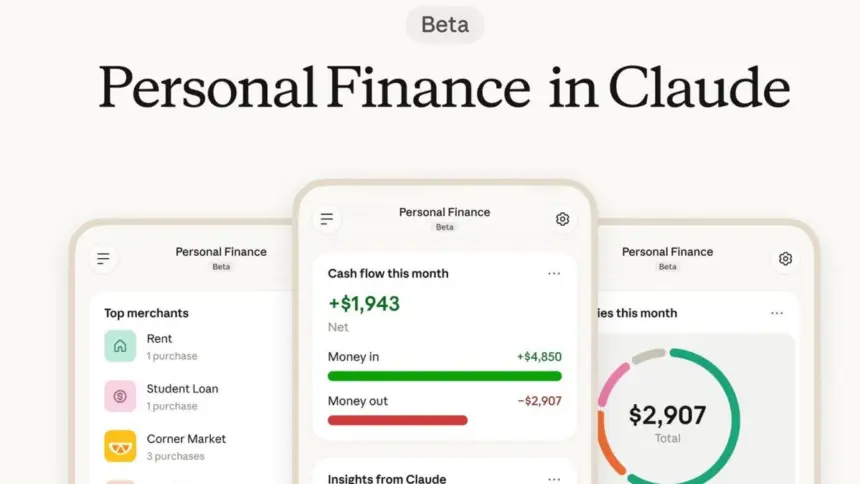
Anthropic launched Claude Personal Finance on Thursday, rolling out a beta tool that connects its chatbot directly to US bank and credit card accounts through the financial data platform Plaid. The read-only service lets subscribers analyse spending and calculate balances without giving the model access to transfer money or view passwords.
Key points
- Anthropic launched Claude Personal Finance in beta for US subscribers on Pro, Max, and Ultra plans.
- The feature uses Plaid to provide read-only access to account balances, credit limits, and up to two years of transactions.
- Financial conversations take place in a dedicated hub and are not used to train Anthropic’s artificial intelligence models.
- The launch follows OpenAI’s release of a similar Plaid-powered personal finance tool for ChatGPT in May.
How the tool accesses banking data
The feature links accounts through Plaid, an intermediary platform that connects consumer banking software to third-party applications. By routing account authentication through Plaid, Claude never receives customer banking passwords, and financial institutions avoid unvetted automated systems crawling customer portals.
Access is restricted to reading existing data. Claude cannot move funds, manage accounts, or execute investments, and Anthropic said the system is not designed to offer formal investment advice.
For accounts a user chooses to connect, the system retrieves the bank name, account names, account types, and the final four digits of each account number. The chatbot can also inspect active balances, credit limits, and up to two years of historical transactions.

Spending analysis and financial tracking
Users interact with the service by typing conversational prompts rather than configuring manual budgeting spreadsheets. A subscriber can ask where their money went during the past month, prompting the chatbot to calculate total expenditure across all linked accounts and sort it into categories such as rent, utilities, food and drink, and shopping.
The tool can answer forward-looking questions about whether a user can afford an upcoming holiday or what recurring bills remain before their next payday. It can also estimate how much money someone could save each month and examine whether a subscriber is spending more than they earn.
Beyond categorising past transactions, Claude scans records to detect anomalies across connected accounts. The system flags potential issues such as duplicate charges, unexpected fees, and subscription bills that have steadily increased over time. It can also calculate total interest paid across accounts over the past year and explain financial terms such as annual percentage rates.
To assist with reviews, the tool generates tables and charts directly in the chat window. Users can ask follow-up questions about specific spending trends, requesting comparisons between current outgoings and earlier months.

Privacy safeguards and training rules
Connecting bank records to artificial intelligence software introduces privacy concerns for consumers. Anthropic addressed these reservations by outlining which data the tool can access and how that information is handled.
Anthropic established specific data boundaries for the feature. Conversations conducted inside the dedicated Personal Finance hub are excluded from model training datasets. If a user discusses financial information outside that designated hub, standard account privacy settings apply instead.
Commercial incentives are also separated from the tool’s responses. Anthropic said: “Like the rest of Claude, Personal Finance has no ads or sponsored recommendations, and it doesn’t offer credit cards, loans, or savings accounts of its own, so your money questions get a straight answer.”
Several technical questions remain open. Anthropic has not stated how the tool addresses the risk of hallucinations when calculating balances across multiple accounts. The company has also not clarified whether generated financial dashboards remain permanently accessible or if subscribers must request new summaries during each session.
Competition with OpenAI and next steps
The feature places Anthropic in direct competition with OpenAI, which introduced similar personal finance capabilities to ChatGPT in May using Plaid. Public feedback on AI financial analysis has been mixed. One Reddit user said that ChatGPT’s financial feature showed potential similar to apps such as Mint or Monarch, but remained weaker in historical syncing, dashboard quality, and generating complete statement PDFs.
The tool is currently available in beta to Pro, Max, and Ultra subscribers in the United States. Anthropic has not announced a timetable for free users or international account holders.
The launch reflects Anthropic’s ongoing expansion into specialised industries, following earlier enterprise releases including Claude for Legal and Claude for Financial Services.
Anthropic indicated that deeper integrations with financial institutions could follow. In its launch announcement, the company said “Personal Finance is a first step” and confirmed it is exploring ways for Claude to work alongside licensed professionals, inviting banks, wealth managers, and regulated firms to help shape future tools.