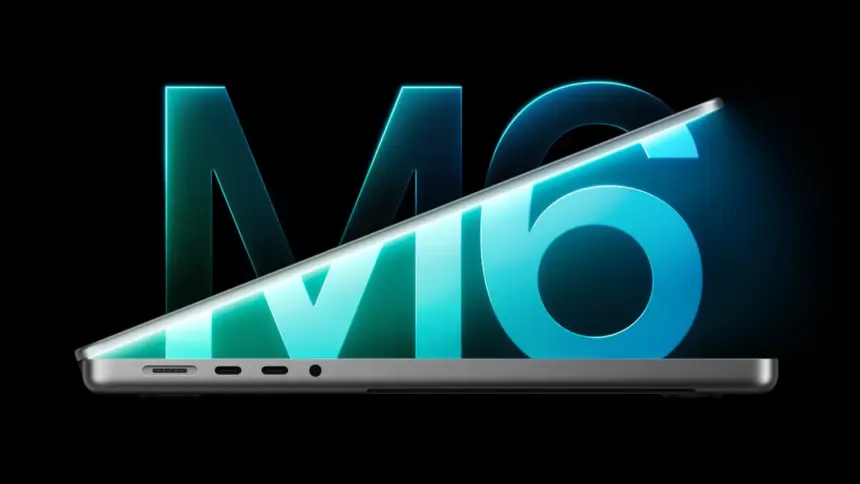
Apple introduced its new M6 MacBook Pro and an updated 24-inch iMac during a hardware presentation on 28 October 2026, bringing its sixth-generation custom processor to consumer and professional workstations. Both computers introduce dedicated neural accelerators on graphics cores, faster wireless connectivity and broader hardware support for local artificial intelligence models.
Key points
- Apple refreshed the 14-inch MacBook Pro and the 24-inch iMac with its M6 processor.
- The M6 chip adds neural accelerators to each graphics core, boosting local machine learning performance.
- Both machines feature Wi-Fi 7, Bluetooth 6 and Apple’s proprietary N1 wireless networking chip.
- Starting prices in the United States remain unchanged at $1,999 for the MacBook Pro and $1,499 for the iMac.
The announcement expands the rollout of the M6 family, which first appeared in the Mac mini in August 2026. Pre-orders for both desktop and portable configurations opened immediately following the event, with worldwide retail availability scheduled to begin on 6 November 2026.
The two computers launch alongside macOS 27 Golden Gate, the operating system release designed to integrate Apple Intelligence and an updated Siri assistant directly into core desktop tasks. Rather than relying on cloud servers for prompt processing, the hardware aims to run lightweight generative models locally on device.
What the M6 processor brings to the Mac
The standard M6 processor builds on the architectural baseline established earlier in the year. In the 14-inch MacBook Pro, Apple includes a 12-core central processing unit alongside a 12-core graphics processing unit. The company said this configuration delivers up to 30 percent faster graphics performance and up to 25 percent faster execution on artificial intelligence tasks compared to the previous M5 chip.
Unified memory bandwidth reaches 170 gigabytes per second on the laptop. Base models ship with 16 gigabytes of unified memory as standard, which buyers can configure up to 32 gigabytes at purchase. Internal solid-state storage tops out at 4 terabytes.
For the 24-inch iMac, Apple offers two silicon tiers. The entry configuration features a 10-core CPU and a 10-core GPU, paired with up to 24 gigabytes of memory and 1 terabyte of storage. A higher-tier model incorporates the full 12-core CPU and 12-core GPU layout, supporting up to 32 gigabytes of unified memory and 2 terabytes of internal storage. Both iMac configurations support fast storage controllers that Apple said double read and write speeds relative to previous models.
AI performance and on-device processing
Apple engineered the graphics architecture of the M6 to shoulder a greater share of machine learning tasks. The company placed dedicated neural accelerators directly onto individual GPU cores, allowing graphics hardware to assist the neural engine during continuous prompt evaluation.
These changes target developers running small language models and image synthesis software on personal machines. Apple said the M6 iMac achieves up to five times faster on-device AI performance than the M4-powered desktop, and up to 18 times the throughput of older Intel-based systems. In developer tools such as LM Studio, the company recorded up to twelve times faster prompt processing compared to original M1 silicon.

The 14-inch MacBook Pro showed similar gains in prompt evaluation. Apple reported that time to first token during large language model inference is up to 13 times faster than an M1-based 13-inch MacBook Pro, and roughly 1.3 times faster than the M5 model. In creative software like Affinity Photo, the new laptop completed complex image rendering tasks 3.3 times faster than the M1 and 1.2 times faster than its immediate predecessor.
Hardware changes and display specifications
The physical enclosures of both machines remain largely consistent with earlier releases, though Apple upgraded the internal input and display options. The 14-inch MacBook Pro retains its 14.2-inch Liquid Retina XDR screen, which outputs 3024 by 1964 pixels with peak brightness reaching 1,600 nits for high dynamic range content. The panel supports the P3 wide colour gamut, True Tone adjustment and variable refresh rates up to 120 hertz.
For work in bright settings, buyers can configure the laptop with Apple’s anti-reflective nano-texture glass. The display lid houses a 12-megapixel Centre Stage camera with Desk View support, paired with studio-grade directional microphones.
The 24-inch iMac retains its 4.5K Retina display, running at 4480 by 2520 pixels with 500 nits of peak brightness. Apple has made the nano-texture glass option available on the all-in-one desktop for the first time. The iMac also includes a six-speaker audio array with force-cancelling woofers, three microphones and a 12-megapixel Centre Stage camera.
Both systems adopt modern networking standards through Apple’s custom N1 chip. The silicon adds support for Wi-Fi 7, Bluetooth 6 and Thread home networking protocols. The MacBook Pro preserves three Thunderbolt 4 ports, an HDMI port, an SDXC card slot, a 3.5mm audio jack and a MagSafe 3 charging port. The laptop houses a 72.4 watt-hour battery rated for up to 24 hours of continuous video streaming.
Pricing and market context
The launch arrives after earlier shifts in Apple’s computing catalogue, which previously saw the introduction of higher-end hardware such as the touchscreen MacBook Pro line. Industry watchers had anticipated another round of price increases following earlier adjustments across accessories and mobile devices.
US pricing for the base M6 hardware held steady. The 14-inch MacBook Pro starts at $1,999, while the entry 24-inch iMac begins at $1,499. In international markets such as India, the entry 10-core iMac sells for 174,900 rupees, rising to 199,900 rupees for the four-port 12-core model. The 14-inch MacBook Pro starts at 239,900 rupees for the standard screen and 257,900 rupees with nano-texture glass.
Apple will begin deliveries and retail store sales of both M6 systems on 6 November 2026.