Apple is offering replacements after early iPhone Duo display cracks hit customer devices, prompting rival Samsung to launch a Canadian ad campaign mocking the hardware flaws. The defect, which causes a bright line across the inner folding screen, emerged shortly after Apple’s October launch, leaving buyers facing repair delays until January.
Key points
- Apple acknowledged that a small number of iPhone Duo units have suffered cracked inner screens along the hinge mechanism.
- Samsung launched an ad campaign on social media highlighting its eight generations of foldable engineering experience.
- Replacement units remain scarce because online orders for the new device are backordered until January.
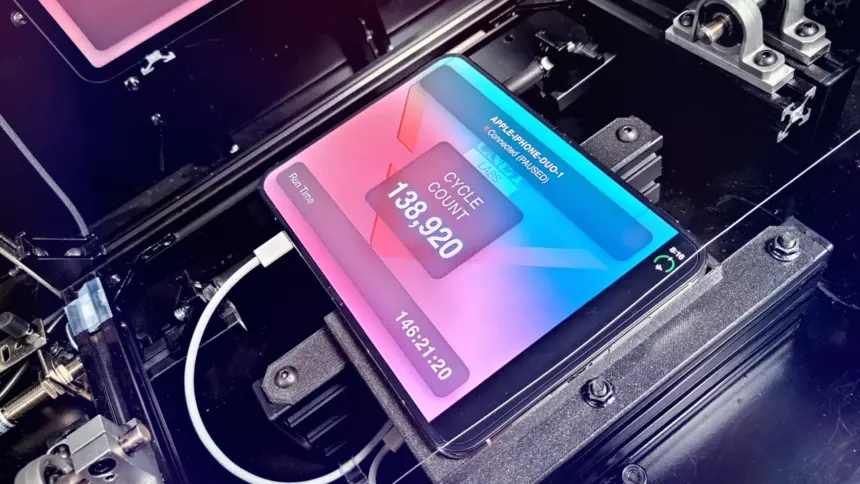
- CNET testing showed the hinge mechanism survived 139,000 folds, though display creases become pronounced if the matte coating is removed.
Inner display cracks on iPhone Duo
Reports of broken hardware surfaced shortly after customers received their handsets. Affected owners reported that the inner folding screen developed fractures directly over the central hinge. The mechanical failure causes a bright vertical line to cut across the OLED panel, rendering parts of the touch interface unusable.
Apple acknowledged the reports and confirmed that early units were failing in the field. The company insisted that the fault is confined to an isolated batch of hardware and typically appears within the first few days of regular operation.
In a statement addressing the failures, Apple said: “If users experience issues with their iPhone Duo display, they should contact AppleCare for a replacement.”

The company also pointed to positive reception from early buyers and noted that software developers are adjusting their applications to support the dual-screen interface. Yet for customers holding damaged hardware, the immediate fix depends entirely on replacement stock that remains difficult to secure.
Hardware technicians in retail outlets have logged customer complaints showing identical failure patterns. The fracture forms along the vertical axis where the panel experiences the greatest mechanical tension during closure.
Samsung launches ad campaign
Samsung reacted quickly to the reports by launching a targeted advertising campaign through its Canadian Instagram account. The promotional graphics depict a bright, illuminated streak slicing down the centre of an image, mirroring the exact aesthetic of the damaged iPhone screens.
The campaign uses three distinct slogans to contrast Samsung’s hardware record with Apple’s initial foldable misstep. The captions read: “Folding is nothing new to us”, “Folding. We know a thing or eight.”, and “Switch to Galaxy Z Fold8”.

A Samsung spokesperson said the effort was a “playful new campaign” that highlights experience in the category. The marketing push leans on the South Korean firm’s head start in flexible displays.
Samsung released its original Galaxy Fold in September 2019, working through its own public durability failures before reaching mass production maturity. The company introduced its eighth-generation Galaxy Z Fold8 three months before Apple unveiled the iPhone Duo.
The campaign also highlights pricing differences between the two competitors. Apple set the starting price for the iPhone Duo at $1,999 for 256GB of internal storage. Samsung sells the equivalent 256GB configuration of the Galaxy Z Fold8 for $1,899, undercutting Apple by $100.
Samsung spent seven years establishing its supply chain and refining hinge tolerances after early review units broke in 2019. The company is using Apple’s early manufacturing struggles to present its own foldable line as the stable option for business buyers and early adopters.
Supply shortages slow replacements
Securing a replacement handset has proved challenging for affected iPhone owners. Reporting from Bloomberg Technology detailed how retail inventory constraints are complicating Apple’s warranty service.
On the Power On podcast, journalists Chris Welch and Mark Gurman explained that low stock levels mean retail technicians cannot offer immediate over-the-counter swaps. Online orders for the iPhone Duo are backordered until January, and physical Apple stores receive only sporadic inventory shipments.
Because retail stores hold minimal spare units, customers with cracked panels must either surrender their phones for offsite repair or wait for backlogged replacement shipments. The bottleneck leaves early adopters without functioning handsets weeks after paying $1,999.
Samsung faces no such supply friction with its rival device. Retail stock for the Galaxy Z Fold8 remains steady across multiple colours and storage tiers, with standard customer orders shipping for delivery on 3 November.
The contrast in availability complicates Apple’s support strategy. While the company offers standard warranty swaps, the lack of buffer stock in stores turns minor failure rates into prolonged customer service disputes.
Durability testing and the screen crease
While some consumers encountered immediate cracks, automated stress testing shows the hardware can endure prolonged mechanical bending under controlled conditions. CNET tested an iPhone Duo unit using its custom Fold-a-Phone machine, subjecting the phone to continuous folding over seven days.
The test device surpassed 139,000 folds without structural failure. The central crease remained largely unchanged from the start of the trial, staying difficult to detect when the OLED panel remained lit. When the screen turned off, however, the indention along the hinge line became visibly distinct.
Apple addresses crease visibility through a removable nano-texture matte layer applied to the inner panel. The matte coating disperses reflections, making the physical bend less noticeable under direct lighting.
The layer has created confusion among users. Video footage published on X by device leaker Ice Universe showed that peeling away the nano-texture film makes the iPhone Duo crease far more visible, matching the appearance of other book-style foldables.
Apple designed the matte coating to be replaced if damaged. The company charges $19 to replace the film for customers enrolled in AppleCare, and $49 for owners without coverage.
Apple service technicians continue to log incoming reports as factory assembly lines work to fulfill order backlogs heading into the new year.