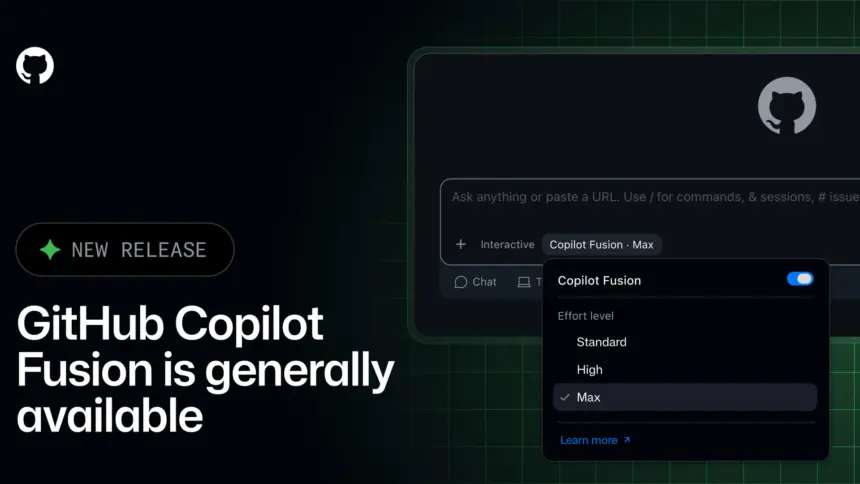
GitHub has rolled out GitHub Copilot Fusion, an automated routing engine that assigns programming tasks across multiple artificial intelligence models, while installing four million additional processor cores at its data centres in San Francisco on Wednesday to stop automated code generation from overwhelming its servers.
Key points
- Copilot Fusion automatically selects and switches between frontier AI models during a coding session across three user-selected effort tiers.
- GitHub expanded its server capacity by more than four million CPU cores and 160 petabytes of storage after processing 7.38 billion commits in September.
- Benchmark results place the system’s top tier within two points of Anthropic’s Claude Code while cutting average programming API costs in half.
- Enterprise accounts will gain standard Copilot access without buying additional individual seats.
The announcements, made at the annual GitHub Universe developer conference, target two linked challenges created by automated coding: controlling the spiralling API costs of running frontier models on trivial tasks, and keeping version control hardware online as autonomous coding agents generate code at machine speed.
Activity on the platform rose sharply at the end of summer. GitHub logged 7.38 billion commits in September alone, representing a fivefold increase over August. The surge followed an earlier expansion in August, when engineers added three million CPU cores and 120 petabytes of storage after reliability incidents caused service interruptions.
To absorb the current wave of agent traffic, GitHub added more than four million CPU cores alongside 160 petabytes of high-speed storage. The company is also rebuilding its underlying Git architecture, decoupling computing capacity from storage layers to achieve an estimated 35-fold improvement in system throughput.

Model orchestration across three tiers
The centrepiece of the software releases is GitHub Copilot Fusion, a routing and orchestration engine that decides which AI model should handle a prompt based on task complexity, execution speed, and token cost.
Instead of requiring programmers to guess whether a task demands an expensive frontier model or a cheaper lightweight alternative, Fusion analyses the prompt requirements across reasoning, code generation, debugging, and external tool use. The technology combines earlier research from Project HydraFusion with GitHub’s existing Copilot Auto Model Selection system.
Developers configure the system using three effort levels. Fusion Standard handles everyday syntax and simple functions. Fusion High tackles complex logic and architectural design. Fusion Max targets difficult, multi-file engineering problems.
The system can also orchestrate multi-step workflows. In a cascading workflow, a smaller model drafts a solution and submits it to an automated evaluator, which either accepts the code or escalates the problem to a larger reasoning model. In a critique workflow, one model writes code while a second independent model reviews the pull request for syntax and security errors.

“Different tasks need different models,” wrote Jay Parikh, executive vice president of CoreAI at Microsoft, in a technical briefing. “Developers shouldn’t have to manage every model choice to get the right result at the right price. Copilot Fusion evaluates what a task needs across reasoning, code generation, debugging, and tool use, then chooses how to execute across one or more models.”
Benchmark results and operating costs
By splitting workloads between specialised models, GitHub claims significant cost and speed improvements over single-model agent tools.
On the Artificial Analysis Coding Agent Index, GitHub reported that Fusion Max achieved an aggregate score of 60. That places the tool within two points of Anthropic’s Claude Code running Opus 5.5 Max. GitHub reported that Fusion Max matched those completion results while consuming approximately half the tokens, reducing average API expenses by 50 percent, and completing tasks 40 percent faster.
Corporate customers tested earlier previews to curb runaway cloud expenses. Hari Pokhrel, a principal software engineer at AT&T, said his teams frequently selected top-tier models for difficult debugging tasks and forgot to switch back to cheaper options for routine work. Using the Standard tier allowed the company to preserve token quotas without degrading routine code suggestions.
Enterprise administrators retain governance over model routing. IT managers can restrict which vendor models Fusion is permitted to call, disable specific engines across entire organisations, and determine whether automated routing serves as the default setting for development teams. The move aligns with broader industry efforts to manage compute budgets, seen in competing developer tooling like Google’s specialised Gemini 4 Carbon code assistant.
Rebuilding Git for agent traffic
The hardware investment highlights how autonomous software agents are altering data centre traffic patterns. Unlike human programmers who write, test, and commit code over hours, autonomous agents can submit hundreds of file changes and run continuous integration pipelines in seconds.
“Agents are changing the volume and shape of software development,” Parikh said. “Adding capacity matters, but capacity alone won’t get us there. We’ve also had to change the architecture.”
The physical upgrade brings GitHub’s two-month hardware additions to more than seven million cores and 280 petabytes of storage. Separating storage from compute prevents synthetic agent workloads from locking the repositories human developers are trying to access.
The operational strain also prompted internal software revisions. In September, GitHub rewrote the runtime engine for its Copilot command-line interface, desktop application, and software development kit in Rust. That transition added roughly 100 megabytes of memory use per client, complicating process management and limiting server density until the infrastructure could be expanded.
Supply chain defences and project management
Alongside the infrastructure updates, GitHub introduced defensive tools to catch errors and hallucinations introduced by rapid automated code generation.
An automated package firewall now inspects npm dependencies at the moment of download. The firewall checks libraries to block malicious code, typosquatting campaigns, and zero-day dependency attacks before external modules enter local build environments.
A companion reachability analysis feature scans pull requests for known security vulnerabilities. Rather than issuing broad warnings about outdated packages, the scanner traces code execution paths to verify whether a project actually executes a vulnerable function, letting engineers ignore dormant risks.
The company also expanded the Copilot desktop client into a project management hub. A feature called Copilot Projects tracks developer goals, active terminal sessions, and work-in-progress code diffs across branching development tracks. Copilot Automations enables teams to run background maintenance agents on schedules, while Copilot Connectors links local environments to live operational telemetry from Cloudflare, Vercel, and Sentry.
GitHub confirmed that Copilot access will roll out to all GitHub Enterprise subscribers without individual seat surcharges, making model routing standard equipment across its enterprise user base.