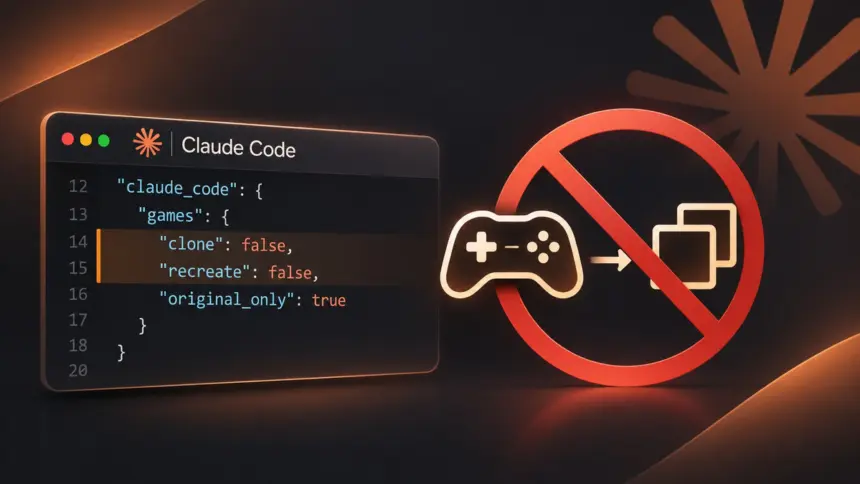
Anthropic introduced new Claude Code game restrictions in late October 2026 to stop its programming assistant from building unauthorised clones of copyrighted titles. The guardrails, deployed through a server-side prompt update for Opus 5.5, have caused immediate friction among software developers who report that legitimate simulations, game mods, and custom gaming modules are facing automatic refusals.
Key points
- Anthropic updated the system prompt for Claude Code to stop users from recreating existing commercial video games under any name.
- Company executive Addy Osmani confirmed the change, citing intellectual property protection while acknowledging that false positives are occurring.
- Independent developers report that custom digital board games and reverse-engineering workflows are being rejected by the coding agent.
- The restrictions arrive amid fierce competition among autonomous programming tools, where safety filters often collide with developer flexibility.
The new guardrails inside Opus 5.5
The updated rules first surfaced publicly around 27 October, when software developers noticed changes delivered under an internal configuration tag identified as tengu_heron_brook. An inspection of the system prompt revealed an explicit directive instructing the AI model to refuse requests that clone existing commercial video games.
Specifically, the system prompt instructs the assistant: “Do not build a recreation of a specific existing game, even if it is renamed or called original.” The restriction applies across Claude Code environments powered by Anthropic’s flagship Opus 5.5 model.
Addy Osmani, an executive at Anthropic, confirmed the modification following initial reports in trade publications. Osmani said the company added two sentences to the model’s base instructions to prevent copyright infringement, which already breaches the platform’s terms of service. He acknowledged the potential for unintended consequences and urged developers experiencing false rejections to submit bug reports so engineers can tune the prompt filters.

Anthropic maintains that the update does not bar video game creation entirely. Programmers remain permitted to generate original game logic, build mechanics inspired by established genres, and construct interactive titles using their own creative assets and software architecture.
Independent developers encounter false positives
Despite assurances that the Claude Code game restrictions target direct copies, programmers quickly encountered barriers while working on bespoke projects. The automated filter appears to struggle to differentiate between illicit commercial clones and legitimate custom software that references existing rule sets.
One clear example emerged in a GitHub issue filed on 30 October by Conflict Simulations LLC, an independent studio that creates specialised digital modules for board wargames. The developer explained that Claude Code began refusing to assist with client-commissioned modules designed to digitise tabletop mechanics for individual players who own the physical games.
According to the studio’s bug report, the software relies on original code and assets provided directly by paying clients. While the modules simulate rules from published tabletop games, they are private, non-commercial tools for existing owners rather than mass-market digital ports. The developer noted that Claude Code only started declining requests after being asked to evaluate whether the new policy applied to the codebase.

Other software engineers have reported problems applying Claude Code to reverse-engineering tasks. The tool has grown popular among PC modders who dissect binary files to improve game performance on modern operating systems or repair bugs abandoned by original publishers. While Anthropic has not explicitly barred game modding, developers report that conversations referencing existing game titles now risk triggering refusal behaviour.
Why copyright pressure is shifting to coding agents
The decision to tighten limits on game creation reflects broader legal pressures confronting frontier AI laboratories. As autonomous coding tools advance from writing simple functions to assembling complete software architectures, the risk of automated copyright infringement has multiplied.
Early versions of AI coding tools could produce simple clones of arcade classics like Pong or Flappy Bird from plain-text descriptions. With Opus 5.5 and equivalent high-reasoning models, developers can generate complex gameplay loops, inventory systems, and network multiplayer code in minutes. When prompted with specific commercial names, models have occasionally generated asset loaders, user interface layouts, and proprietary physics parameters closely copying the original titles.
Major video game publishers have monitored AI generation tools closely, seeking to protect their intellectual property from uncredited duplication. By embedding strict prohibitions directly into the model instructions, Anthropic aims to shield itself from contributory infringement claims. The company already prohibits users from generating content that violates third-party intellectual property, but automated prompt rules enforce the policy preemptively.
The dilemma for Anthropic lies in model calibration. Instructing a model to avoid building recreations of known games forces the AI to guess developer intent. Because video games routinely borrow mechanical conventions from one another, defining the boundary between genre conventions and an unauthorised recreation remains an unresolved technical problem.
The impact on the PC modding community
The friction over Claude Code is particularly acute among hobbyist modders and digital archivists. Over the past year, AI programming assistants have transformed community-led game preservation, allowing programmers without deep assembly-language expertise to write memory patches and visual enhancements for older software.
Modders recently used Claude to build a performance enhancement for older role-playing games, restructuring thread scheduling to eliminate frame stutters and raise performance by more than 40%. Such projects require the AI model to analyse proprietary executable files and game file formats, activities that look suspicious to an automated copyright filter looking for mentions of commercial games.
If prompt filters interpret technical discussions of existing game files as clone attempts, modders may migrate to open-weight models that operate without hosted safety guardrails. As open alternatives evolve, proprietary model providers face commercial consequences when prompt restrictions disrupt normal development workflows.
Autonomous coding competition intensifies
The controversy surfaces as the market for autonomous software development tools becomes increasingly competitive. Models built specifically for software engineering are advancing rapidly, with rivals seeking to balance compliance with permissive user controls.
Competition in the sector has expanded beyond traditional hosted coding assistants. Laboratories across the globe are testing specialized programming agents, such as the DeepSeek coding agent prototype, which aims to challenge western frontier models on developer benchmarks while offering high execution speed. When closed-source assistants impose restrictive guardrails that catch benign projects in the crossfire, developers often test competing platforms that apply lighter filters.
Anthropic engineers are reviewing developer reports from the GitHub repository to refine the instruction phrasing in upcoming configuration releases. The company has not announced an exact timetable for an updated system prompt, but developers affected by the initial rollout continue to log edge cases where custom software projects were blocked.