Hamburg deeptech startup MuRay has secured €7.1 million in blended financing to advance its active muon imaging technology, a non-destructive inspection system designed to examine the interior structures of thick metal hardware such as 3D-printed rocket engines and gas turbines.
Key points
- MuRay raised €3.5 million in private equity and €3.6 million in public grants to develop compact muon inspection hardware.
- The technology uses controlled beams of subatomic muons to penetrate dense metals and ceramics beyond the physical reach of conventional X-rays.
- A demonstration with the German Space Agency at DLR is planned for 2027 to inspect full rocket engines.
- Initial commercial testing will begin in 2027 using Hamburg’s DESY electron accelerator, followed by mobile laser-driven units in 2029.
The limits of industrial X-rays
Modern aerospace and energy manufacturing relies increasingly on dense, complex components, including additive-manufactured combustion chambers and turbine blades. Inspecting these parts without destroying them has remained an operational obstacle. Standard industrial X-rays lose transmission when attempting to penetrate more than a few centimetres of steel, leaving engineers unable to confirm the internal integrity of thick alloy builds.
Muons are elementary subatomic particles similar to electrons but roughly 207 times heavier. Because of their greater mass, muons interact far less through electromagnetic radiation when passing through matter, allowing them to penetrate deep into heavy metals, concrete and rock without losing energy as rapidly as X-rays do.
Dr Andi Hektor, co-founder and co-chief executive of MuRay, said: “Active muon imaging lets manufacturers see inside those large, dense components.”

The system generates three-dimensional reconstructions of internal structures, resolving variations in material density and chemical composition across metals, ceramics and composite materials. MuRay reports that its inspection process takes minutes rather than the hours typically needed for heavy radiographic setups, while subjecting inspected hardware to substantially lower radiation doses than conventional high-energy X-ray machines.
Funding and investor backing
The €7.1 million package combines commercial venture capital with non-dilutive public research support. The private funding round totalled €3.5 million and was led by First Momentum Ventures alongside Caelora, an investment arm of laser fusion company Marvel Fusion.
Additional private backing came from Superangel, Mätch VC, Arcas VC, Tiny VC and existing shareholder Nordic Science Investments. The remaining €3.6 million consists of public research support, including a research grant from the European Union’s Horizon Europe programme.
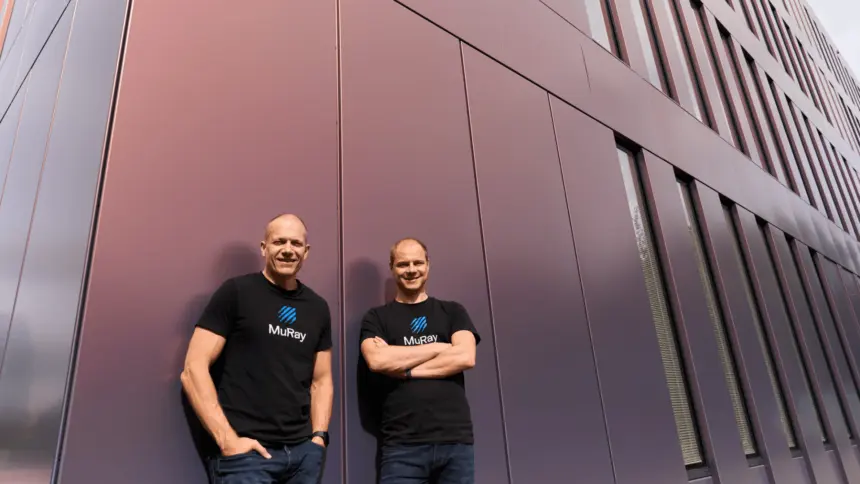
Co-founded by Dr Hektor and Dr Kristjan Põder, who serve together as co-chief executives, MuRay spun out of research into particle physics to tackle quality control in heavy manufacturing. Dr Põder said: “Defects that manufacturers can’t see keep parts out of service for longer than they should be.”

Aerospace testing and commercial rollout
MuRay is focusing first on flight hardware. The company is collaborating with the German Space Agency at the German Aerospace Centre (DLR) to model the structural inspection of rocket engines. The partnership plans to run its first real-world engine assessment in 2027 to verify whether the system can spot minute stress fractures, voids and powder residues inside safety-critical propulsion components.
The company intends to introduce its first commercial inspection service to enterprise clients in 2027. That initial service will pair MuRay’s detector systems with the established electron beam infrastructure at the Deutsches Elektronen-Synchrotron (DESY) facility in Hamburg.
The startup is also building self-contained hardware. MuRay is developing a mobile inspection unit housed within a standard shipping container, allowing field engineers to scan heavy industrial assemblies on factory floors and at launch sites.
A standalone, full-scale inspection machine powered by an internal laser-driven particle accelerator is scheduled to enter service in 2029, removing the need to transport test components to scientific particle accelerators.
Broader industrial and security uses
Beyond rocket propulsion and aviation turbines, the company is evaluating the platform for border protection and heavy infrastructure monitoring. Because muons react distinctively to elements with high atomic numbers, the detectors can identify dense radioactive matter such as enriched uranium concealed inside heavy shipping containers.
The company also views long-term commercial potential in structural civil engineering, including assessing the integrity of aging bridges, scanning nuclear waste casks, and performing clinical medical diagnostics where dense bone and tissue obscure standard imaging systems.