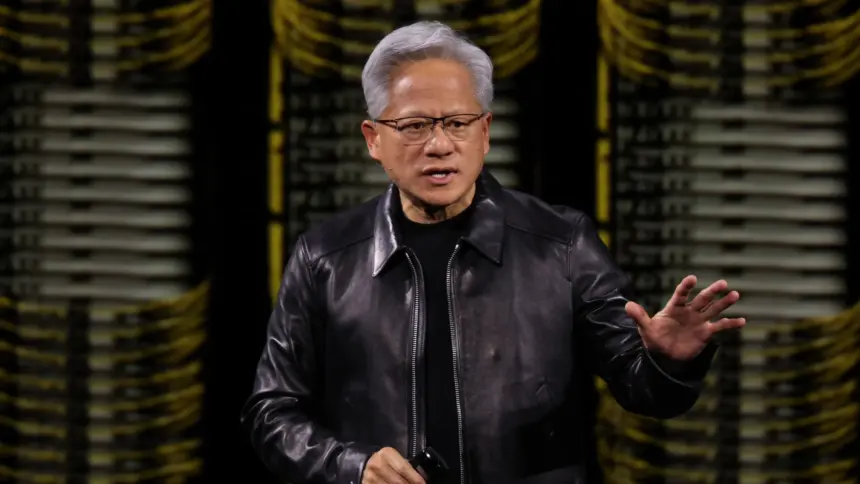
A suspected Chinese intelligence asset targeted Nvidia chief executive Jensen Huang to gather information, according to a report by The New York Times. The newspaper reported that intelligence agencies found no evidence Huang knew of the operative’s alleged espionage ties, while Nvidia rejected claims of impropriety and said past chip diversion allegations were thoroughly debunked.
Key points
- United States intelligence agencies surveilled Alice Huang, an executive linked to Singapore-based Megaspeed, suspecting she was an intelligence asset for Beijing, The New York Times reported.
- Investigators identified contact between Alice Huang and Jensen Huang through surveillance unmasking, but found no evidence the Nvidia chief executive was aware of her alleged espionage role, according to the report.
- Nvidia rejected allegations of misconduct, stating that customer conversations never involve trade secrets and that past claims regarding chip diversion had been investigated and debunked.
- President Donald Trump was briefed on the surveillance about a year ago, the Times reported, but officials chose not to provide Jensen Huang with a defensive briefing.
The surveillance investigation and the White House briefing
According to The New York Times, a classified inquiry focused on Alice Huang, also known as Huang Le, who has not been charged with any crime. The Times reported that she was briefly listed as managing director of Megaspeed after the Singapore-based data centre company launched in 2023, though her name was later removed from corporate filings. American intelligence agencies tracked her digital communications after suspecting that she was passing information to Beijing and cultivating proximity to Jensen Huang, the newspaper reported.
During that surveillance, analysts discovered communications between Alice Huang and the Nvidia chief executive through a legal process known as unmasking, according to the Times. The Times reported that the two had socialised at industry gatherings, including an after-party following a technology trade exhibition in Taipei in mid-2024. The specific extent and substance of their communications have not been publicly disclosed, according to the report.
Intelligence officials concluded at the time that Jensen Huang had no knowledge of Alice Huang’s alleged role as a Chinese agent, according to the Times. However, unnamed White House officials told the newspaper that they doubted he was completely unaware of her background. The Times reported that agencies briefed Donald Trump on the findings roughly a year ago, but the administration chose not to intervene. Officials also withheld a defensive briefing from Jensen Huang, according to the Times, reportedly out of concern that a warning might reveal to Alice Huang that she was under federal surveillance.

Megaspeed and the Malaysian chip inspection
The espionage allegations reported by the Times follow earlier federal scrutiny into Megaspeed’s hardware shipments. The Times reported that the Department of Commerce opened an investigation in late 2024 after an American official visited a Megaspeed data centre in Malaysia. According to the Times, the inspector found Nvidia processors stored in unpacked boxes rather than deployed in server cabinets, raising suspicions that advanced artificial intelligence chips were being diverted into China.
A Malaysian sister company tied to Megaspeed purchased at least $4.8 billion worth of artificial intelligence hardware containing Nvidia processors between June 2024 and February 2026, according to reporting cited by The Decoder. American export rules prohibit the sale of advanced computing silicon to Chinese entities over concerns that the technology could accelerate Chinese military and commercial artificial intelligence programmes.
Megaspeed announced an internal investigation in response to the allegations. A spokesperson for the Chinese embassy in Washington dismissed the claims as “groundless smears and slanders.”
Nvidia rejects claims of secrets and diversion
Nvidia firmly rejected any suggestion of wrongdoing by the company or its chief executive. In statements to reporters, an Nvidia spokesperson emphasised that customer meetings are standard procedure for corporate leadership, noting that Jensen Huang speaks with thousands of customer executives every year. The company said customers never receive access to proprietary trade secrets or sensitive national security data.

Addressing the export control concerns, the company stated that earlier diversion claims involving Megaspeed had already been settled. An Nvidia spokesperson said: “The diversion allegations against this regional cloud were thoroughly investigated and debunked last year.”
The company also noted the lack of any official communication from federal law enforcement. “We’re confident that if the U.S. government believes that any person is a threat to American industry, it would let us know,” an Nvidia spokesperson said. The company added that the Chinese government has actively blocked imports of American chips to support its domestic semiconductor industry, which led Nvidia to write off approximately $4.5 billion in custom-tailored Chinese processors last year.
Export controls, tariffs and White House ties
The scrutiny comes as Nvidia remains at the centre of commercial and geopolitical tensions between the United States and China. Nvidia’s valuation expanded rapidly after late 2022, when global demand surged for high-performance accelerator chips used to train and run generative models.
Jensen Huang has regularly spoken out against strict semiconductor export controls, arguing that severe trade limits encourage foreign markets to develop rival hardware. In December, the Trump administration cleared Nvidia to export its Hopper-generation H200 processors to Chinese customers under an agreement granting the federal government 25 per cent of the profits. However, Chinese regulatory agencies stepped in to prevent domestic buyers from importing the shipments.
Jensen Huang has maintained close contacts across Washington during this period. In September, he attended a White House dinner honouring Chinese President Xi Jinping, sitting at the table of honour. Earlier this month, Donald Trump praised the executive at an artificial intelligence summit and awarded him the National Medal of Science. United States authorities have not announced any formal regulatory or legal action against Nvidia or Jensen Huang.