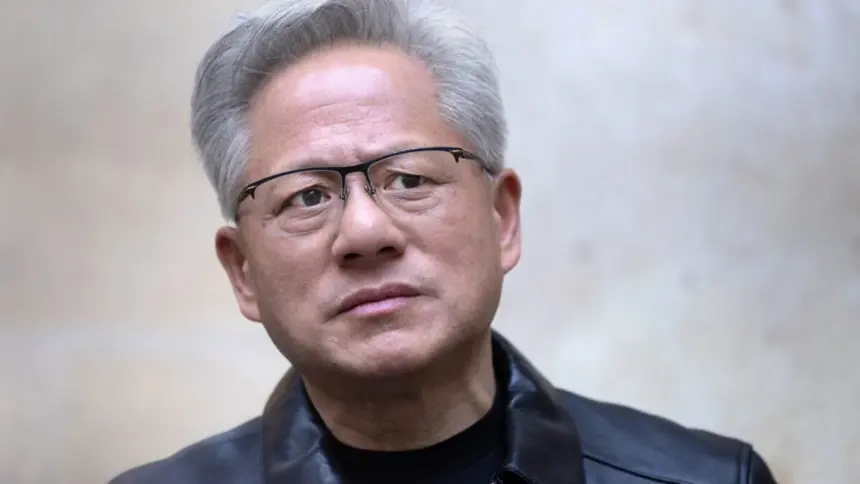
As Jensen Huang resigns as Nvidia chief executive, the California chipmaker has appointed chief financial officer Colette Kress as interim leader to steady the company after sudden leadership changes. Huang stepped down on Thursday following revelations of extramarital relationships with a suspected Chinese intelligence operative and an Nvidia executive.
Nvidia confirmed the departure following an emergency board meeting late on Wednesday. The Silicon Valley firm said its directors have started a search for a permanent successor, considering both internal and external candidates.
Harvey C. Jones, the former chief executive of Synopsys, has been named the first board chair in Nvidia’s history. Kress, who joined Nvidia as chief financial officer in 2013 after senior roles at Cisco and Microsoft, will retain her finance responsibilities while serving as interim leader.
Nvidia made no direct reference to the personal scandals in its statement announcing the changes. “Jensen’s contributions to Nvidia are profound,” the board said, thanking him for his work building the company into one of the most consequential technology businesses in the world.
The allegations that forced Huang out
The board’s decision came four days after it launched an independent investigation run by law firm Wachtell, Lipton, Rosen & Katz into Huang’s relationship with Alice Huang. Alice Huang, who is not related to him, was a managing director at Megaspeed International, a Singapore data centre firm and major Nvidia customer.
United States intelligence services suspect Alice Huang of being a Chinese asset, according to The Guardian. The New York Times reported that she was an operative for China’s Ministry of State Security who sought information on advanced AI chips and attempted to influence sales to Chinese companies.

Jensen Huang admitted in an email to employees on Sunday that he had been unfaithful to his wife, but said he had no knowledge of any ties to Chinese intelligence. The Chinese government dismissed the espionage allegations as unsubstantiated smears.
Pressure intensified on Wednesday when The New York Times reported that Huang also had an affair with Kimberly Powell, Nvidia’s vice president of healthcare, who reported directly to him. The two were filmed together at a San Jose hotel during Nvidia’s GTC conference in March, after which company security staff offered a bystander a non-disclosure agreement.
The relationship with a subordinate altered the board’s stance, following days in which the Nvidia board probed the chief executive’s affair. Stacy Rasgon, a senior analyst at Bernstein, told CNBC that the report of an affair with a direct report made it “much tougher for the board to leave him in position”.
Market sell-off and Washington pressure
Nvidia shares fell more than 10 percent in pre-market trading on Thursday following the announcement. The drop extended a month-long decline that has erased more than 20 percent of the stock’s value, wiping out over $600 billion in market value and allowing Apple to overtake Nvidia as the most valuable US company.
Brokerage firm Bernstein halved its price target on Nvidia stock from $400 to $200 on Thursday, citing the sudden leadership vacuum. Legal scrutiny also expanded, with an investor group filing a shareholder lawsuit against Nvidia over the handling of the spy scandal.
Political pressure had mounted across Washington before Huang stepped down. Republican leaders of three US House committees had demanded closed-door testimony from Huang regarding his contacts with Megaspeed. Democratic senators Elizabeth Warren and Chris Coons wrote to Commerce Secretary Howard Lutnick asking federal officials to preserve all documents related to Nvidia’s exports to China.
President Donald Trump had initially defended Huang, calling him an honourable figure, while technology figures including Elon Musk offered public support. However, White House discussions grew contentious over whether to place Megaspeed on the Commerce Department’s trade blacklist for alleged chip diversion.
Thirty-three years at the helm
Huang founded Nvidia with Chris Malachowsky and Curtis Priem in 1993, planning the graphics business over meetings at a California Denny’s diner. The company spent its first two decades producing graphics processing units for video games before pivoting to artificial intelligence.
That shift accelerated in 2012 after the AlexNet neural network proved that graphics chips could train computer vision models far faster than standard processors. By combining specialised silicon with its proprietary CUDA software platform, Nvidia became the foundation for modern AI systems used by companies such as OpenAI and Anthropic.
As Wired reported, Nvidia controlled roughly 90 percent of the AI processor market by late 2026. Huang maintained tight control throughout that rise, keeping dozens of direct reports rather than delegating through traditional layers of management.
Huang owns roughly 870 million shares, or about 3.6 percent of Nvidia, giving him a personal fortune estimated between $145 billion and $155 billion. His departure removes one of Silicon Valley’s most prominent leaders at the height of global competition for advanced computing hardware.
What happens next for Nvidia?
Kress takes charge of Nvidia during its most turbulent period since the artificial intelligence boom began. The board has begun vetting candidates for the permanent chief executive post, with external names including Apple hardware chief Johny Srouji circulating alongside internal contenders.
Nvidia is scheduled to report its quarterly earnings on Tuesday, 17 November. That presentation will give Kress her first public platform as interim leader to address customer commitments, chip supply allocations, and the company’s product roadmap without its founder.