Thousands of customers experienced US bank outages on Monday, 16 November, after a technical fault at JPMorgan Chase disrupted online banking, mobile apps and interbank transfers. The bank blamed a software bug in its on-premise hardware systems and ruled out a cyberattack.
Reports on outage tracker Downdetector began climbing around 10am ET for some banks, according to Engadget. Mashable reported that complaints surged around noon and reached a peak of more than 4,800 reports for Chase over the preceding 24 hours by 2pm ET, making it the worst-affected institution.
Error reports also spiked at other major lenders and payment services. Gizmodo tracked more than 1,000 complaints for Bank of America and hundreds for U.S. Bank and Zelle, while Al Jazeera reported over 800 for Wells Fargo. Capital One, PNC Bank and Truist also saw spikes.
What caused the Chase bank outage?
In a statement posted on X on Monday, JPMorgan Chase said the disruption stemmed from “a software bug in on-premise hardware systems” and stressed there was no evidence of cybercrime. The bank told customers their accounts and funds remained accessible, even though some transactions were taking longer to process.
Chase described the incident as an isolated fault rather than a systemic failure across US banking. It said other lenders felt slower service only where they were party to a transaction with Chase, and pledged to resolve the problem by the end of Monday.
How other banks and Zelle were affected
Because US banks constantly route transfers between one another, Chase’s hardware bug triggered knock-on delays elsewhere. As Livemint reported, the issues centred on Chase users and people at other banks trying to transact with Chase, while Bank of America and Citigroup had no faults with their own banking services.

U.S. Bank confirmed its own systems were unaffected, though clients sending or receiving Zelle payments with other institutions faced delays. Zelle is run by Arizona-based Early Warning Services, which is owned by banks including JPMorgan Chase, Bank of America, Wells Fargo, U.S. Bank, Capital One, PNC and Truist.
An Early Warning Services spokesperson told The Independent that the Zelle network was operating fully and attributed any payment delays to an issue at financial institutions, while a Zelle spokesperson said “Zelle is operating as it should”. The Federal Reserve’s own payment systems, including interbank ACH transfers, kept running normally, ABC News reported from the Fed’s website. However, Interesting Engineering noted that Wells Fargo acknowledged technical problems on its website.
What services failed for customers
Downdetector data cited by The Hill showed that 52% of Chase complaints concerned balances and transactions, 21% involved web logins and 17% covered transfers, while Al Jazeera separately put the share of balance and transaction issues at 50%. Affected Chase app users were shown a notice advising them that some services were temporarily unavailable.
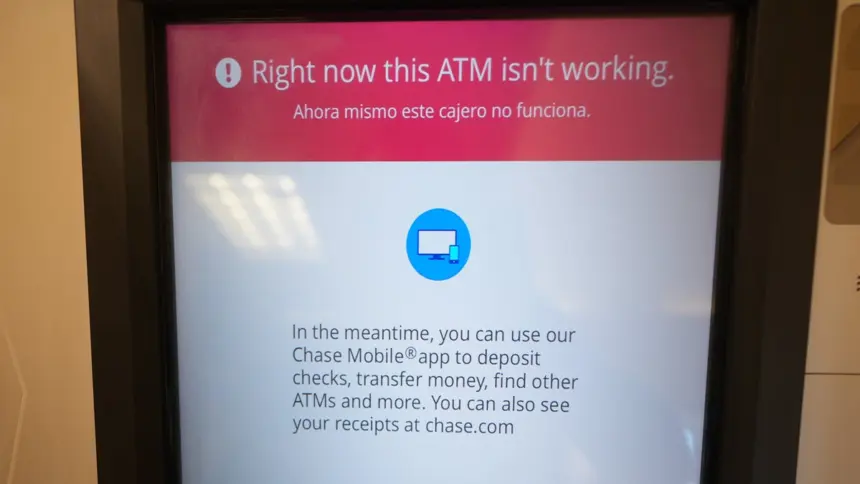
Customer experiences varied across channels during the afternoon. One Chase user told Gizmodo he could log in but could not view his routing number, while The Next Web cited New York Times reports of social media posts describing failed ATM card use and stalled branch transactions. A photo reported by The Independent showed an error screen on a Texas ATM.
In contrast to those social media reports of ATM card failures, Pocket-lint reported that transactions using debit and credit cards on linked accounts should still go through, even where online statements, balance checks and peer-to-peer transfers stalled.
A week of major US tech outages
Monday’s banking disruption was the third major technology failure to hit US users in five days, though no link has been established between them. Microsoft suffered a roughly 20-hour Microsoft 365 outage that began on 12 November, knocking out Outlook, Teams and Copilot for businesses worldwide before the company confirmed full service restoration on 14 November.
On Monday, Microsoft said it had identified the bug behind last week’s outage, having earlier confirmed that AI was not implicated. Even so, Futurism noted that Downdetector continued to register user reports for Outlook and Teams on Monday, alongside separate spikes for Google, Amazon and Steam.
Air travel was also disrupted on Friday, 13 November, when the Federal Aviation Administration ordered a nationwide ground stop that caused 14,000 flight cancellations over two days. US Transportation Secretary Sean Duffy said the failure occurred while defence contractor L3Harris was replacing copper wire with fibre, while officials traced it to an Arkansas router upgrade and the FAA said it was not a cybersecurity incident.
At the time of reporting, Bank of America and Wells Fargo had not immediately responded to requests for comment from Gizmodo and Al Jazeera, and the cause of the technical problems Wells Fargo acknowledged on its website remained unclear.