Nvidia unveiled the Nvidia Rubin HPC GPU at the SC26 conference on 16 November 2026, targeting scientific simulations, engineering and data analytics. Built on the company’s Vera Rubin platform, the processor packs more than 50,000 CUDA cores onto a single GPU and is expected to be available in 2028.
Nvidia designed the Rubin HPC GPU for research teams using AI agents to generate and test candidate molecules, materials and industrial designs. As agents propose more options, teams need faster simulations to evaluate each candidate before committing to lab experiments or physical prototypes.
“For agents tackling science and engineering, faster simulation means faster discovery,” said Ian Buck, Nvidia’s vice president of hyperscale and high-performance computing. He said the chip is intended to shorten the loop between hypothesis, simulation and refinement.
How does Rubin HPC handle scientific workloads?
Across climate modelling, genomic analysis, engineering simulation and financial risk, Nvidia said scientific applications follow a shared pattern. Software repeatedly pulls small sets of scattered values from huge datasets, runs calculations and repeats that sequence at large scale.
Raw arithmetic power alone cannot speed up those workloads if cores sit idle waiting for memory. Nvidia said Rubin HPC balances compute with data movement by adding sparse data acceleration aimed at sparse matrix operations, stencil computations, sorting and reductions.
Data transfers between chips use seventh-generation Nvidia NVLink interconnect hardware. Unite.AI reported that NVLink Switch links multiple connections so GPUs can communicate all-to-all across a server rack and between separate nodes.

What do we know about Rubin HPC chip layout and servers?
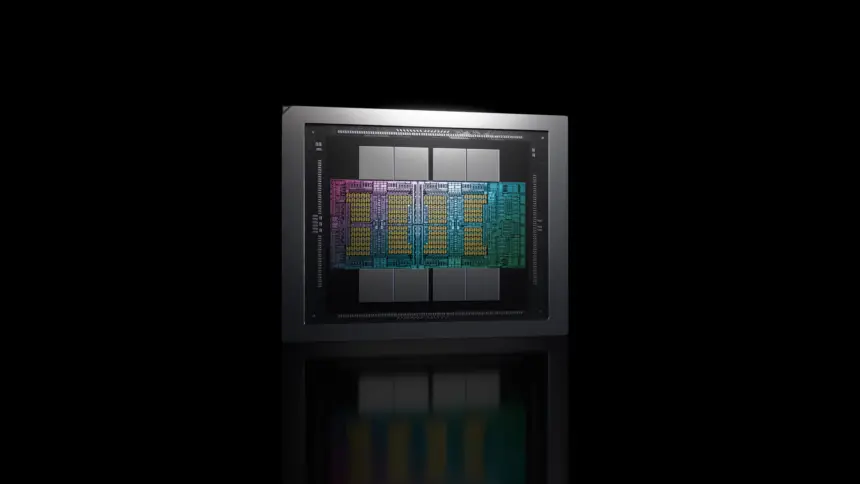
Nvidia has not released a full specification sheet for the chip beyond its record count of more than 50,000 CUDA cores. However, Wccftech reported that an official image of the processor shows a large central GPU die flanked by eight high-bandwidth memory sites.
Based on that layout, Wccftech observed that the package appears to join two Rubin dies using NVLink in the middle alongside a wide input-output section. Neither detail has been formally confirmed by Nvidia in its announcement.
At the system level, Wccftech reported that Rubin HPC server trays will house the latest NVLink switches alongside two Superchips, each pairing one Vera CPU with two Rubin HPC GPUs. That configuration places more than 100,000 CUDA cores on each Superchip and over 200,000 cores inside every server tray.
Software tools and Vera Rubin context
On the software side, AI agents will pair the processor with Nvidia CUDA-X libraries, which provide pre-built algorithms for maths, physics, scientific computing, parallel processing and data analytics. Using those drop-in modules means application developers do not have to hand-tune every simulation workload from scratch.
While Nvidia has started shipping Vera Rubin hardware as the wider platform moves into full production, the specialist HPC variant remains more than a year away. The Vera Rubin architecture links five rack-scale systems to run AI agent tasks that require extended context and several steps of reasoning.
Wccftech reported that Nvidia has focused primarily on AI rather than traditional high-performance computing in recent years, making few advances in FP64 compute while rival AMD prepares a special variant of its Instinct MI400 series expected to deliver record numbers. Wccftech described Rubin HPC as a return to traditional scientific data-centre hardware for Nvidia.
Expected 2028 availability
Nvidia expects Rubin HPC to become available in 2028, though it has not disclosed full details beyond the core count or a narrower release window. Because the company previously cancelled its planned Rubin CPX GPU, Wccftech wrote that it remains to be seen whether Rubin HPC reaches the market in 2028.