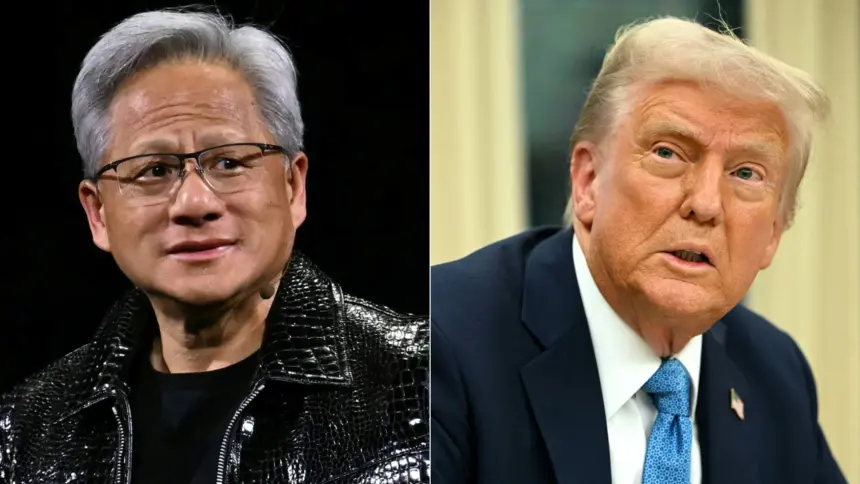
An Nvidia shareholder lawsuit has been filed against the chipmaker and its chief executive, Jensen Huang, in a California federal court on Monday, accusing leadership of misleading investors after an alleged extramarital affair with a suspected Chinese intelligence operative wiped $190bn from the company’s market value.
The proposed class action was submitted to the US District Court in San Jose five minutes after trading closed on Monday. It seeks unspecified damages on behalf of investors who purchased Nvidia shares between 9 October and 8 November 2026, according to a report by Quartz.
Retail investor Mark Kistenmacher filed the complaint through a Los Angeles law firm, as first detailed by the Guardian. The lawsuit names both Nvidia Corporation and Huang as defendants, claiming they concealed personal conduct that exposed the semiconductor business to severe national security and operational hazards.
The allegations in the complaint
At the centre of the dispute is Huang’s relationship with Alice Huang, a former executive at Singapore-based technology distributor Megaspeed who is not related to him. The New York Times reported last month that US intelligence agencies concluded she was acting as a Chinese intelligence asset.
When the relationship first attracted scrutiny in October, Nvidia told the press that customer meetings were routine for a chief executive and described Huang’s interactions with Alice Huang as expected business practice. The lawsuit alleges that public explanation was materially false and misleading because Huang was engaged in a personal affair with her at the time.
On Sunday, Huang admitted in a public statement that he had been unfaithful to his wife, though he did not publicly name his partner. The lawsuit argues that failing to disclose the affair hid acute risks to Nvidia’s commercial reputation, customer relationships and regulatory standing in Washington.

Scrutiny over Megaspeed chip shipments
The legal action also takes aim at Nvidia’s public disclosures regarding Megaspeed. Federal authorities have reportedly been examining whether the Singaporean distributor diverted advanced Nvidia graphics processing units into China in breach of US export trade bans.
Huang attempted to calm market concerns during an interview published on 30 October. He said the chipmaker had audited and counted every GPU deployment sent to Megaspeed, adding that he believed American officials had done the same.
Megaspeed has previously defended its conduct, stating last year that it operated in full compliance with all relevant laws, including American export rules. Even so, the lawsuit contends that Nvidia misled the public about the stability of its supply chain oversight while its chief executive maintained an undisclosed relationship with a Megaspeed executive.
Federal inquiry and board reaction
The shareholder filing followed a chaotic weekend inside the company, which began when the Nvidia board launched an internal probe into whether foreign intelligence had targeted its co-founder. The board named lead independent director Stephen Neal to oversee the inquiry.
Political pressure mounted on Monday when President Donald Trump told reporters at a White House briefing that federal law enforcement had taken an interest in the situation. Trump said the FBI was examining the matter, but said he spoke to Huang directly and believed the chief executive would avoid personal culpability.
Trump told reporters: “He said he had absolutely no idea that the person in question was a spy.” Huang also addressed the scrutiny in a letter published on the company website, writing: “I support the investigation and will cooperate fully.”
Other legal challenges are gathering pace alongside the San Jose case. Several class action practices have announced securities investigations into Nvidia, soliciting institutional and retail clients to join potential claims over misleading statements.
Impact on the Nvidia share price
The revelation triggered an immediate selloff on Wall Street. Nvidia shares dropped 4.3% during Monday’s trading session, wiping roughly $190bn from the company’s market valuation, as TechSpot reported. The decline came on a day when the broader Nasdaq index gained 2%.
Shares recovered approximately 1% in Tuesday premarket trading, according to CNBC. However, analysts and institutional investors have raised questions about corporate governance and the absence of a visible succession plan should Huang be forced to step aside.
Huang has led Nvidia since co-founding the business in 1993, steering it to a valuation of $4.3tn on the back of global demand for artificial intelligence hardware. The San Jose lawsuit will now proceed to initial procedural motions, where the federal court must decide whether to certify the class.