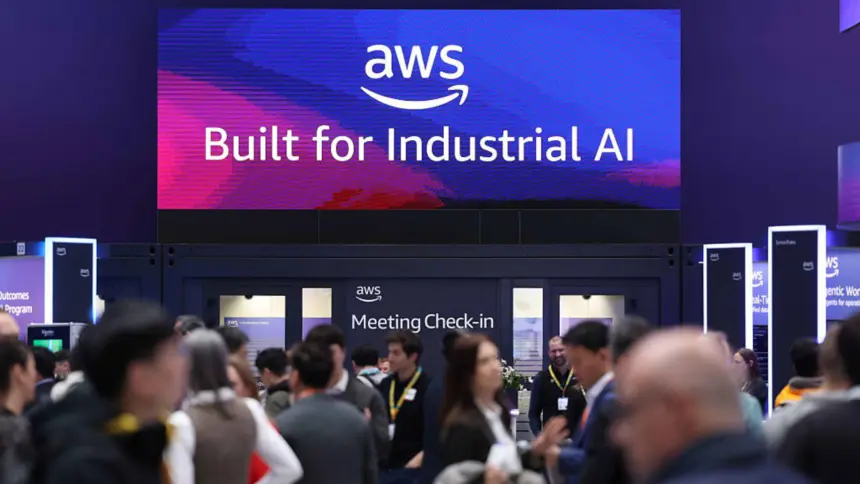
Amazon AI spending surged to historic levels in the third quarter of 2026, as heavy data centre investments pushed free cash flow into a $42.4bn deficit. The aggressive capital expenditure in Seattle overshadowed a 39% leap in cloud computing revenue on 29 October, sending the company’s shares down more than 7% in extended trading.
Key points
- Amazon Web Services grew 39.3% to $46.0bn, its fastest growth rate in nearly five years.
- Trailing twelve-month free cash flow swung from a $14.8bn surplus to a $42.4bn outflow due to AI infrastructure purchases.
- Third-quarter net income fell to $20.7bn, missing analyst targets alongside total revenue of $201.9bn.
- Amazon reiterated full-year capital expenditure plans of roughly $220bn, driven by semiconductor and data centre demand.
The cost of the AI data centre buildout
Amazon spent more than $77bn on property and equipment during the third quarter alone. The company released its third-quarter financial results statement showing that total net sales rose 12% to $201.9bn, falling just short of the $202.2bn average forecast tracked by FactSet.
Cash outflows tied to property and equipment purchases jumped by $94.8bn over the trailing twelve months. That surge reversed Amazon’s cash flow profile, turning a $14.8bn free cash flow inflow a year ago into a $42.4bn cash deficit. The company confirmed it remains on course for approximately $220bn in cash capital expenditures for the full 2026 calendar year.
Chief executive Andy Jassy warned earlier this year that AWS capacity remains booked out as hardware supply struggles to match enterprise appetite. Rising costs for server components, advanced semiconductors and power connections have driven up building expenses across every major geographic region.

Overall net income fell to $20.69bn, or $1.89 per diluted share, down from $21.19bn, or $1.95 per share, in the third quarter of 2025. Wall Street had projected $1.97 per share. Amazon attributed much of the profit contraction to comparisons with the previous year, when it recorded a $9.5bn pre-tax gain on its equity investment in Anthropic.
Cloud growth hits five-year high
Despite group profit misses, Amazon Web Services delivered its strongest expansion in nearly five years. AWS revenue jumped 39.3% year-over-year to $45.98bn, topping the consensus estimate of $45.29bn. The division now operates at an annualised run rate of $184bn and represents nearly 23% of Amazon’s consolidated revenue.
AWS operating profit rose 55% to $17.77bn, up from $11.4bn during the same period in 2025. Consolidated operating margin reached 13.9%, which Amazon stated was the highest in company history.
“Our core compute and storage revenue grew at their fastest rates in several years,” said Andy Jassy, Amazon’s chief executive, on an earnings call with analysts.

Jassy projected that AWS could sustain revenue growth above 40% throughout both 2027 and 2028. He told investors that Amazon could establish two distinct businesses producing $1tn in annual revenue within the next five to ten years.
Bedrock demand and silicon roadmaps
AWS saw broad enterprise adoption across its machine learning platform. Fortune 500 customers spent roughly seven times more on the Bedrock inference service than they did a year earlier, while Bedrock token volume increased seventeenfold.
Amazon expanded Bedrock by introducing OpenAI’s GPT-6 series, Anthropic’s Claude 5.5 family, Moonshot AI’s Kimi K3, and Grok 4.7. The cloud provider also launched Bedrock Managed Agents for corporate workflows and open-sourced the Strands harness, a framework that lowers execution expenses by 32% through improved token handling.
The company also strengthened its software stack by acquiring open-source database developer DuckLabs to improve server-side analytics. For its proprietary Trainium accelerator line, Amazon introduced TorchNeuron, enabling teams to execute standard PyTorch code without manual code changes.
To secure hardware capacity, AWS signed an expanded infrastructure pact with Nvidia to deploy graphics processors alongside its proprietary hardware. The company also signed service agreements with Meta, OpenAI, Salesforce, Oracle and Qualcomm.
Amazon plans to export its in-house accelerator hardware outside its proprietary cloud. “With Trainium demand so strong, customers continue encouraging us to make it available outside of AWS,” Jassy said, confirming external deployments will start in late 2027.
Market pressure across cloud providers
Amazon is not the only provider facing questions from financial markets over heavy data centre spending. Earlier this week, Alphabet shares slumped after third-quarter capital expenditures reached $51bn, sparking worries about the cash required to sustain rapid machine learning development.
Competition among the top providers has intensified. Microsoft recently began reporting its Azure cloud figures in absolute dollars, revealing that Azure has expanded to 72% of the scale of AWS, up from 58% two years ago. Google Cloud also reported that its division revenue more than doubled during the third quarter.
Core commerce growth at Amazon was more subdued. North America retail sales grew 6% to $112.9bn, while international segment sales rose 5% to $43.1bn. According to Amazon’s quarterly regulatory filing, the timing of Prime Day shifted to the second quarter in several major markets this year, which reduced apparent annual third-quarter growth by roughly 400 basis points.
Fourth-quarter targets and logistics
For the fourth quarter of 2026, Amazon forecast net sales between $240.0bn and $247.0bn, reflecting growth between 12% and 16%. The midpoint lands near Wall Street consensus expectations of $244.16bn. Operating income is projected at $28.5bn to $33.5bn, up from $25.0bn a year ago.
To support retail demand, Amazon is hiring 300,000 seasonal workers across the United States, up from 250,000 workers last year. It also allocated more than $1.5bn to lift baseline hourly wages for operational staff to $20 per hour.
In other technical programmes, Amazon confirmed that its low Earth orbit satellite network, Project Leo, will begin commercial service later this year, with AT&T onboarded as its first commercial telecommunications partner. Autonomous vehicle unit Zoox has begun offering fare-paying robotaxi rides in Las Vegas while running road trials in Houston and San Diego.