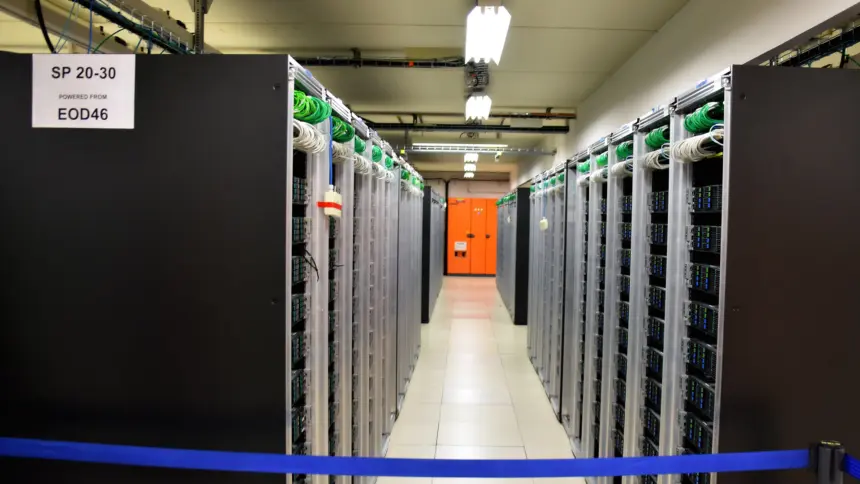
Amazon heads into its third-quarter Amazon earnings report on Thursday facing an acute infrastructure squeeze, after the company confirmed that cloud computing capacity at Amazon Web Services is booked out through most of 2027. The company raised its annual capital expenditure budget to $220 billion as demand continues to outpace server deployment.
Key points
- Amazon Web Services has booked out its available cloud capacity for 2026 and most of 2027, leaving the business supply-constrained.
- Amazon raised its 2026 capital expenditure guidance to $220 billion from an earlier projection of $200 billion.
- Wall Street consensus estimates put third-quarter revenue at approximately $202 billion, representing a 12 per cent increase from a year earlier.
- The surge in infrastructure spending has pushed company cash flow into negative territory ahead of the earnings conference call.
Cloud capacity sold out
Amazon Web Services is confronting an unusual challenge for a cloud market leader: customer demand is outpacing its physical ability to supply compute resources. Andy Jassy, Amazon’s chief executive, said capacity is fully booked for this year and for most of next year.
The backlog means AWS enters the end of 2026 unable to absorb immediate new compute workloads at scale. Cloud providers have raced to build specialized facilities and procure hardware, but physical construction timelines and hardware delivery lead times have capped expansion.
For enterprise customers, the shortage limits how quickly teams can stand up large training clusters and deploy high-intensity workloads. Instead of competing purely on pricing or software features, cloud providers now find themselves constrained by raw rack space and power access.

Capital spending rises to $220 billion
To relieve the bottlenecks, Amazon has committed vast sums to infrastructure. The company raised its 2026 capital spending forecast to $220 billion, up by $20 billion from the $200 billion target set in the previous quarter.
That increased outlay has had immediate financial consequences. The aggressive build-out has pushed Amazon into negative free cash flow, marking a sharp pivot from earlier periods when retail efficiencies and cloud margins generated tens of billions of dollars in surplus cash.
The vast majority of the expenditure goes directly toward data centre construction, land acquisition, electrical power contracts, and specialized processors. The scale of the spend reflects the reality that cloud leadership now requires continuous, multi-billion-pound commitments just to prevent existing clients from turning elsewhere.
What Wall Street expects from the results
Wall Street analysts anticipate total net sales of around $202 billion for the quarter, which would represent roughly 12 per cent growth compared to the identical quarter in 2025. While double-digit top-line growth remains intact, investor attention will centre on operating margins and forward guidance.

The earnings call is scheduled for 5:00 p.m. Eastern Time on Thursday. Analysts will press executives for details regarding when new capacity will come online and whether capital spending will climb higher still in 2027.
With AWS sold out for the immediate future, revenue growth in cloud services is effectively bound to the speed of physical data centre handovers rather than software sales pipelines. Investors will watch whether Jassy outlines a timeline for capacity to catch up with market demand.