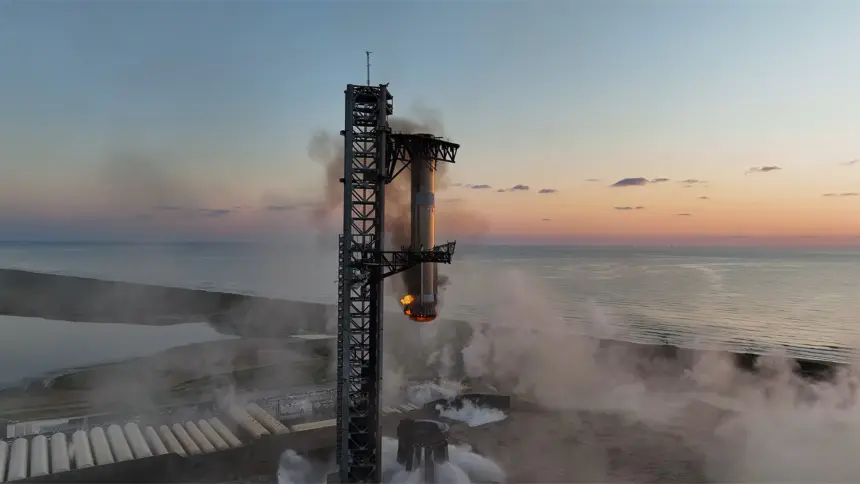
SpaceX is preparing to launch Starship Flight 15 from Boca Chica, Texas, on Friday, 13 November, aiming to catch both the Super Heavy booster and the Starship upper stage for the first time. The 75-minute launch window opens at 5:45 p.m. Eastern Time (10:45 p.m. GMT), following regulatory clearance from the Federal Aviation Administration.
The test mission pairs Booster 22, an upgraded Super Heavy V3 vehicle standing 72 metres tall, with Ship 42, a 52-metre upper stage. If both recoveries succeed at the Starbase launch facility, the flight will mark the first time an entire orbital rocket system is retrieved intact after reaching space.
As reported by Teslarati, the Federal Aviation Administration granted the launch licence ahead of Friday’s window at Orbital Launch Pad 2. The flight profile calls for the booster to return minutes after lift-off, while the upper stage orbits Earth for almost a full day before attempting its own landing.
How does the dual tower catch work?
The recovery system relies on the Mechazilla launch and catch tower at Starbase, which uses two giant mechanical arms like chopsticks to catch descending rockets out of mid-air during controlled descent.
Shortly after lift-off, the Super Heavy booster will separate from the spacecraft, execute a flip manoeuvre and perform a boostback burn to set course back towards the Texas pad. Roughly six and a half minutes into the mission, the booster will return to Starbase for the tower catch attempt.
The tower arms will attempt to close around the returning booster during its powered descent. SpaceX has caught three Super Heavy V1 boosters using this system, but Friday marks the first catch attempt for the larger Super Heavy V3 design.

Ship 42 faces a different flight profile. The upper stage will climb to an orbital altitude of about 275 kilometres, deploying 26 Starlink V3 satellites into low Earth orbit during Starlink Group 31-2 operations.
Three of these satellites carry cameras to inspect the spacecraft’s heat shield in orbit. That imagery will help mission controllers evaluate the thermal protection system and verify that the heat shield survived the ascent before clearing a return to the tower.
How will the Starship upper stage return from orbit?
Returning from orbit poses significantly greater mechanical challenges than recovering a booster, as Gizmodo reported. The upper stage re-enters the atmosphere at orbital velocity, far faster than the booster’s suborbital descent.
Starship is scheduled to circle Earth roughly 14 times during a 22-hour flight, though ABC Tech reported the flight plan as 15 laps around the world. According to CNET, the expected landing time for the upper stage at Starbase is 4:17 p.m. Eastern Time (9:17 p.m. GMT) on Saturday, 14 November, assuming the schedule holds.
During atmospheric re-entry about 22.5 hours after launch, the vehicle will fall in a horizontal belly-flop position to bleed off speed through atmospheric friction. As it approaches the tower, the ship will fire its engines to swing upright into a vertical catch position.
The mechanical chopstick arms will then attempt to close around the descending ship. If flight controllers decide the vehicle is damaged or misaligned with the tower, SpaceX maintains contingency ocean splashdown options instead.
What happened during Starship Flight 14?
Full recovery has been the central engineering goal of the Starship programme, but previous attempts have ended in the sea. Across the first 14 Starship test flights, every upper stage either splashed down into the water by design or broke apart during re-entry.
The inaugural full-scale launch in 2023 suffered multiple engine failures, forcing controllers to activate the flight termination system. Flight 14 reached orbit for the first time in September, marking a major milestone for SpaceX, but an engine fault forced controllers to deorbit early after a shortened flight, skipping any recovery attempt.
The company has already re-flown two Super Heavy boosters, proving that ground teams can refurbish and launch earlier hardware again. Catching both stages on Flight 15 would demonstrate that the entire rocket stack can be preserved for rapid turnaround.
“The only way that we can extend consciousness beyond Earth on a sustained basis is with a fully reusable orbital launch vehicle”, Elon Musk, SpaceX’s chief executive, said during a company earnings call in October.
Why is full reusability critical for Artemis?
The push for two-stage recovery directly influences SpaceX’s commercial launch cadence and government contracts. The company has logged more than 280 launches since 2025, primarily relying on its existing Falcon fleet.
Falcon rockets “are still not fully reusable. We still throw that second stage away every single flight”, said Kiko Dontchev, SpaceX’s vice president of launch, at a NASA tech summit.
NASA is paying SpaceX billions of dollars for Starship to serve as a lunar lander for the Artemis programme. Jeff Bezos’ Blue Origin is the other major contractor developing a crew lander, the Blue Moon vehicle.
During the Artemis III mission scheduled for next summer, astronauts will practice docking their capsule in Earth orbit with both a Starship lander and a Blue Moon craft. NASA expects to decide a year before Artemis IV whether to use Starship or Blue Moon to land astronauts on the lunar surface as early as 2028.
To support higher flight frequencies, SpaceX plans to expand Starship operations to launch pads in Florida within months, followed by Louisiana sites in a few years. SpaceX will stream the test on its X account and the company’s website, beginning 30 minutes before the launch window opens.