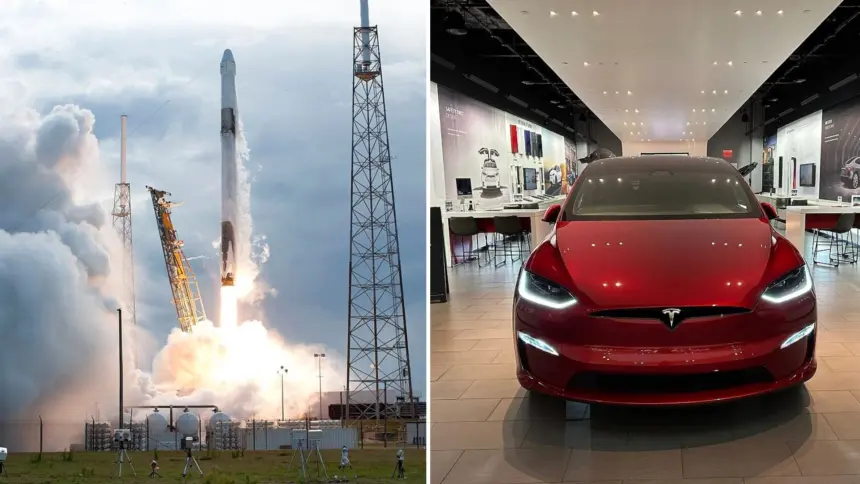
Advisers and independent board committees for Tesla and SpaceX are advancing negotiations over a historic SpaceX Tesla merger that could be announced as early as December, Bloomberg reported on Thursday. The proposed share swap would combine Elon Musk’s rocket manufacturer and electric car maker into a $3.4 trillion business.
A December announcement would move the timetable forward by several months, after earlier discussions pointed to an agreement during the first half of 2027. Negotiators have also examined a scenario where talks extend into early 2027 if open issues take longer to resolve. Neither company responded to requests for comment.
Tesla shares rose by as much as 1.9 per cent to $398.35 following the report, leaving the car maker valued at roughly $1.55 trillion. SpaceX shares rose 0.6 per cent to $140.63, putting its market capitalisation at approximately $1.9 trillion after its initial public offering in June.
At those prices, the combination would become the largest corporate takeover in history. The transaction would far exceed Vodafone’s $183 billion takeover of Mannesmann in 2000, as well as SpaceX’s own $250 billion acquisition of Musk’s artificial intelligence company xAI earlier this year.
Operational ties between the two companies are already expanding. Tesla and SpaceX collaborate on the Terafab semiconductor plant in Texas. Tesla also displayed its next-generation Roadster at SpaceX headquarters last month, featuring cold gas thrusters built on SpaceX hardware.
Deal terms and voting power
Advisers and boards on both sides are working through the specific terms of the transaction, led by the exchange ratio determining how many SpaceX shares Tesla investors would receive. Teams are also drafting governance rules for the combined company.
Musk first suggested combining Tesla and SpaceX in May, weeks before the rocket company’s public listing. On 20 October, he confirmed during SpaceX’s third-quarter earnings call that independent director committees had been formed at both firms to review a deal.
Musk told investors on that call that he could not participate in the discussions because he is a conflicted party, calling the formal review “an odd kabuki dance”. Cross-board ties already link the firms: Ira Ehrenpreis joined the SpaceX board in February while continuing to chair Tesla’s compensation and governance committees, as Interesting Engineering reported.
A share swap would also reshape voting control for Tesla investors. Musk owns roughly 20 per cent of Tesla, where each share carries one vote. At SpaceX, supervoting shares give him approximately 85 per cent of the voting power, according to regulatory filings from its June flotation. If absorbed by SpaceX, Tesla investors would hold stock in a business where Musk controls an outright voting majority.
The China operations hurdle
The primary structural obstacle in negotiations is determining how to isolate Tesla’s large manufacturing operations in China from SpaceX’s US government and defence contracts.
Tesla’s factory in Shanghai produces more than half of the company’s electric cars, shipping 67,829 vehicles in October. SpaceX, meanwhile, operates as one of the Pentagon’s most important launch and satellite contractors.
Rajat Gupta, an analyst at JPMorgan, described Tesla’s presence in China and SpaceX’s defence work as “key dynamics that are at odds with each other” for regulatory authorities and shareholders. Musk has repeatedly insisted that Tesla will not separate its Chinese business, denying a Wall Street Journal report in July that claimed the company was considering a sale or spinoff of those operations.
Political developments in Washington introduce further scrutiny. Bloomberg previously reported that the companies wanted to complete the merger before President Donald Trump leaves office. Democrats won control of Congress in the November midterms and have pledged to examine Musk’s businesses, government contracts and political ties.
What happens to Musk’s pay package?
A takeover by SpaceX would accelerate Musk’s executive compensation under change-of-control provisions in his 2025 pay package, according to Interesting Engineering. Those terms drop operational milestones and determine his stock awards strictly on Tesla’s valuation in the transaction.
If the deal values Tesla at $2 trillion, representing a 33 per cent premium over its current market value, Musk would clear the first market-value threshold and trigger immediate vesting of shares earned at that level. An earlier award of 286 million restricted shares from 2018 would also vest early.
Shareholder approval requirements
Even if negotiators settle on terms by December, the deal faces a steep hurdle in securing shareholder approval at Tesla. As Teslarati reported, the merger requires backing from 50 per cent of all outstanding shares, rather than a simple majority of votes cast.
Tesla has struggled to clear that threshold before. In 2025, a management proposal to declassify the board drew support from only 39.4 per cent of outstanding shares, falling well short of the required mark.
Tesla’s annual meeting on 3 December at Giga Texas will not address the merger. The proxy ballot includes the re-election of Musk, board chair Robyn Denholm and director JB Straubel through 2029, alongside advisory votes on executive pay and the company’s auditor. Any merger agreement announced in December would require Tesla to call a separate special meeting for shareholders to vote on the transaction.