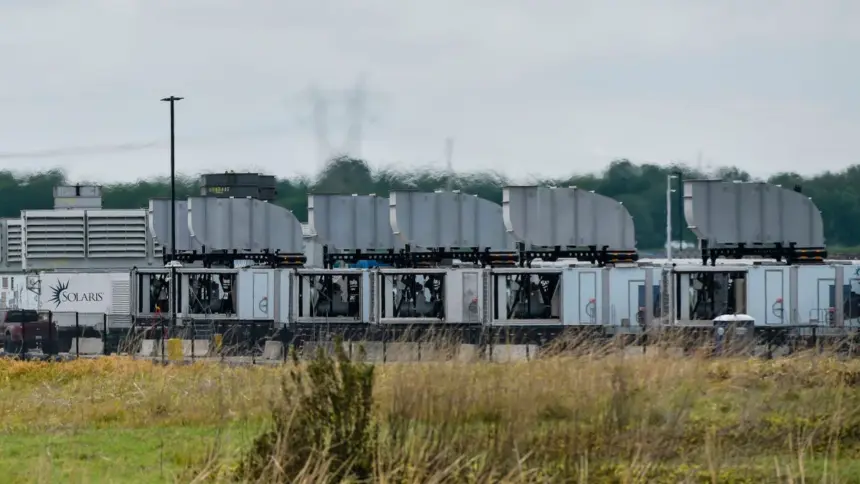
A federal judge in Mississippi has refused to throw out an xAI data centre lawsuit brought by civil rights and environmental groups, ruling on Friday that claims the company ran unpermitted gas combustion turbines to power its Colossus supercomputer cluster near Memphis can go to trial.
Key points
- U.S. District Judge Debra M. Brown denied xAI’s motion to dismiss a Clean Air Act lawsuit filed by the NAACP, the Southern Environmental Law Center, and Earthjustice.
- The company argued its gas turbines were exempt mobile power units and that private citizen enforcement was unconstitutional, positions the court firmly rejected.
- The decision follows an earlier ruling this month that turned down a Department of Justice effort to shut down the litigation against Elon Musk’s AI venture.
- The case comes amid mounting political and community scrutiny across the United States over the energy and pollution footprints of massive AI facilities.
The judge’s rejection of dismissal
Late on 31 October, Judge Debra M. Brown issued an order in federal court in northern Mississippi concluding that local residents and civil rights groups have the legal authority to enforce federal clean air standards against xAI. The company, an artificial intelligence business absorbed into Elon Musk’s SpaceX corporate structure, had sought to halt the litigation before evidence gathering could begin.
According to the judge’s written opinion, the court found that the plaintiffs demonstrated clear statutory standing under the Clean Air Act. Judge Brown also dismissed xAI’s constitutional challenge to citizen suits. Musk’s legal team had claimed that allowing private non-profit groups to bring enforcement actions violated the executive branch powers established in Article II of the U.S. Constitution and breached the private nondelegation doctrine.
Judge Brown wrote that because citizen groups sue to redress their own injuries and seek statutory remedies for local harm, they “are not exercising the federal government’s executive power.” That finding keeps the lawsuit on course in federal court, exposing xAI to formal discovery regarding its procurement and operation of industrial power hardware.

Gas turbines and permit disputes in Greater Memphis
The core of the dispute centres on the emergency generation units installed to power the Colossus AI cluster and an adjacent facility in Southaven, Mississippi, just south of the Tennessee border. The NAACP filed its complaint in April 2026 alongside the Southern Environmental Law Center and Earthjustice, accusing xAI and its subsidiary MZX Tech of deploying heavy industrial power gear without regulatory clearance.
The plaintiffs alleged that between August and December 2025, the company installed and operated dozens of gas-fired combustion turbines without obtaining the preconstruction or operating air permits mandated by state and federal law. While the initial lawsuit highlighted 27 turbines deployed in Southaven, filings from the Southern Environmental Law Center indicated that at least 35 combustion turbines and associated emission points were active across the Colossus footprint.
The industrial combustion units burn methane to generate electricity directly on site, releasing nitrogen oxides and fine particulate matter into surrounding neighbourhoods. These pollutants contribute directly to ground-level ozone formation, cause respiratory distress, and create pervasive chemical smells for adjacent residential communities.
In its formal motion to dismiss filed in June, xAI maintained that its hardware was outside the scope of local stationary source permitting. The company asserted that the turbines were mobile generators and therefore fell under explicit regulatory exemptions within Mississippi’s State Implementation Plan. Judge Brown rejected that classification, ruling that the equipment did not qualify as mobile sources under state air quality rules.

Community pushback and Department of Justice involvement
The environmental lawsuit represents the culmination of protracted friction between Musk’s venture and residents living along the Mississippi and Tennessee border. Rapid construction of the Memphis supercomputing site outpaced the capacity of the local electric grid, leading xAI to rely on temporary gas plants to provide base-load generation. The installations generated continuous low-frequency hums and exhaust fumes, prompting local outrage.
The operational strain has previously forced the company to seek property agreements. Earlier this year, xAI attempted to offer buyouts to nearby Mississippi homeowners over generator noise, reflecting the persistent disruption surrounding the Southaven and Memphis sites.
Legal tensions deepened when federal authorities intervened in the court proceedings. Earlier in October, the same federal court rejected a separate U.S. Department of Justice attempt to throw out the case, leaving xAI to defend its permitting track record without government backing.
Following Friday’s decision, Abre’ Connor, director of environmental and climate justice at the NAACP, welcomed the court’s stance in a statement on the ruling. “Our position has been clear: xAI cannot operate gas turbines without the required permits,” Connor said, describing the denial of the motion as a crucial step toward protecting local public health.
Wider scrutiny on AI energy infrastructure
The legal clash in Mississippi arrives as public resistance to data centre expansion sharpens nationwide. The massive power demands of frontier AI models have driven technology firms to secure gigawatt-scale supplies from strained municipal grids, often turning to fossil fuel generation as a stopgap measure when public utility hookups face multi-year delays.
The environmental and grid impacts have triggered political action elsewhere. New York recently approved a legislative moratorium on new commercial data centre construction, while municipal governments in several southern and midwestern states are reviewing zoning rules for unpermitted power assets. The dispute over utility access and toxic emissions has also shaped regional political debates ahead of the upcoming U.S. midterm elections.
The industry has faced pressure over commercial secrecy as well. Backlash from consumer advocacy organisations recently pushed rivals Amazon and Microsoft to abandon non-disclosure agreements in their negotiations with regional utility regulators and local councils.
SpaceX, which manages xAI under its aerospace corporate umbrella, did not issue a public response to the Friday decision. The lawsuit now advances to evidentiary proceedings in federal district court, where xAI must provide records concerning the operational timeline and emissions data of its Southaven turbine fleet.