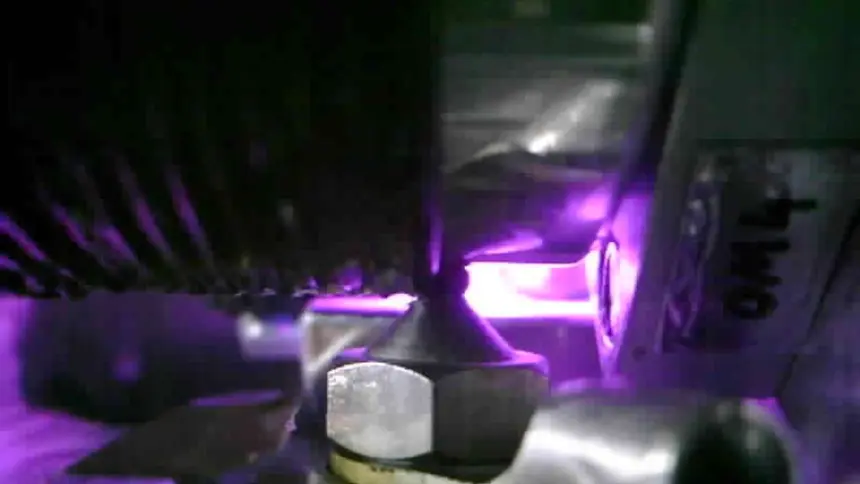
German startup Orbital Matter has achieved 3D printing in space by manufacturing a half-metre rigid beam outside a free-flying satellite in low Earth orbit. The test, confirmed on Tuesday, demonstrates that autonomous construction in the vacuum of space can build structural supports for future orbital data centres and giant solar arrays.
Key points
- The hardware flew aboard the Replicator-2 satellite, launched during a SpaceX rideshare mission earlier this year.
- In-orbit manufacturing removes rocket fairing size limits for solar power generation and thermal radiators.
- The company aims to fly a five-kilowatt solar demonstration in 2028 before scaling to 100-kilowatt arrays by 2030.
The small satellite, named Replicator-2, carried four compact 3D printers into orbit on a SpaceX Falcon 9 rideshare mission during the summer. Once in orbit, the primary device extruded coils of custom resin into the vacuum. An integrated ultraviolet light source cured the liquid into a rigid cylindrical beam as it emerged, a process the company compares to combining cement and water.
Previous additive manufacturing experiments in orbit took place inside the pressurised cabins of the International Space Station. Terrestrial projects, such as NASA-funded vacuum chamber tests conducted by Redwire in 2023, never reached launch. The Replicator-2 mission marks the first time a free-flying satellite has extruded and hardened an external structural component directly into the space environment.
Why orbital data centres need in-space manufacturing
Tech companies and aerospace researchers are evaluating whether placing compute hardware in low Earth orbit can bypass terrestrial grid constraints. However, orbital data centres face sharp cost hurdles and severe physical bottlenecks around cooling and power generation.

A satellite designed for heavy computation requires megawatts of continuous electrical power and massive surface area to radiate waste heat away into the vacuum. Earth-bound launch vehicles impose strict limits on payload dimensions. Rocket payload fairings, which protect spacecraft during ascent, typically measure between three and five metres in diameter. Engineers must fold solar panels and radiators into tight origami patterns that use complex mechanical hinges to open once in orbit.
Mechanical deployment systems carry high failure rates and limit the ultimate size of space structures. By manufacturing trusses and booms directly on orbit from raw chemical feedstocks, satellite operators can deploy structures far larger than any launch fairing could hold. A compact spool of resin takes up minimal volume during launch, expanding into long structural elements only after arriving in space.
“Replicator 2 is the first proof that we can simply build the array in space, at whatever size the mission demands,” said Jakub Stojek, chief executive and co-founder of Orbital Matter.
Testing four printers in orbit
Building hardware for orbit rarely follows a smooth path. Two of the printers aboard Replicator-2 were configured to pull out a flexible solar panel sheet along the freshly printed boom. One of those printers suffered an anomaly during the mission and failed to complete its run. The remaining printer finished the extrusion, creating a rigid boom that successfully deployed its attached solar array.

Orbital Matter intentionally packed redundant hardware onto the demonstration craft to test software adjustments in real operational conditions rather than relying on ground simulations.
“We preferred to learn in orbit and adapt the software as needed rather than waste years testing every possibility on the ground,” Robert Ihnatisin, chief technology officer at Orbital Matter, told TechCrunch.
Ihnatisin previously worked at desktop 3D printing manufacturer Formlabs before co-founding Orbital Matter alongside Stojek in 2022. The Munich-based company raised a $3 million seed funding round to finance its initial hardware development and has secured partnerships with the European Space Agency and aerospace contractor Thales Alenia Space.
Scaling up to 100-metre booms
The length of an in-space printed beam depends almost entirely on the mass of liquid resin stored within the spacecraft. While Replicator-2 produced a half-metre demonstration beam, company engineers calculate that their production-grade printers can fabricate continuous booms up to 100 metres in length.
For comparison, SpaceX’s Starlink V2 Mini satellites rely on factory-assembled solar panels that measure roughly 20 metres across. Achieving 100-metre structural spans would allow individual satellites to capture hundreds of kilowatts of solar power without requiring multiple launches or manual robotic assembly.
Such scale matches the long-term infrastructure required by teams running early AI inference in space, where specialised accelerators demand dependable power supplies and dedicated cooling radiators to prevent chips from overheating.
What happens next
Orbital Matter is developing a commercial product called the Printer-Assisted Deployment System, or PADS. The company is offering the module to commercial satellite manufacturers as an alternative to mechanical deployment hinges for large communication antennas, sensor booms and solar wings.
The engineering team is now designing an expanded orbital mission scheduled for launch in 2028. That spacecraft will fly an upgraded version of the extrusion printer mounted on a larger satellite chassis, with the goal of deploying a solar array capable of generating five kilowatts of power. Orbital Matter plans to use that flight as a baseline before attempting 100-kilowatt wing deployments by 2030.