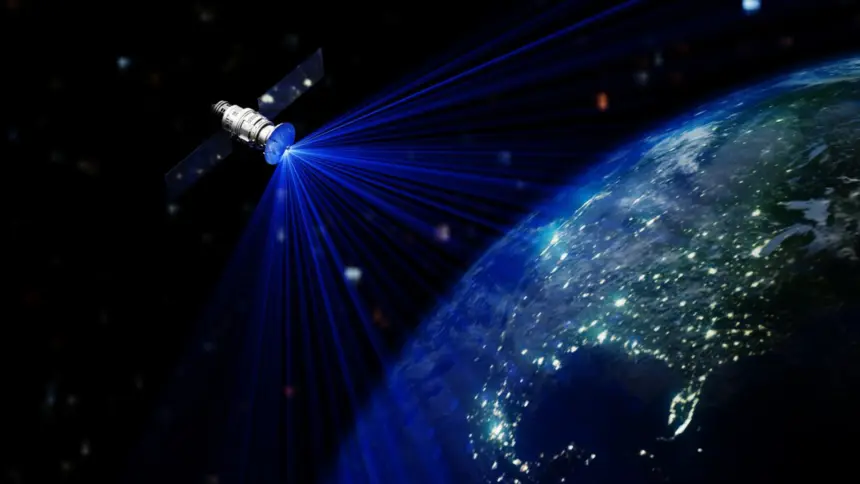
A Google space TPU has executed the company’s first orbital AI inference, generating text from an open-source Gemma 4 model aboard a prototype satellite in low Earth orbit. The spacecraft beamed the result to a ground station in Svalbard, Norway, on 30 October 2026, confirming that data-centre-grade accelerators can operate in space.
Key points
- Google ran its Gemma 4 language model on an orbital Tensor Processing Unit aboard the Project Suncatcher test satellite.
- The spacecraft carries four Google TPUs and a one-kilowatt power system, operating a single processor in 20-minute bursts.
- Pre-flight radiation checks at UC Davis showed the hardware can withstand cosmic rays equivalent to a five-year mission.
- Google plans to launch two interconnected satellites in 2027 to test high-speed optical links between orbital processors.
The Svalbard transmission
The test occurred during a routine ground-station pass over Svalbard, Norway. Flight controllers uplinked a prompt instructing the onboard Gemma 4 model to compose a haiku about its environment. The satellite processed the instruction on its custom accelerator before transmitting the generated lines back to Earth: “Blue marble below / Data streams in silent grace / Starlight feeds my core.”
Engineers followed the initial transmission with space-themed limericks and telemetry queries designed to inspect payload subsystems. Travis Beals, senior director of paradigms of intelligence at Google, detailed the result in a Google Research post, describing the transmission as the mission’s “Hello World” milestone. The event verified bidirectional communications and confirmed that the model weights loaded correctly into memory without corruption during launch.
SpaceX launched the test vehicle on 1 October 2026 aboard the Transporter-18 rideshare mission from California, carrying the Google payload alongside more than 100 commercial and research spacecraft. Satellite builder Planet assembled the bus, integrating Google’s processor tray into a standard small-satellite chassis. Ground controllers spent three weeks completing commissioning checklists, powering up host electronics and running diagnostic workloads before attempting model execution.

Power and thermal limits in orbit
Operating server-grade silicon in the vacuum of space presents physical constraints absent from terrestrial facilities. The prototype spacecraft carries four Google TPUs, but the electrical system limits operations to one processor at a time. Solar arrays provide approximately one kilowatt of electrical generation, which restricts active machine learning workloads to roughly 20 minutes before onboard batteries require recharging.
Thermal dissipation creates an equally demanding hurdle. In orbit, the lack of air prevents conventional convective cooling through fans or liquid loops routed to outdoor chillers. Heat produced by dense silicon dies can escape only through conduction and thermal radiation. Google addressed this by pairing heat pipes with external radiator panels designed to bleed thermal energy into cold space, validating the system in terrestrial vacuum chambers before launch.
Vibration profiles during ascent added mechanical risk. A launch to low Earth orbit subjects internal structures to sustained acceleration loads ten times the force of gravity, while individual chip assemblies experience transient shocks between 50 and 100 g. Google conducted three-axis shake testing to ensure circuit boards, solder joints, and optical interfaces could survive ascent aboard Falcon 9.
Radiation testing and silicon resilience
Radiation remains the primary operational threat to semiconductors operating outside the protection of Earth’s atmosphere. High-energy protons and cosmic rays can flip bits inside memory registers, corrupting calculation matrices or causing system panics. While terrestrial centres rely on parity checking and physical shielding, space systems must tolerate continuous particle bombardment.

Before flight, the engineering team tested Google Trillium TPUs under a proton beam at the University of California, Davis Crocker Nuclear Laboratory. Researchers ran machine learning benchmarks during active beam exposure to measure error rates. According to Google’s engineering disclosures, the processors sustained a total ionising radiation dose exceeding the exposure expected over a five-year operational mission in low Earth orbit.
Those laboratory tests revealed that AI inference handles radiation-induced faults far better than model training. A single flipped bit in an inference run may alter an individual token or slightly distort a vector calculation without crashing the underlying software stack. In contrast, training runs risk compounding numerical errors across backward passes, destabilising model parameters and ruining weeks of computation.
Why put data centres in space?
Google originally announced Project Suncatcher in November 2025 as a long-term research moonshot. The project examines whether vast arrays of solar-powered satellites could eventually bypass Earth’s land, water, and power bottlenecks. On Earth, commercial demand for high-density compute has pushed data centre operators to secure gigawatts of power, driving deals where OpenAI plans purchases of Google TPUs and cloud providers like Oracle expand cloud compute options across regional grids.
In low Earth orbit, satellites can capture uninterrupted solar energy without atmospheric attenuation, weather disruptions, or night cycles. In a behind-the-scenes engineering post, Google researchers noted that orbital platforms can capture up to eight times more solar power per square metre than land-based solar installations. Operating directly in orbit could theoretically allow large fleets to run continuous compute tasks without drawing on municipal electricity grids.
Hardware startups are pursuing parallel orbital concepts. Satlyt, an American startup founded by former Google and SpaceX engineer Rama Afullo, completed an in-orbit test earlier in October 2026 aboard three satellites running a simulated compute mesh funded by NASA. Other ventures, including Starcloud and Cowboy Space, are building dedicated inference satellites to process earth observation imagery directly in orbit, eliminating the need to downlink raw sensor data.
What comes next for Project Suncatcher?
Google researchers published the foundational physics and economic modelling for the initiative in the peer-reviewed journal Joule. The paper notes that large-scale deployment depends heavily on launch vehicle economics. Google calculates that realising cost-effective orbital clusters would require SpaceX’s fully reusable Starship vehicle to fly roughly 1,800 missions, reducing payload launch prices to levels where space-based capital expenditure rivals terrestrial builds.
Immediate engineering goals remain focused on hardware verification. Over the coming months, flight controllers will subject the single orbiting TPU to varied machine learning tasks across extreme temperature swings as the satellite passes in and out of Earth’s shadow.
The next major flight milestone is scheduled for 2027. Google plans to launch twin prototype satellites equipped with inter-satellite optical terminals. Those spacecraft will attempt to link multiple space TPUs across free-space laser beams, testing whether orbital nodes can share memory and divide complex computing jobs while travelling at 17,000 miles per hour.