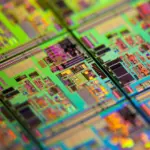
Toyota revealed a specialised physical AI chip on Tuesday that stores neural network model weights and its operating system directly on integrated memory. The automotive system-on-chip design aims to eliminate external memory transfer delays, providing faster and cheaper edge processing for autonomous and robotic vehicle systems.
Key points
- Toyota developed an automotive system-on-chip that keeps neural model weights and system software directly in integrated memory.
- Moving storage on-chip eliminates the latency and power costs associated with shuttling data across external memory buses.
- The architecture targets physical AI applications, where vehicles and automated machinery require immediate, deterministic local decisions.
The memory wall in physical AI
Physical artificial intelligence refers to autonomous systems that perceive, navigate and manipulate the real world. In cars, this involves constant inputs from cameras, lidar and radar sensors, which machine learning models process to calculate immediate driving actions.
Standard automotive computing platforms rely on external memory modules, such as dynamic random-access memory, to house large model weights. Every time an algorithm evaluates a frame of road data, the processor must pull gigabytes of numerical parameters across a motherboard bus.
That journey creates a bottleneck known in computer engineering as the von Neumann bottleneck. Accessing off-chip memory introduces latency and accounts for a significant portion of an autonomous system’s overall power consumption. In a car moving at motorway speeds, millisecond delays in computing sensor data can alter braking distances.

How integrated memory changes processing
Toyota’s system-on-chip sidesteps off-chip data transfers by placing both the model weights and the core operating system inside integrated on-die memory. The Register reported on 3 November 2026 that the carmaker developed the architecture as an economical, low-latency shortcut for physical AI processing.
Holding parameters directly alongside compute circuits shortens the physical distance electrical signals must travel from centimetres down to micrometres. This cuts the energy required per calculation and prevents the thermal spikes that occur when running demanding vision models at high frame rates.
Storing the operating system on the same integrated memory fabric also ensures predictable execution times. Automotive safety requires deterministic computing, meaning the software platform must guarantee task completion within strict deadlines regardless of background workloads.
Automotive power and packaging constraints
Data centres can manage heavy AI workloads using liquid cooling loops and power draws reaching multiple kilowatts per server rack. Road vehicles have no such leeway, operating instead under severe size, weight and power limits.

In battery electric vehicles, excessive power consumption by driver assistance computers directly reduces driving range. Cooling fans and large heat sinks also add weight, cost and mechanical failure points inside passenger compartments.
By fitting the operating system and model weights onto a single integrated die, carmakers can build smaller, sealed electronic control units. These units require less cooling, simplifying packaging in vehicle bulkheads and lowering assembly costs across volume production lines.
What happens next
Carmakers worldwide are shifting from off-the-shelf processing components to custom silicon tailored to their proprietary software stacks. Designing chips in-house gives manufacturers greater control over supply chains, software updates and safety margins.
Toyota has not yet published deployment schedules or stated which production vehicle platforms will first receive the new processor. Automotive silicon typically faces extensive validation programmes, including thermal shock tests and electromagnetic interference screening, before entering commercial fleets.