Google‘s energy leadership has warned that orbital data centres could cost up to 100 times more than terrestrial facilities, challenging Elon Musk’s assertion that SpaceX will deploy more artificial intelligence compute in orbit than on Earth by the end of 2028.
Key points
- SpaceX aims to launch its Starmind constellation of up to one million satellites starting in late 2027.
- Financial models show orbital deployment requires hundreds of billions in capital expenditure and hundreds of Starship flights.
- Google argues the logistical and operational overhead makes orbital compute up to 100 times more expensive than ground sites.
- SpaceX has already borrowed $40 billion to fund initial hardware procurements as it builds toward a 13-gigawatt target.
The technical clash comes as Musk intensifies his public push for space-based data processing. Writing on social media platform X, Musk claimed that “Terrestrial compute will be peanuts compared to orbital compute,” arguing that monthly orbital compute deployments will match terrestrial installations by the end of 2028 before outstripping them in 2029.
Google has pushed back directly against that timeline. The company’s energy specialists caution that the economics of putting heavy compute clusters into orbit remain deeply unfavourable compared to land-based facilities. While Google has tested orbital processing on a small scale, notably running inference tests with a Space TPU for Google Project Suncatcher, company analysts calculate that operating high-density AI clusters in orbit could multiply total costs by a factor of 100.
The Starmind constellation
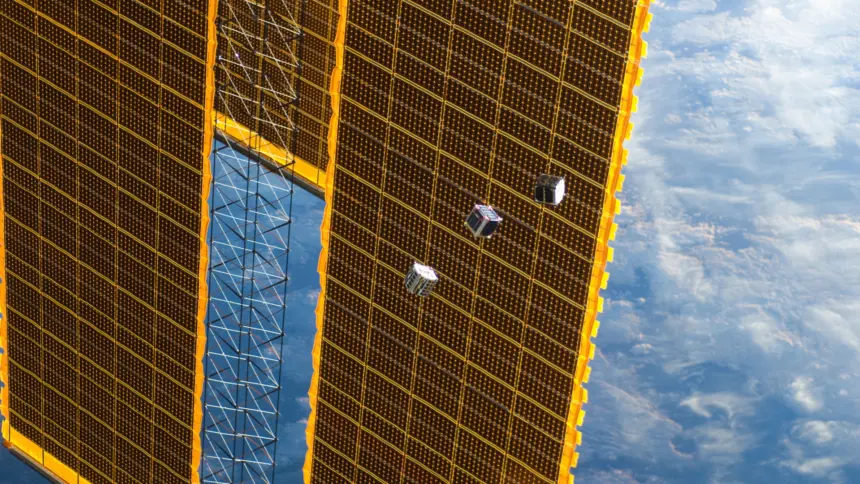
SpaceX’s orbital architecture relies on a planned constellation named Starmind. According to disclosures on SpaceX’s space safety page, the system envisions operating up to one million AI satellites. These spacecraft would operate in small clusters of approximately 10 satellites, interconnected by optical laser links providing roughly 10 terabits of bandwidth.

Musk stated that each individual Starmind spacecraft will generate more than 250 kilowatts of solar power. To manufacture the constellation at volume, SpaceX is preparing its Gigasat facility in Bastrop, Texas. The company plans to begin deploying thousands of production satellites from the facility as early as late 2027.
SpaceX frames this orbital push as a solution to terrestrial energy bottlenecks. Ground-based facilities face mounting grid constraints, cooling limits, and community disputes, seen in recent fights over xAI data centre expansion across the southern United States. Moving workloads outside the atmosphere offers unfiltered solar radiation and eliminates local land-use disputes, but it replaces them with thermal dissipation and radiation shielding problems.
How will SpaceX fund the orbital buildout?
Before SpaceX can put data centres into low Earth orbit, it must complete an enormous terrestrial expansion designed to generate the cash required for orbital launches. According to calculations by analyst Kyle Reidhead, SpaceX must deploy roughly $470 billion across the next five quarters to reach its planned infrastructure targets.
SpaceX disclosed on its third-quarter earnings call that it plans to reach 13 gigawatts or more of operational compute capacity by the end of 2027. It closed the third quarter with 1.7 gigawatts of nameplate capacity and guided capital expenditure for the fourth quarter to between $35 billion and $40 billion. Reidhead calculated that Nvidia will capture between 83 and 89 percent of that spending.

SpaceX executives insist the hardware will finance itself quickly. Chief financial officer Bret Johnsen said new compute hardware currently pays for itself in less than 12 months at prevailing market prices. Musk projected that this payback window could shrink to six months next year.
Based on that rapid return, Reidhead calculated that SpaceX could fund around $230 billion of the required $470 billion through operating cash flow. Another $60 billion could come from the company’s estimated $90 billion cash balance. That leaves roughly $180 billion in debt financing. Musk confirmed last week that SpaceX had closed a $40 billion debt facility to purchase GPUs, drawing scrutiny from institutional investors who have raised warnings over SpaceX debt expansion.
Launch capacity and Starship flight targets
The timeline for orbital compute depends entirely on the flight rate of SpaceX’s Starship rocket. A detailed financial projection published in modelling from Sequoia Capital partner Shaun Maguire outlines the steep operational ramp required between now and 2029.
Maguire’s model projects SpaceX capital expenditure climbing from $88 billion in 2026 to $290 billion in 2027, reaching $369 billion in 2028. Under Maguire’s projections, SpaceX would see negative cash flow of $77.8 billion this year followed by a $122.6 billion deficit next year, swinging into a positive cash generation of $114.9 billion in 2028. Responding to the projections, Musk wrote: “I think we can do better.”
The physical cadence is equally demanding. Maguire’s model assumes SpaceX will launch 250 Starship missions in 2028 to deliver Starmind hardware to orbit. That represents a dramatic escalation from two Starship flights conducted this year and the 38 flights projected for 2027.
SpaceX must also sustain rapid top-line revenue expansion to support the flight programme. The company guided revenue for the first quarter of 2027 to between $33 billion and $37 billion. That target represents more than double the $14.58 billion in revenue recorded during the third quarter of 2026.
Why orbital compute costs multiply
Google’s assessment that orbital data centres face a hundredfold cost disadvantage centres on operational reality rather than launch pricing alone. Terrestrial data centres benefit from standard commercial supply chains, ambient air or water cooling, and direct technician access for component repairs.
In orbit, hardware cannot be serviced once deployed. Every server rack must incorporate radiation-hardened components, structural reinforcement to withstand launch vibration, and redundant power systems. Because space is a vacuum, thermal management cannot rely on convection; heat must be rejected entirely through radiative panels, requiring massive surface areas that add weight and mechanical complexity.
Network topology adds further friction. Transferring petabytes of training data and synchronising distributed GPU memory states across satellite constellations requires constant laser inter-satellite links and heavy ground-station infrastructure. Ground facilities, by contrast, link directly into transcontinental terrestrial fibre networks with sub-millisecond latencies.
While Musk maintains that the economics will tip in favour of orbit as terrestrial power grids become saturated, the immediate test will be financial. SpaceX enters 2027 needing to double its quarterly revenues and execute dozens of Starship test flights before the first production Starmind satellite leaves the factory in Bastrop.