Ericsson has launched an Integrated Sensing and Communication platform designed to deliver wide-area 5G drone detection across existing commercial mobile masts. The Swedish telecommunications vendor announced the system following successful field trials with AT&T in Arlington, Texas, and parallel defence network experiments conducted with NATO forces across the Baltic region.
Key points
- Ericsson’s Integrated Sensing and Communication (ISAC) system allows mobile operators to track aerial objects alongside standard data traffic.
- A field trial with AT&T outside a Texas sporting stadium detected and tracked multiple drones operating between 300 and 400 feet.
- NATO independently trialled commercial 5G masts for passive airspace tracking during its DiBaX 2026 exercise in Latvia.
- Dual-use telecom sensing raises operational benefits for public airspace management alongside physical security risks for ground infrastructure.
How cellular masts become radar sensors
The new ISAC platform converts standard cellular base stations into distributed radar sensors. Instead of using cellular frequencies purely to transmit data packets to smartphones and modems, the hardware analyses reflected radio signals bouncing off solid moving objects in the surrounding airspace.
This dual functionality allows mobile operators to monitor airspace without deploying dedicated standalone radar hardware across metropolitan areas. The platform calculates the position, direction, and speed of objects moving across coverage zones, handling data processing alongside normal mobile traffic.
The system forms a foundational bridge between current 5G Advanced deployments and upcoming 6G standards, where sensing and communications are planned to function as a unified network layer across licensed spectrum.

Texas trial tests stadium airspace security
To demonstrate the platform in a municipal environment, Ericsson partnered with American operator AT&T near AT&T Stadium in Arlington, Texas. The test evaluated whether cellular equipment could secure complex low-altitude air corridors around crowded public venues.
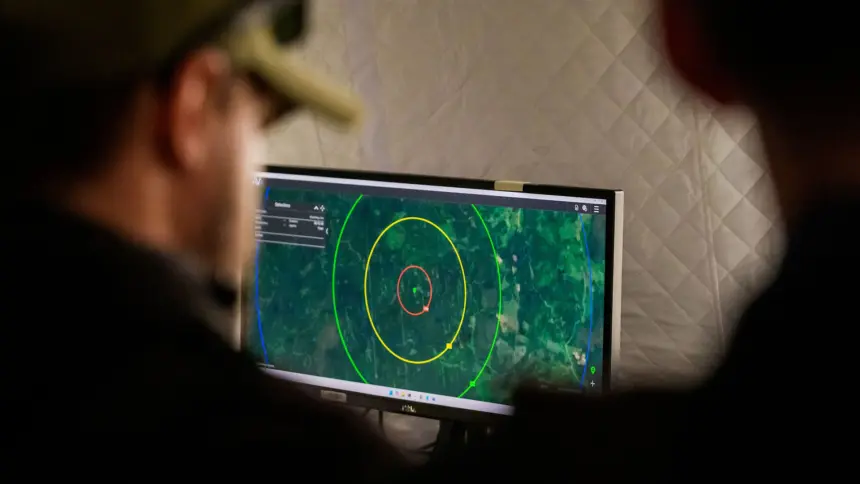
During the trial, AT&T and Ericsson configured local commercial transmitters to monitor the immediate airspace. The deployment successfully identified and located multiple airborne drones simultaneously, tracking their movement patterns within the venue’s coverage boundary.
The aircraft used in the Arlington exercise flew at altitudes between 300 and 400 feet, precisely the corridor where unauthorised commercial drones pose risks to public gatherings and commercial flight paths. Venue operators and local authorities currently rely on radio frequency sniffers or dedicated optical cameras, both of which face range limitations in dense suburban environments.
NATO trials 5G sensing on the Baltic frontier
Commercial mobile masts are also drawing strong interest from military planners seeking resilient airspace awareness. Between 19 October and 30 October 2026, NATO conducted the Digital Backbone Experimentation exercise, known as DiBaX 2026, in Latvia.

The allied exercise brought together military and technical specialists from the United States, Canada, Germany, Finland, Lithuania, and host nation Latvia. Engineers investigated whether passive signal interception across domestic 5G cellular towers could reliably spot incoming hostile drones across contested airspace.
Software integration for the exercise made extensive use of automated coding tools to bridge disparate military frameworks. Admiral Pierre Vandier, NATO’s Supreme Allied Commander Transformation, said: “It’s the first time that we have, for example, a Maven system that is speaking to a national system, and that has been fixed in hours with Agentic AI.”
NATO tested three distinct operational methods for extracting telemetry from commercial cellular grids. While alliance officials confirmed that several test configurations failed under field conditions, the broader trials demonstrated that widespread cellular towers could serve as an ad-hoc warning network against low-flying threats when primary radar installations are unavailable.
Commercial opportunities and infrastructure risks
For mobile network operators, ISAC capabilities offer an entirely new revenue stream outside saturated consumer data tariffs. Operators can licence low-altitude airspace monitoring services to municipal transport regulators, logistics companies managing automated delivery corridors, and private security teams protecting critical infrastructure.
The technology eliminates the prohibitive capital costs associated with erecting dedicated radar towers across thousands of square miles. By upgrading baseband software and radio units on existing masts, telecommunications providers can offer real-time tracking across entire urban centres.
This dual-use utility also introduces serious strategic vulnerabilities. Transforming commercial cellular masts into secondary air defence and surveillance assets makes mobile towers high-priority targets during armed conflicts. Neutral civilian infrastructure could face physical strikes or targeted electronic warfare attacks if opposing forces perceive domestic mobile networks as active battlefield sensor arrays.
Ericsson plans to roll out ISAC software updates to partner operators through phased network releases, while international standards bodies continue formalising joint communication-sensing specifications for global 6G roadmaps.