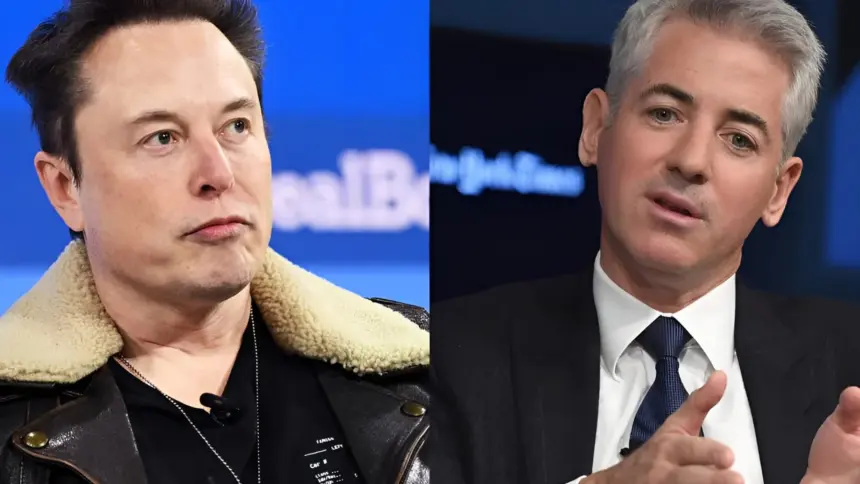
Hedge fund manager Bill Ackman warned that SpaceX AI compute ambitions could require the aerospace company to borrow up to $1 trillion in capital, speaking after Elon Musk detailed aggressive data centre expansion targets and long-term concepts for lunar-launched orbital computing clusters.
Key points
- Bill Ackman estimated that SpaceX could require $1 trillion in debt financing if it meets Elon Musk’s targets for tens of gigawatts of data centre capacity.
- SpaceX aims to reach up to 3 gigawatts of capacity by late 2026 before expanding towards a cumulative 20 gigawatts by the end of 2027.
- Ackman expressed confidence in well-capitalised hyperscalers but cautioned that debt-heavy neocloud providers face severe refinancing risks.
- Musk has separately floated deep space computing powered by lunar mass drivers to bypass terrestrial power constraints.
The price tag on 20 gigawatts
Ackman, the founder and chief executive of Pershing Square Capital Management, outlined his calculations during a discussion on the sustainability of the global artificial intelligence infrastructure buildout. While Ackman argued that corporate spending on machine learning infrastructure remains broadly justified by the economic value of artificial intelligence, he pointed directly to SpaceX’s capital requirements.
“If he meets his objective, he might have to borrow a trillion dollars of capital,” Ackman said, referring to Musk’s public projections for gigawatt-scale data centre deployments.
The $1 trillion estimate reflects an assumed cost of approximately $50 billion per gigawatt across SpaceX’s broader buildout. SpaceX intends to close 2026 with between 2.5 and 3 gigawatts of operational compute capacity. That deployment includes roughly 1.2 million Nvidia Blackwell graphics processing units earmarked for its Colossus 2 facility.

SpaceX is working to install an additional 13 gigawatts of capacity during 2027, which would lift its cumulative footprint to roughly 20 gigawatts. Independent financial estimates suggest SpaceX’s compute-related capital spending could reach $390 billion for the 2027 phase alone, implying an incremental cost closer to $30 billion per gigawatt rather than Ackman’s higher figure.
Tightening debt markets and neocloud risks
Ackman’s comments arrive as credit markets reassess capital commitments across the artificial intelligence sector. Musk recently claimed that commercial debt markets have curtailed lending to infrastructure businesses that lack steady revenues outside of AI data centres.
That credit pullback has already had operational consequences for specialist software providers. Developer platform Daytona.io said that an infrastructure supplier attempted to renegotiate an existing agreement and lending banks halved credit offers after Musk’s warnings circulated among financial institutions.
Ackman drew a sharp line between traditional balance-sheet leaders and independent GPU-as-a-service operators. High capital expenditures have already rattled public equity investors, a trend seen when Alphabet shares plunged as AI search and capital spending rattle markets earlier in the cycle.

“I worry more about the pure play neocloud companies that are a bit like highly levered real estate developers playing a theme,” Ackman said. He argued that hyperscale operators possess the balance-sheet depth and credit ratings required to weather higher borrowing costs, whereas smaller providers remain exposed to interest rate swings.
Orbital ambitions and lunar mass drivers
Beyond terrestrial data centres, Musk has argued that physical grid constraints on Earth will eventually force leading AI labs into orbit. Responding to economic modelling published by Sequoia Capital partner Shaun Maguire, Musk suggested that ground-based infrastructure cannot match extraterrestrial solar energy availability.
Musk claimed that deploying orbital computing platforms could generate petawatt-scale capacity over time. That would represent a massive leap beyond terrestrial energy generation, given that global human activity consumes around 20 terawatts of energy collectively.
Under the concept outlined by Musk, compute satellites would be assembled on the lunar surface and launched into deep space orbits using an electromagnetic track system. Escaping Earth’s gravitational pull requires a velocity of 11.2 kilometres per second, whereas departing the Moon requires just 2.38 km per second, dramatically lowering the propulsion energy required for heavy payloads.
Orbital computing is already seeing initial hardware trials. Researchers recently achieved a milestone when a Space TPU ran the first orbital AI inference for Google Project Suncatcher, proving that accelerators can operate in low Earth orbit despite radiation risks.
What happens next
Delivering 20 gigawatts of ground capacity by the end of 2027 will test private debt markets even if SpaceX avoids the full $1 trillion figure cited by Ackman. Investors will watch whether SpaceX turns to syndicated debt packages, commercial bond markets or equity sales across 2027 to finance its Nvidia processor orders and substation construction.