The UK’s Advanced Research and Invention Agency has selected Lumai optical servers to test rack-scale artificial intelligence inference inside commercial data centres, backing multi-node optical compute hardware across an initial deployment in Cambridge.
Key points
- Lumai Iris servers will form the first optical-compute deployment in ARIA’s £50 million Scaling Inference Lab.
- The hardware offloads large matrix calculations during the initial prefill phase of model serving using beams of light.
- Nonprofit operator CommonAI will evaluate complete rack performance under normal data-centre power and cooling conditions.
- Published figures show potential efficiency gains, but independent rack-scale benchmark results have not yet been produced.
The trial represents the first optical computing deployment inside the Scaling Inference Lab, a multi-year project backed by £50 million from ARIA. Run by CommonAI CIC, a Cambridge-based non-profit community interest company, the facility tests emerging computing designs under realistic data-centre conditions. Rather than bench-testing isolated silicon dies or optical chips, the lab builds complete, production-ready server racks to determine whether alternative architectures can cut running costs and power consumption across modern workloads.
Hardware developers have often struggled to move from laboratory demonstrations to working systems. An accelerator may process numbers quickly on a test bench, yet lose that advantage once engineers wire it into ordinary servers with standard network interfaces, thermal ceilings, memory buses, and software drivers. CommonAI structured its testbed to expose those real-world integration bottlenecks early.
How optical matrix computing works
Founded in 2021 as a spin-out from the University of Oxford, Lumai builds hybrid machines that split mathematical duties between optics and traditional electronics. Standard chips use transistor switches to execute arithmetic step by step. Lumai instead routes light through free space to execute dense linear algebra, which forms the overwhelming majority of computational work in large neural networks.

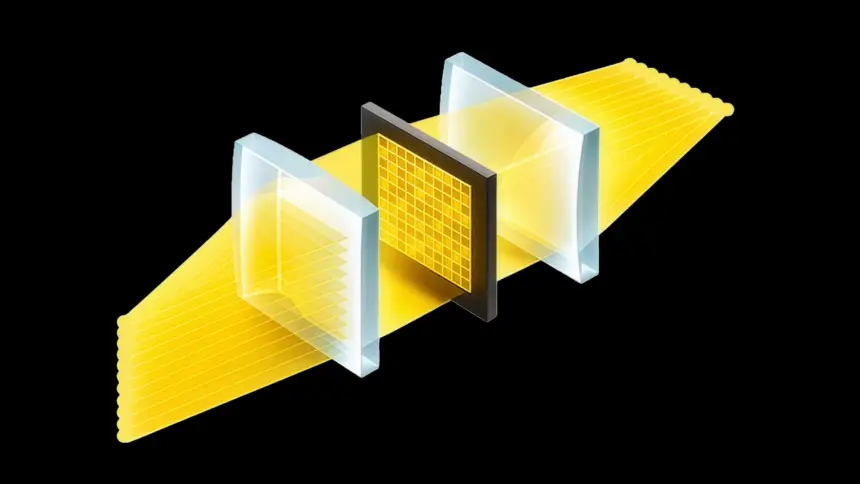
According to the company’s technical description, the processor converts incoming digital information into patterned beams of light. Those light beams travel through three-dimensional optical arrays that carry out parallel mathematical transformations simultaneously through physical propagation. Sensors then capture the resulting light patterns and convert them back into digital data for the rest of the server to handle.
This arrangement does not eliminate electrical power consumption. Every optical rack still relies on laser diodes, digital-to-analogue and analogue-to-digital converters, high-speed system memory, and standard digital host processors to manage system state and communications. The engineering challenge lies in keeping data conversion losses low enough that the optical core’s efficiency survives the transition.
To protect that efficiency advantage, Lumai built a wide data interface designed to distribute conversion overhead across very large batches of work. The system also pairs hardware-aware numerical quantisation with a three-tier memory architecture designed to hold the model’s key-value cache, preventing memory starvation while the optical engine runs.
Targeting the prefill phase
Large language model serving splits into two separate computational jobs: prefill and decode. Lumai designed its hardware specifically to accelerate the first half. In the prefill stage, an inference server ingests a user’s prompt or context document, generating internal key-value representations across all tokens simultaneously. This phase requires heavy matrix multiplications that saturate compute engines.

Once prefill finishes, the serving workload shifts into the decode phase. Generating output tokens one by one requires reading model weights and memory caches repeatedly, turning decode into a memory-bandwidth problem rather than a raw arithmetic one, particularly under smaller batch sizes. As national workloads shift toward serving models, industry tracking shows AI inference overtaking model training in total compute consumption, intensifying pressure on inference power budgets.
Rather than designing an accelerator for both jobs, Lumai positions its hardware within heterogeneous clusters. Detailed in Iris product documentation, the system acts as a dedicated prefill accelerator working alongside silicon-based processors that handle decoding. The product family uses standard server racks and direct air cooling, requiring no exotic liquid-cooling retrofits.
“Running a multi-node system in a commercial data center is where new compute architectures prove whether they are ready for real deployment,” said Xianxin Guo, Lumai’s co-founder and chief executive. The hardware evaluated by CommonAI builds on the Iris Nova platform launched in April 2026, which supports open-weights models including 8-billion and 70-billion parameter versions of Meta’s Llama series.
Inside the Scaling Inference Lab
The trial forms part of ARIA’s broader Scaling Compute programme, which funds unconventional computational models to circumvent the thermal and electrical limits facing silicon microelectronics. Researchers across the sector are pursuing alternative operating environments, from data-centre micro-architectures to experimental off-planet hardware such as the Space TPU orbital inference project.
ARIA aims to deploy a new experimental rack every six months through CommonAI. According to the nonprofit’s programme outline, the project plans to assemble more than five distinct rack-scale architectures. Each installation undergoes comparative benchmarking against commercial GPU and TPU systems, giving public and private developers transparent performance data.
Lumai has claimed that its optical technology can achieve up to a 90% reduction in data-centre energy consumption, total ownership costs roughly one-tenth of conventional GPU servers, and an eventual 50-fold performance increase. In company statements, pairing optical prefill with silicon decode demonstrated at least 16 times higher energy efficiency per inference request.
Those performance figures reflect internal engineering projections and narrow comparative conditions. ARIA’s trial will measure the complete system under shared benchmark regimes, tracking time to first token, sustained token throughput, total kilowatt-hours consumed per million tokens, and precision loss across long context windows. The first multi-node benchmark results from the Cambridge deployment are expected later in the year.