China Telecom, YOFC, and ZTE have completed a long-distance trial using hollow-core optical fiber, transmitting 800 Gb/s per wavelength in both directions across a single 1,007.48-kilometre link to achieve a total real-time capacity of 128 Tbps.
Key points
- The test achieved 800 Gb/s per wavelength in both directions across 1,007.48 km of hollow-core fiber.
- Total data throughput across the single-strand link reached 128 Tbps in real time.
- The project combined network engineering from China Telecom Research Institute, fiber fabrication from YOFC, and transmission hardware from ZTE.
- Hollow-core glass structures cut optical latency by around 30 percent compared with standard silica glass lines.
Breaking the 1,000-kilometre barrier
The field trial pushed hollow-core transmission past the 1,000-kilometre threshold on a single strand of fiber. Conducted jointly by China Telecom Research Institute, fiber manufacturer Yangtze Optical Fibre and Cable (YOFC), and telecoms equipment maker ZTE, the project demonstrated real-time transmission at high speeds without relying on parallel return lines.
Sending 800 Gb/s per channel bidirectionally across the same fiber core requires tight control over reflections and signal interference. In standard single-mode silica cables, bidirectional traffic can suffer from Rayleigh backscattering, where light reflects back into opposing channels and degrades reception. Hollow-core cables contain air or a vacuum rather than solid glass, which fundamentally alters how light interacts with the medium.
By achieving 128 Tbps of aggregate capacity over the link, the test showed that hollow-core architectures can support the dense wavelength division multiplexing (DWDM) schemes used in enterprise backbone networks.

How hollow-core optical fiber works
Standard telecommunications networks rely on solid silica glass cores. Light travels through solid silica at roughly 200,000 kilometres per second, roughly two-thirds of its speed in a vacuum. This physical limitation creates an unavoidable floor for latency across long-distance terrestrial routes.
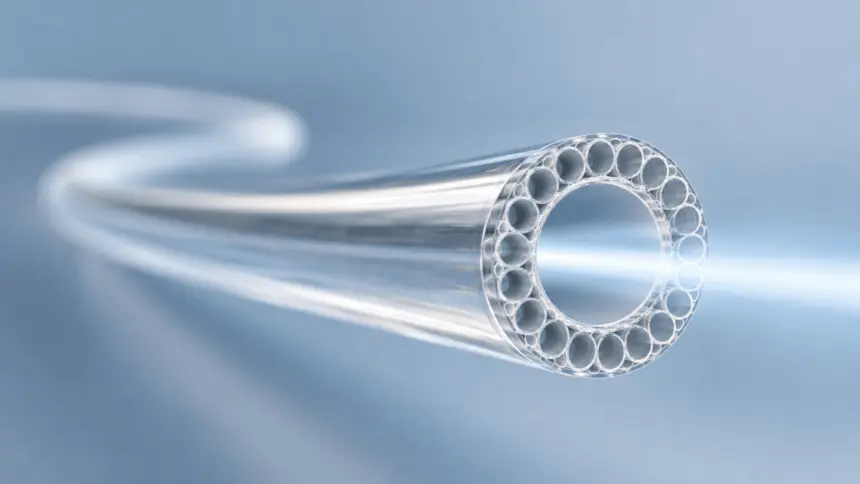
A hollow-core fiber replaces the solid glass centre with a structured micro-tubular air channel surrounded by a protective glass cladding. Light is guided along the air channel through anti-resonant reflection rather than total internal reflection. Because the core is composed of air, light travels through it roughly 30 to 40 percent faster than it does through glass, cutting transmission delays by roughly 1.5 microseconds for every kilometre traversed.
The hollow structure also removes the non-linear optical effects found in solid silica. In conventional cables, high laser power creates non-linear distortion, limiting how much optical power engineers can inject into a channel. Without solid glass in the beam path, hollow-core fiber tolerates higher optical power and offers wider operational spectrum windows.
The demand for low-latency optical backbones
Telecommunications operators and data centre providers are seeking new ways to support distributed artificial intelligence clusters and time-sensitive financial networks. Modern AI training workloads increasingly run across multiple regional data centres that must synchronise gradient updates with minimal delay. High-bandwidth connections that cut transit latency can improve cluster utilisation.

Standard silica fiber has reached physical thresholds where marginal improvements in transceivers yield smaller efficiency gains. Operators must install additional parallel cables or deploy expensive amplification to meet expanding bandwidth requirements. Hollow-core systems offer an alternative upgrade path by improving the underlying physical medium.
Until recently, hollow-core designs suffered from high attenuation and complex manufacturing processes, restricting deployments to short test links and niche financial trading conduits. Reaching 1,007 km indicates that optical loss rates in manufactured hollow-core strands have dropped to levels viable for national backbones.
Manufacturing and deployment hurdles
Despite the milestone, commercial deployment across national networks faces practical obstacles. Fabricating hollow-core preforms at scale requires precise geometrical uniformity across thousands of kilometres of draw towers. If the internal capillaries collapse or vary in diameter during drawing, optical loss increases sharply.
Splicing hollow-core fiber to existing solid-core equipment also presents mechanical challenges. Connecting an air-filled core to standard silica transceivers requires hermetic sealing to prevent dust, moisture, and ambient gases from entering the air channels. The joints must also manage the refractive index mismatch between air and glass to avoid damaging signal reflections.
YOFC, China Telecom, and ZTE have not disclosed commercial deployment timelines or the cost per kilometre of the specialized cable. The operators are expected to run further stress tests to evaluate long-term mechanical reliability and temperature stability under commercial field conditions.