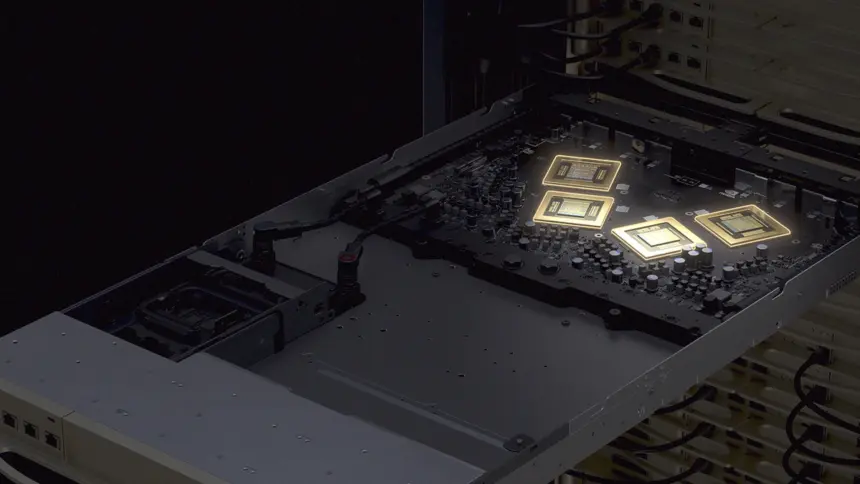
Nvidia is evaluating polytetrafluoroethylene, commonly known as Teflon, for use in its next-generation NVLink switch boards to counter severe signal degradation at speeds of 200 gigabits per second, Taiwan’s Commercial Times reported in late October 2026. The move aims to maintain data transmission across artificial intelligence server racks without relying entirely on complex copper cabling.
Key points
- Nvidia is testing polytetrafluoroethylene (PTFE) to curb signal attenuation on high-speed printed circuit boards running at 200Gbps per lane.
- The material could feature in Rubin Ultra switch trays or next-generation orthogonal mid-planes instead of external copper cable assemblies.
- Severe fabrication challenges keep current manufacturing yields below 5 per cent, according to industry sources.
- Supply chain partners across Taiwan, the United States, and China have acquired processing equipment, targeting potential deployment between 2028 and 2030.
The 200Gbps transmission problem
Modern artificial intelligence workloads require thousands of graphics processing units to share data across massive clusters. As per-lane data transfer speeds climb to 200Gbps, electrical signals suffer rapid degradation when traveling through standard circuit board substrates. Even minor impedance mismatches or physical interference can reduce data throughput across the cluster.
Hardware designers traditionally route high-frequency connections through thick bundles of copper twinaxial cables to bypass circuit board losses. While effective, cable assemblies add physical bulk, block cooling airflow, and raise assembly costs in dense server racks. Co-packaged optics, which replaces electrical connections with laser light directly at the chip package, remains several years away from widespread commercial readiness.
Because optical interconnects are not yet mature, improving the circuit board itself represents the most immediate path forward. Nvidia displayed its latest switch designs at the Open Compute Project Global Summit in early October, followed by material demonstrations at the TPCA Show in Taipei, where suppliers presented PTFE laminates as a potential alternative to conventional resins.
Why Teflon reduces signal loss
Polytetrafluoroethylene, best known as the non-stick coating on cookware, possesses an exceptionally low dielectric constant and minimal dielectric loss. These electrical properties mean the synthetic fluoropolymer absorbs far less electrical energy at high frequencies than standard board laminates.
Aerospace engineers and defence contractors have used PTFE for decades in satellite communications, military radar, and high-frequency automotive radar sensors. In those applications, antennas require pristine signal integrity across short, direct pathways. AI server clusters now operate in similar microwave frequency bands, creating identical transmission demands on internal server components.
Industry analysts point out that high-end AI boards are growing to more than 70 layers. Even top-grade conventional laminates, such as M9 hydrocarbon and modified polyphenylene ether materials, struggle to preserve signal clarity across those thicknesses at 200Gbps. Teflon offers the electrical headroom needed to allow direct high-speed routing on the printed circuit board rather than through external jumper cables.
Manufacturing bottlenecks and low yields
Despite its electrical advantages, PTFE introduces steep manufacturing penalties inside printed circuit board factories. The same non-stick qualities that prevent food from adhering to a frying pan prevent Teflon from bonding securely to copper foils and adjacent laminate layers.

Standard server circuit boards rely on epoxy or hydrocarbon resins that soften under heat, flow evenly across glass weaves, and adhere cleanly during lamination. By contrast, PTFE is mechanically soft, prone to deformation under pressure, and notoriously difficult to drill and plate. Creating microscopic through-holes across dozens of stacked layers often results in smeared material and broken electrical connections.
Industry estimates cited by the Commercial Times indicate that overall production yields for complex, multi-layer PTFE boards currently sit below 5 per cent. The material remains largely restricted to prototype sampling. The yield problem has generated open skepticism among established circuit board manufacturers. One industry executive questioned why the sector should adopt a material largely avoided by mainboard fabricators for 30 years, arguing that interest may simply stem from broader shortages of premium high-speed laminates.
Supply chain preparations for Rubin Ultra
Nvidia is reportedly considering PTFE integration for its Rubin Ultra switch boards as well as next-generation orthogonal mid-planes. An orthogonal mid-plane connects processor cards and switch modules directly at right angles, eliminating backplanes and extensive internal cable harnesses.
Suppliers are already moving to address the manufacturing barriers. Equipment vendors and printed circuit board manufacturers across Taiwan, China, and the United States have started securing specialised presses, laser drilling systems, and plasma etching tools tailored for fluoropolymer handling.
Component analysts expect fabricators will require at least two years to resolve the primary lamination and drilling bottlenecks. If production yields improve sufficiently to justify commercial volume, Teflon-based circuit architectures are projected to reach data centres between 2028 and 2030.