Nvidia is rolling out DLSS 5 neural rendering to several major PC titles this November, introducing 3D-guided artificial intelligence models and 6X multi-frame generation to increase frame rates and visual fidelity on its latest graphics hardware.
Key points
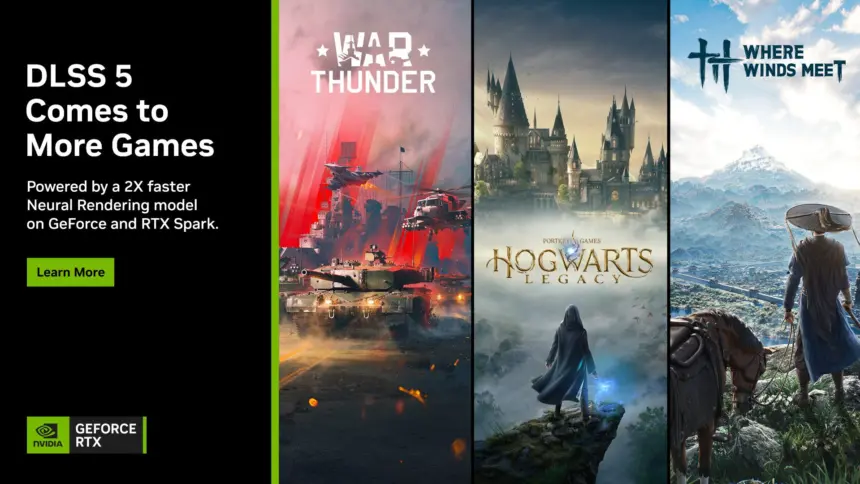
- Gaijin Entertainment will add DLSS 5 to War Thunder in mid-November alongside its Eagle’s Shadow content update.
- Avalanche Software is integrating the technology into Hogwarts Legacy this week, masking character faces to preserve artistic intent while enhancing lighting and textures.
- Everstone Studio will deploy DLSS 5 support to Where Winds Meet on 23 November, following player demand across its 100-million user base.
- Phantom Blade Zero developer S-GAME appears to have reconsidered planned DLSS 5 support, remaining on DLSS 4.5.
Three major titles gain neural rendering
Nvidia confirmed that three games will officially integrate the DLSS 5 suite during November. The rollout marks a wider deployment of the company’s 3D-guided neural rendering architecture, which uses spatial data from game engines alongside deep learning models to reconstruct imagery.
Gaijin Entertainment’s vehicular combat title War Thunder will receive the technology in mid-November through an update titled Eagle’s Shadow. The patch includes new aircraft, naval vessels, tanks, and visual improvements such as cluster munitions. With neural rendering, ray tracing, DLSS Ray Reconstruction, and 6X multi-frame generation running on the flagship GeForce RTX 5090, Nvidia said the game can reach up to 400 frames per second at 4K resolution.
In War Thunder, the neural rendering model targets highlights, shadows, surface materials, and microcontrast rather than animated human figures, reflecting the title’s mechanical focus.

Preserving artistic identity in Hogwarts Legacy
Avalanche Software is deploying DLSS 5 support to Hogwarts Legacy this week, making it one of the first narrative action titles to adopt the full feature set. The game already supported earlier iterations of Nvidia’s deep learning super sampling stack.
Studio engineers took a targeted approach to the implementation. Avalanche chose to preserve “character identity” by masking character faces out of the neural rendering pass. Instead, the AI model processes environmental scenery, cast shadows, character clothing textures, surface shading, reflections, and ambient lighting.
Nvidia stated that Hogwarts Legacy reaches up to 300 frames per second at 4K on the RTX 5090 with neural rendering, ray tracing, Ray Reconstruction, 6X multi-frame generation, and Reflex latency reduction enabled. Access to DLSS 5 in the title will be available across GeForce RTX 50 series desktop graphics cards, compatible laptops, RTX Spark desktop systems, and the GeForce NOW cloud gaming platform for Ultimate tier subscribers.
Rollout timeline and developer adoption
The third confirmed title for November is Where Winds Meet, the free-to-play martial arts game from Everstone Studio. The developer will push DLSS 5 support live on 23 or 24 November depending on the player’s territory, following requests from its player base, which recently passed 100 million registered users.

Not all planned integrations are moving forward on schedule. Action role-playing game Phantom Blade Zero, developed by S-GAME, was previously listed as a DLSS 5 title. Game director Soulframe Liang recently indicated on social media that the studio may have reconsidered the upgrade. S-GAME and Nvidia declined to comment on whether the project will adopt DLSS 5, leaving the game running on DLSS 4.5 Super Resolution alongside path tracing and Dynamic Multi Frame Generation.
Nvidia’s broader software ecosystem also saw updates for indie releases. Nacon launched Hunting Simulator 3 with support for DLSS Super Resolution, DLAA, Reflex, and Dynamic Multi Frame Generation. Early access co-op builder GRAVHOUNDS debuted with the same suite alongside native integration of RTX Dynamic Vibrance, an AI-driven filter designed to improve contrast and colour saturation.
The mid-November update to War Thunder will serve as the next benchmark for how the 6X frame generation algorithms handle fast-moving multiplayer combat.