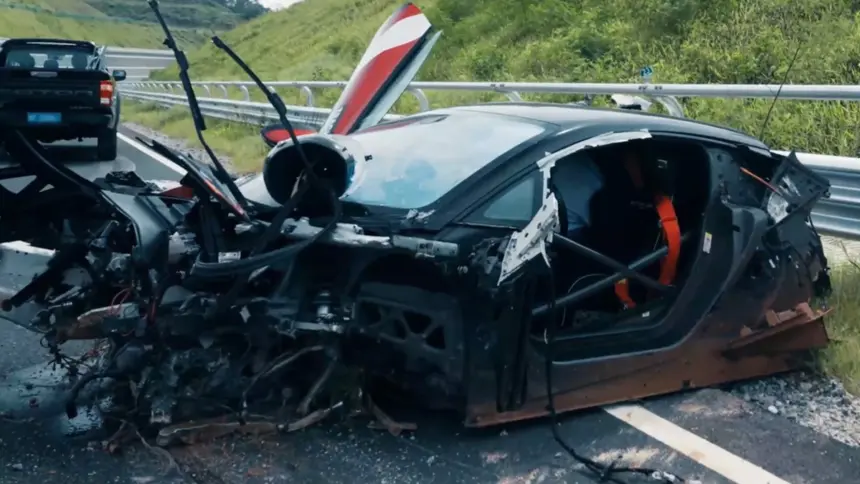
A prototype of the Yangwang U9 Xtreme, BYD‘s 2,977-horsepower electric hypercar, crashed at high speed during track trials in preparations to cross the 500 km/h (311 mph) threshold. The car struck a guardrail and spun across the track, but the carbon-fibre safety cell remained intact and the driver was discharged from hospital without serious injuries.
Key points
- BYD released video footage showing the Yangwang U9 Xtreme losing control while attempting a run above 450 km/h (280 mph).
- The driver suffered no major injuries after the vehicle’s carbon-fibre monocoque absorbed the impact against trackside barriers.
- Engineers achieved 457.89 km/h (284.5 mph) in a subsequent run as part of preparations for an official 500 km/h attempt in the United Arab Emirates.
- The track-focused hypercar runs on a 1,200-volt electrical platform with four electric motors spinning at up to 30,000 rpm.
What happened during the crash
Footage published on the BYD YouTube channel documents the development programme for the track-focused hypercar. The team ran three consecutive speed tests during the recorded session. The first trial passed 350 km/h (217 mph), and the second crossed 420 km/h (261 mph).
During the third run, as the vehicle attempted to exceed 450 km/h (280 mph), the prototype broke loose, struck the metal barrier and spun down the track. In-car cameras showed severe rotation while the outer body panels tore away from the chassis.
The impact crushed the front and rear crash structures. Despite the structural damage to the exterior, the central passenger compartment stayed intact. BYD reported that medical staff conducted a full hospital examination and found the test driver in good health.

The engineering behind the hypercar
The vehicle is an extreme variant of the commercial Yangwang U9 Xtreme, built under BYD’s luxury sub-brand. It uses the company’s proprietary e4 powertrain architecture, which assigns a dedicated electric motor to each wheel.
Together, the four motors produce nearly 3,000 metric horsepower (2,977 brake horsepower). BYD stated that the motor assembly is the first mass-produced system in the world rated to spin at 30,000 revolutions per minute. Power feeds from a 1,200-volt high-voltage electrical network, designed to reduce thermal strain and maintain current delivery during sustained acceleration.
To protect the driver at speeds approaching regional aircraft velocity, the chassis relies on a high-rigidity carbon-fibre tub. High-speed crashes expose electric vehicles to secondary risks, including battery cell rupture and electrical shorts. The survival of the passenger capsule without intrusion confirms that the structural composite met its core safety targets under violent deceleration.
Overcoming high-speed aerodynamic instability
The crash was not the only hurdle engineers faced during the vehicle’s development cycle. During initial testing in China, the car developed an aerodynamic wobble once speeds exceeded 400 km/h (253 mph).

Telemetry analysis helped BYD track down the source of the instability. Engineers discovered that external monitoring equipment attached to the body disturbed airflow at critical points across the bodywork. Removing those sensors eliminated the oscillation and allowed the vehicle to resume full-power acceleration runs.
The team returned to the circuit after the crash and completed a run at 457.89 km/h (284.5 mph). Jiang Gong, a test driver for the Yangwang programme, stated after the run that the car retains performance margin and that the team remains confident of breaking 500 km/h.
Chasing the production speed benchmark
BYD set an earlier benchmark with the model when it reached 496.22 km/h (308.4 mph) at the Automotive Testing Papenburg oval in Germany. That run surpassed the 304.77 mph recorded by the Bugatti Chiron Super Sport 300+ in 2019.
Data logged from the Papenburg run indicated that the driver still had approximately 1.5 seconds of usable throttle room before the braking marker. That margin convinced BYD executives that the car could cross the 500 km/h threshold under suitable atmospheric conditions.
Stella Li, executive vice president at BYD, confirmed earlier this year that the brand intends to push beyond 311 mph. High-speed testing of this calibre requires long stretches of uninterrupted tarmac. In 2017, Swedish manufacturer Koenigsegg used an 11-mile section of closed public highway in Nevada to set an average speed of 277.87 mph (446.97 km/h) with the Agera RS. BYD’s target would exceed that mark by roughly 13 per cent.
What happens next
BYD is preparing to transport its technical crew and updated prototypes to the United Arab Emirates later this month for the official speed trials. The company has not published the exact venue or date for the attempt, but team engineers are fine-tuning final gear ratios and tyre compounds for the desert run.