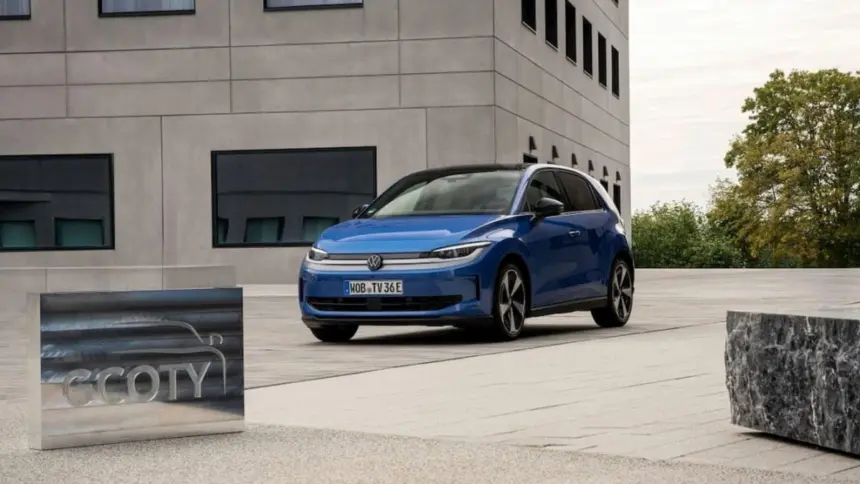
The Volkswagen ID. Polo has won the overall German Car of the Year 2027 award, beating vehicles across every price category after first winning its entry-level class. An international jury of nearly 50 motoring journalists selected the €24,995 electric hatchback in Germany on Tuesday following a sweep of all award categories by battery-powered models.
Key points
- The Volkswagen ID. Polo took the overall German Car of the Year title after winning the under-€25,000 entry category.
- Volkswagen has secured more than 50,000 orders for the model since sales opened in April.
- Electric vehicles won every category in the competition, mirroring a broader shift where the Car of the Year 2027 shortlist is entirely electric.
- The wider MEB+ small electric vehicle family has accumulated nearly 150,000 orders across four group brands since June.
How the ID. Polo took the overall title
The annual German Car of the Year competition evaluates new vehicles across five categories based on price, utility, and driving dynamics. The ID. Polo first secured top honours in the compact class for cars priced below €25,000 before progressing to the final round against winners from the commercial, premium, and performance brackets.
Jurors selected the entry-level hatchback over larger, more expensive vehicles from German and international manufacturers. The result marks the second consecutive overall victory for Volkswagen Group in the competition. Last year, the Czech subsidiary took the top spot with the Skoda Elroq compact sport utility vehicle.
Thomas Schäfer, chief executive of the Volkswagen brand, said the award confirms the vehicle’s role in the mass market. The entry-level car “brings electric mobility to where it can make the greatest impact: right into people’s everyday lives,” Schäfer said.
Volkswagen opened European order books for the ID. Polo in late April, initially offering the larger 52 kilowatt-hour battery variant. In July, the company introduced the base specification fitted with a 37 kilowatt-hour pack at €24,995, or roughly $28,000. Customer demand followed quickly, with Schäfer confirming that drivers have placed more than 50,000 orders for the hatchback since April.
Battery specifications, charging, and trims
The base ID. Polo relies on a 37 kilowatt-hour lithium-ion battery pack that delivers a driving range of up to 207 miles, or 334 kilometres, under the European Worldwide Harmonised Light Vehicles Test Procedure. Power output feeds the front wheels, shifting away from the rear-wheel-drive layout seen on larger models in the ID. family.
Charging speeds on the entry-level battery peak at 90 kilowatts on direct-current fast chargers. That rate allows the pack to charge from 10 percent to 80 percent capacity in approximately 23 minutes under typical conditions. For urban drivers and daily commuters, the charge rate provides around 140 miles of range during a standard motorway stop.
Volkswagen sells the 37 kilowatt-hour battery across multiple equipment lines. Beyond the base trim, buyers can select the Life and Style variants, which add comfort features, upgraded interior textiles, and advanced driver-assistance software. These higher specifications start at €29,195, equivalent to around $32,500.
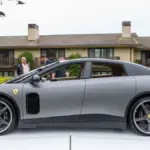
The car is also the first model to carry an established petrol nameplate into Volkswagen’s dedicated electric era. The design departs from earlier ID. vehicles, adopting what the company calls its Pure Positive design language. The styling brings back traditional exterior proportions, physical dashboard switchgear, and a horizontal front grille layout intended to recall classic generations of the Polo and Golf.
Electric sweep across all award categories
The jury’s decision on the ID. Polo reflects a clean sweep for battery-electric vehicles across every segment of the 2027 awards. Combustion engines and plug-in hybrids failed to secure a single class victory in this year’s voting.
In the compact class covering vehicles priced between €25,000 and €40,000, the Kia PV5 electric van took top honours. The victory highlights growing commercial interest in dedicated electric delivery and passenger platforms built with modular body sections.
The premium segment, spanning cars between €40,000 and €70,000, went to the Mercedes-Benz GLC Electric. In the high-end bracket, judges pointed to efficiency gains and improved software interfaces over earlier generations of German luxury electric vehicles. Hyundai secured the German Performance Car 2027 title with the IONIQ 6 N sports saloon, demonstrating that track-capable electric vehicles continue to win critical backing over traditional petrol saloons.
Martin Sander, sales chief at Volkswagen Group, said earlier this month that the manufacturer is “seeing a significantly accelerated trend towards all-electric vehicles” in Germany. The commercial performance of sub-€30,000 models suggests that high purchase prices, rather than consumer reluctance toward battery technology, had been the primary obstacle slowing European adoption.
The MEB+ platform and volume production
The ID. Polo is the lead vehicle in Volkswagen Group’s Electric Urban Car Family, an industrial project aimed at cutting the manufacturing cost of small battery-electric cars. The models use the MEB+ platform, an updated version of the group’s modular electric architecture that incorporates cheaper battery chemistries and consolidated electronic control units.
Series production across the small car family began in June. Alongside the ID. Polo, the lineup includes the Volkswagen ID. Cross crossover, the Cupra Raval hot hatchback, and the Skoda Epiq compact SUV. Together, the four vehicles have generated nearly 150,000 customer orders across Europe within five months of factory lines starting.
By sharing mechanical components, suspension hardware, and battery enclosures across four brands, Volkswagen aims to reach profit margins comparable to its petrol superminis. Factory tooling and component purchasing across Germany, Spain, and eastern Europe allow the group to spread fixed costs over hundreds of thousands of planned annual units.
The sub-€25,000 price point also positions Volkswagen against incoming competition from Chinese carmakers. Brands including BYD and Geely have targeted European urban buyers with compact models, prompting European manufacturers to accelerate development of smaller domestic platforms.
Market availability and international plans
Despite strong European reception, Volkswagen has no plans to sell the ID. Polo in North America. Low margins on subcompact cars, combined with consumer preference for larger utility vehicles and federal tax credit rules, continue to keep small European electric hatchbacks out of the United States and Canada.
American showrooms will instead receive larger battery-electric models. Volkswagen plans to introduce the ID. Tiguan in early 2027, replacing the ID.4 compact crossover. The electric Tiguan will offer more cargo room, higher battery capacities, and all-wheel-drive configurations suited to highway driving in North America.
Deliveries of the ID. Polo will expand across right-hand-drive and continental European markets through the remainder of 2026, with the 52 kilowatt-hour long-range variant leading initial showroom arrivals.