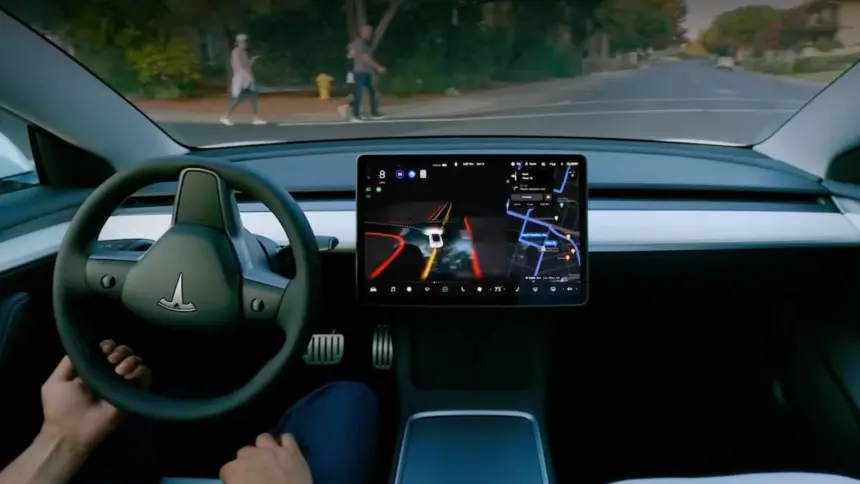
European regulators have curbed the Tesla Full Self-Driving speed margin from 50% to 10% above the posted limit, forcing the carmaker to rebrand the software as Tesla Assisted Driving across the European Union and the United Kingdom ahead of a decisive bloc-wide regulatory vote in December.
Key points
- The Dutch vehicle authority approved an over-the-air update that restricts Tesla’s driver-assistance speed tolerance to 10% above detected limits.
- The software setting now resets to zero each time the vehicle starts, and the Full Self-Driving name has been stripped from in-car screens and manuals.
- The concessions satisfy conditions set by Germany, but Sweden and France continue to raise safety objections over vehicles exceeding local limits.
- An EU technical committee will vote as early as December on whether to authorise the system across all 27 member states.
How the new speed cap works
The Netherlands vehicle authority, the RDW, confirmed on Tuesday that it has signed off on an update restricting how fast Tesla vehicles can travel when using automated steering and cruise control. Under the previous configuration approved by the Dutch regulator on 10 April, drivers could set the system to travel up to 50% faster than the detected speed limit.
That allowance let vehicles travel at up to 150 km/h on a 100 km/h motorway or 45 km/h in a 30 km/h residential street. Tesla argued the margin allowed vehicles to flow naturally with surrounding traffic. Regulators across Europe rejected that reasoning, warning that automated speeding created unacceptable hazards for pedestrians and cyclists.
Under the revised rules, the maximum speed offset cannot exceed 10% of the posted limit. The system also resets the margin to 0% at the start of every trip, meaning drivers must deliberately add any extra speed manually each time they turn on the car. The RDW said other speed-related functions are now turned off by default, though it did not detail which secondary features were restricted.
Tesla is distributing the changes as an over-the-air software update to European vehicles equipped with its Hardware 4 computer. The update modifies the software profile on the central display, the digital owner’s handbook and customer documentation.
Why the name changed
Alongside the speed limit cap, Tesla dropped the Full Self-Driving label across the continent. On in-car screens, websites and order forms in the UK and Europe, the system is now branded as Tesla Assisted Driving.
The change followed direct pressure from Germany’s transport ministry. Steffen Bilger, the German transport minister, backed legalising advanced driver assistance but stated publicly that the American brand’s original terminology was misleading to buyers. Bilger noted that the software remains a Level 2 driver-assistance feature under international automotive standards, requiring human drivers to monitor the road and retain full legal responsibility at all times.
The marketing shift also anticipates tighter British transport laws. Under the Automated Vehicles Act 2024, which comes into force on 7 January 2027, vehicle manufacturers in the UK cannot use words such as self-driving, automated or autonomous unless a vehicle meets strict statutory criteria. The Department for Transport confirmed that vehicles only pass that test if they do not require human supervision or manual intervention.
Opposition across European capitals
The RDW classified the software update as a minor modification within its existing type approval. The agency notified nine other member states that formally recognise Dutch vehicle certifications: Belgium, Croatia, Czechia, Denmark, Estonia, Latvia, Lithuania, Slovakia and Slovenia.
Securing broad access across the wider European market remains contentious. Approval across all 27 member states rests with the European Union’s Technical Committee on Motor Vehicles. The committee postponed its vote until December at the earliest, where passing the measure requires a qualified majority of at least 15 member states representing 65% of the EU population.
Several national delegations remain unconvinced by a 10% tolerance band. In June, transport officials in Sweden demanded that the EU reject Tesla’s application unless the carmaker eliminated speed offsets entirely. Swedish regulators argued that automated systems should never be permitted to breach statutory limits.
Safety advocates have pointed to real-world performance problems. In September, a pedestrian advocacy group in Brussels tested Tesla vehicles using the software in a country that had already accepted Dutch approval. The group recorded cars breaking speed limits along 55% of tested 30 km/h road sections, often caused by the camera system misreading signs or applying incorrect digital map data. French authorities cited those urban speeding infractions when refusing to accept the Dutch ruling.
What the decision means for European drivers
Tesla has long treated Full Self-Driving as a central commercial asset, charging US customers $99 a month for supervised versions of the software. In Europe, strict type-approval rules have kept those capabilities tightly constrained for years.
By agreeing to cap speeds and drop the self-driving label, Tesla secured Germany’s crucial backing for the upcoming European committee vote. German support provides substantial population weight in the qualified majority calculation, but resistance from France, Italy or Spain could still block approval if smaller member states side with Sweden’s zero-tolerance stance.
Domestic European manufacturers are preparing their own rival systems under conventional branding. BMW announced plans this week to introduce its Symbiotic Drive software in Germany early next year. The BMW system offers hands-on Level 2 assistance across motorways, country roads and urban roundabouts using interior gaze-tracking cameras and satellite navigation.
Tesla’s software update is rolling out immediately to supported customer cars in countries covered by the Dutch approval. The European Commission’s motor vehicle committee is scheduled to consider the revised software submission during its December sessions in Brussels.