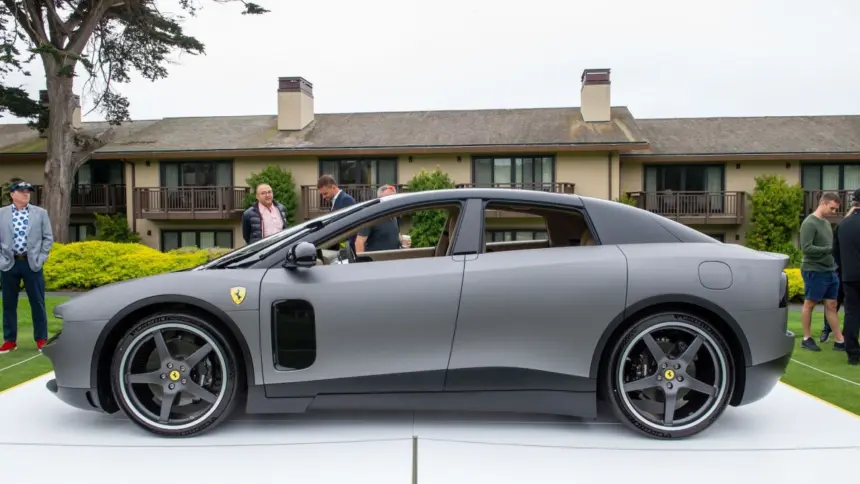
Ferrari has sold out the entire 2027 production run for the Ferrari Luce EV, its debut battery-electric model, chief executive Benedetto Vigna told investors on Tuesday. The $615,000 five-seater has secured full orders across next year despite facing widespread public mockery and a share drop when it was first unveiled in May.
Key points
- Ferrari confirmed its 2027 production run for the Luce electric vehicle is fully allocated, with new buyers facing at least a one-year waiting list.
- The five-seater grand tourer, styled by former Apple design chief Jony Ive, carries a starting price of roughly $615,000.
- Strong deliveries of custom vehicles and the F80 helped Ferrari lift its full-year earnings forecast above €3 billion.
- Ferrari has not published official volume figures, but earlier estimates put initial output at roughly 500 cars per year.
Buyer demand defies debut criticism
Speaking on the company’s third-quarter earnings call, Vigna said every Luce vehicle scheduled for manufacture in 2027 already has a confirmed buyer. The model represents Ferrari’s first commercial step into all-electric powertrains after decades of building high-revving petrol engines.
“If someone comes, he has to wait one year to get the cars,” Vigna said. Initial customer deliveries are scheduled to begin in the fourth quarter.
The strong order book contrasts with the reaction to the car’s initial reveal six months ago. Designed in partnership with Jony Ive, who spent more than two decades directing hardware design at Apple, the Luce drew heavy criticism from automotive enthusiasts for its subdued styling and five-seat cabin. The negative reaction briefly sent Ferrari shares lower on European exchanges.

Vigna declined to provide a detailed breakdown of customer profiles for the electric model. He dismissed speculation that orders were dominated by a single demographic, such as technology executives, describing the order sheet as a balanced spread across traditional collectors and new buyers across multiple continents.
Production targets and delivery timelines
Ferrari maintains tight secrecy over exact production volumes for the Luce. The company has never publicly disclosed the annual capacity planned for the model at its Maranello assembly lines.
Reporting by the Financial Times earlier this year indicated that Ferrari aimed to assemble just under 500 units during its initial manufacturing phase. The same report suggested a long-term goal of approximately 2,500 units by 2030, which equates to an average build rate of about 600 vehicles annually.
By limiting annual output to several hundred units, Ferrari protects the vehicle’s resale value and preserves exclusivity. The strategy mirrors the controlled delivery schedules used across the luxury vehicle sector, even as broader European electric vehicle registrations reach fresh volume records in the mass market.
Customisation fuels record margins
The update on the Luce came alongside strong financial results for the three months ending 30 September. Ferrari published its third quarter performance showing revenue rose 7% year on year to €1.9 billion, while net income climbed 13% to €431 million.
Operating profit reached €563 million, delivering an operating margin of 29.7%. That metric means Ferrari generated nearly 30 cents of operating profit from every euro of revenue, maintaining its position among the most profitable manufacturers in global industry.
Surging demand for personalised vehicle trims drove the expansion in earnings. Bespoke paint schemes, custom upholstery and interior modifications contributed more than 21% of total turnover from cars and spare parts during the period. Deliveries of the F80, the brand’s limited-run hypercar, also supported profitability alongside existing hybrid models.
On the back of these figures, Ferrari raised its full-year guidance. Management now projects adjusted earnings of at least €3 billion for 2026, an increase from its earlier target of €2.97 billion.
The luxury electric transition
Ferrari’s success in filling its 2027 order books demonstrates that elite vehicle manufacturers can persuade wealthy collectors to purchase electric models without traditional combustion noise. While mainstream automotive brands continue to balance pricing pressures and battery costs, high-end marques rely on exclusivity and bespoke styling to maintain pricing power.
The industry’s broader shift is visible across award panels as well, where competitions like the Car of the Year 2027 shortlist feature exclusively battery-electric candidates. For Ferrari, the Luce serves as the foundation of its electrification roadmap before additional zero-emission sports cars arrive later in the decade.
Ferrari will begin customer handovers for the Luce before the end of the year, with full-rate manufacturing across the sold-out 2027 allocation scheduled to start in January.