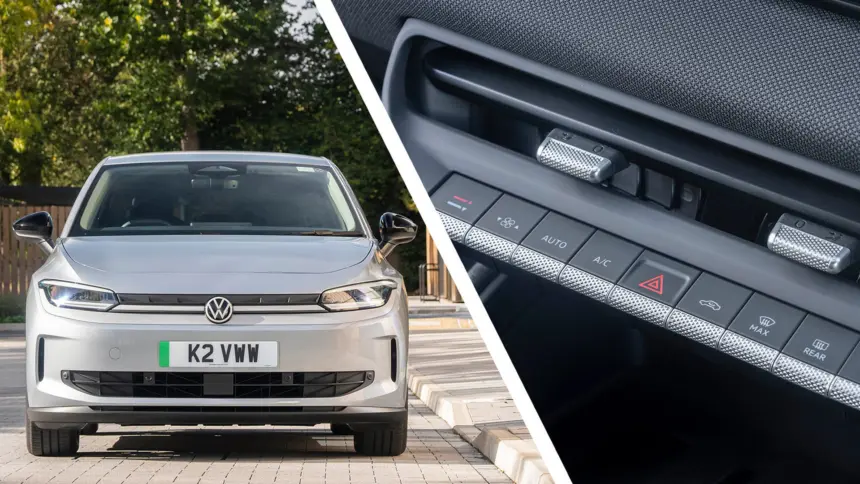
Volkswagen has launched initial press drives of its electric Polo, revealing a production-ready hatchback starting at roughly £24,000 that reinstates physical cabin buttons and offers up to 278 miles of range. The German carmaker showed the vehicle in Europe this week ahead of customer deliveries aimed at small-car rivals across Britain and the continent.
Key points
- The new supermini abandons the earlier ID 2 All concept name in favour of the Polo badge.
- Buyers can choose between a 37kWh lithium-iron-phosphate battery and a 52kWh nickel-manganese-cobalt pack.
- Physical switches return for window controls, climate settings, hazard lights and windscreen demisters.
- Prices will start at around £24,000, with Volkswagen targeting eligibility for the UK plug-in car grant.
Hardware and battery options
The vehicle sits on an updated version of the group’s MEB architecture, designated MEB+. Moving the wheels further into the corners gives the hatchback a shorter overall length than its petrol predecessor while increasing interior room.
Volkswagen offers two battery chemistries from launch. An entry-level 37kWh lithium-iron-phosphate pack delivers a claimed 208 miles of range. A larger 52kWh nickel-manganese-cobalt battery provides up to 278 miles between charges.
Motor outputs run from 116hp on entry grades to 211hp on top-specification versions. The most powerful variant covers the sprint from zero to 62mph in 7.1 seconds, placing performance on par with traditional warm hatchbacks.
Replenishing the battery relies on direct-current fast charging. The smaller pack accepts up to 90kW, while the larger unit peaks at 105kW. Volkswagen said a standard 10 to 80 per cent top-up takes approximately 25 minutes on compatible rapid chargers.
Restoring physical controls to the cabin
The interior design marks a direct retreat from the touch-only controls introduced on earlier electric models such as the ID 3 and ID 4. Motoring journalists and drivers had spent years criticising those cars for unreliable touch sliders, missing backlights and complex sub-menus.
In the new cabin, drivers get four separate physical window switches on the door armrest. That ends the contentious arrangement on earlier ID models that forced drivers to toggle a small selector button to operate rear glass.
A dedicated row of hard buttons sits beneath the 13-inch central touchscreen. These physical keys provide direct access to hazard lights, heating adjustments and front and rear windscreen demisters without requiring screen interaction.

Behind the steering wheel sits a 10-inch digital instrument cluster. Drivers can configure the display to mimic the analogue dials of the first-generation Golf, complete with simulated liquid-crystal display ghosting around the numbers.
Software features include native integration with OpenAI’s ChatGPT service to handle voice queries. Boot capacity stands at 441 litres, representing a 25 per cent increase over the petrol-powered Polo currently on sale.
Pricing against small European rivals
Volkswagen plans to sell the car from approximately £24,000 in the UK before incentives. The company hopes the entry price point will qualify buyers for the government’s £3,750 grant, potentially lowering transaction prices below £21,000.
That pricing strategy puts the model in direct competition with French and South Korean rivals. Renault recently began sales of its retro-styled 5 E-Tech, while Hyundai prepares to launch the budget-conscious Ioniq 3 in European showrooms.
The car also shares mechanical components with the upcoming Cupra Raval from sister brand SEAT. While the Spanish marque plans a firmer, sport-oriented setup, Volkswagen tuned the Polo for stability on motorways and everyday urban commutes.
Optional equipment moves beyond typical supermini specifications. Buyers will be able to specify massaging front seats, an amenity rarely found in small hatchbacks.
What the hatchback means for Volkswagen
The Polo badge carries significant weight for the brand. Volkswagen has sold more than 20 million petrol and diesel Polos worldwide over a production run spanning half a century.
Returning to proven nameplates reflects a wider strategic reset at company headquarters in Wolfsburg. Slow electric sales, complex software and intense Chinese competition have hurt group finances. The company recently paused plans for an electric Golf while working through restructuring programmes and factory cost cuts.
Senior managers intend to update existing models across the ID line-up with better charging software and physical interior switches. Future introductions will include high-riding ID Cross and ID Tiguan variants alongside performance GTI editions of the electric Polo and ID 3.
Volkswagen has not yet confirmed the exact date for first British customer deliveries, with production schedules set to follow European homologation early next year.