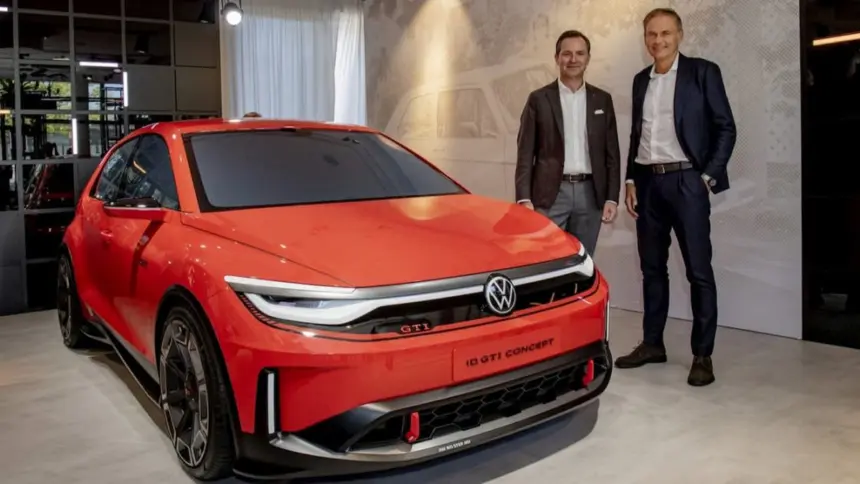
Volkswagen has paused development work on the upcoming electric Golf at its primary plant in Wolfsburg, Germany, following an after-tax loss of €5.8 billion in the third quarter. The automaker cited falling sales in China, tariff costs, thin electric vehicle margins and a massive write-down on its Porsche holding.
Key points
- Development of the ID. Golf is suspended at Wolfsburg as the plant faces a €300 million deficit against internal savings targets.
- Volkswagen reported a €5.9 billion operating loss for the third quarter, its worst quarterly performance since late 2015.
- The company faces a €6.4 billion impairment charge on Porsche, alongside collapsing vehicle deliveries in China.
- Management plans to cut up to 100,000 jobs and potentially close four factories in Germany under its broader restructuring effort.
Thomas Schäfer, chief executive of the Volkswagen passenger car brand, told staff in an internal memo on Friday that engineering work on the battery hatchback must stop. Reuters reviewed the memo, in which Schäfer explained that the brand cannot fund the project under current conditions.
“We simply can’t afford this work right now,” Schäfer wrote, describing the choice as difficult given the Golf’s central role at the company’s home factory. The Wolfsburg site is roughly €300 million short of its immediate cost-reduction goals, putting local development programmes under direct scrutiny.
What the losses mean for Volkswagen
The decision follows financial figures published on Thursday in the company’s nine-month results. Volkswagen posted an operating loss of €5.9 billion for the quarter, down from an operating profit a year earlier. Group revenue fell 6.3 percent to €75.3 billion as global vehicle deliveries slipped 14.3 percent to 1.89 million units.
A company spokesperson confirmed to Reuters that the quarterly loss was Volkswagen’s largest since the final months of 2015, when the group accounted for the costs of the diesel emissions scandal. Total one-off charges during the third quarter reached €7.8 billion.
A primary driver of the deficit was a €6.4 billion non-cash impairment charge on the group’s investment in Porsche. According to Volkswagen’s interim report, Porsche revised its long-term volume forecasts downward, lowering the carrying value of the luxury marque on Volkswagen’s balance sheet.
Margin pressure and the shift to electric vehicles
The manufacturer is also grappling with the economics of battery technology. Arno Antlitz, chief financial officer of Volkswagen Group, said in the company’s results release that electric models yield weaker returns than equivalent petrol and diesel cars.
“The market success of our electric vehicles is putting additional pressure on our earnings, as we currently earn less from electric vehicles than from combustion-engine vehicles,” Antlitz said.
The group’s commercial balance sheet shows that electric models now represent roughly 40 percent of its European order book. Yet profitability remains constrained by battery pack costs and industry price pressure, even as Volkswagen relies on those vehicles to meet regional fleet emissions rules.
International trade barriers have created further headwinds. United States import tariffs reduced operating profit by approximately €2.1 billion during the first nine months of the year, matching the tariff burden incurred during the same period in 2025. In the US market, Volkswagen’s electric car sales dropped 90 percent over the quarter.
Collapsing demand in China
Volkswagen’s difficulties have multiplied in China, historically the group’s most reliable profit centre. Third-quarter deliveries in the country fell 38.5 percent to 405,800 vehicles, according to official delivery figures.
Domestic Chinese automakers have expanded their market share through lower manufacturing costs, software integration and aggressive price cuts. In an interview with Handelsblatt, Ralf Brandstätter, head of Volkswagen’s China operations, said the market was no longer an engine of expansion for international carmakers.
Handelsblatt reported that Volkswagen now projects annual sales of roughly 2.2 million vehicles in China by 2030. That marks a sharp downgrade from a previous target of 3.2 million, and stands far below the peak period when the company delivered more than four million vehicles per year in the country.
Restructuring plans and the Golf timeline
The halt to Golf development fits into an aggressive retrenchment programme titled Future Plan 2030, which Volkswagen’s supervisory board approved in September. The plan aims to eliminate up to 100,000 jobs worldwide, trim vehicle variants, simplify management layers and shutter four production facilities in Germany.
The electric Golf, expected to enter showrooms as the ID. Golf, has faced prior revisions. Volkswagen initially intended to introduce the vehicle in 2028, but Schäfer confirmed earlier this year that the date had slipped closer to 2030. That delay stemmed partly from extended development work on the group’s Scalable Systems Platform, which incorporates software architecture developed with Rivian.
Despite the development pause at Wolfsburg, Volkswagen’s works council maintains that the factory will still meet the 2030 release schedule. Employee representatives said the lost engineering time can be recovered before mass assembly begins.
Production of the conventional, combustion-powered Golf is scheduled to transfer from Wolfsburg to Volkswagen’s plant in Puebla, Mexico, in 2027. For now, Volkswagen expects full-year 2026 revenue of roughly €315 billion, with an operating margin of up to 1 percent.