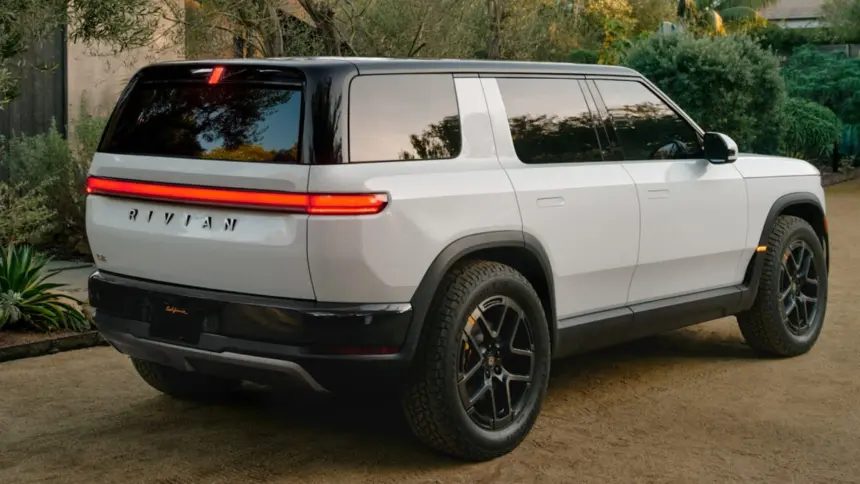
Rivian R2 sales propelled the electric vehicle manufacturer to a 38 percent rise in revenue during the third quarter of 2026, reaching $2.155 billion as the lower-cost SUV became the company’s top-selling model by volume just months after its launch.
Key points
- Rivian generated $2.155 billion in third-quarter revenue, up 38 percent from $1.558 billion a year earlier.
- The R2 SUV outsold the R1T pickup, R1S SUV, and commercial delivery vans to become the company’s volume leader.
- Deliveries rose 45 percent year on year to a record 19,248 vehicles, prompting Rivian to raise its full-year target floor to 67,000 units.
- Software licensing and joint venture revenue from Volkswagen Group generated $256 million in gross profit, offsetting vehicle production losses.
The R2 becomes Rivian’s volume leader
Rivian released its third-quarter financial results on 29 October 2026, confirming that its new mass-market vehicle has quickly reshaped its retail business. The R2 sport utility vehicle, which entered production earlier this year, surpassed Rivian’s more expensive legacy consumer lines and its electric delivery vans in unit volume during its first full quarter of deliveries.
Total deliveries reached 19,248 vehicles across all product lines during the three months ending 30 September, while production hit 19,751 units at the company’s manufacturing facility in Normal, Illinois. That represented an 85 percent jump in factory output and a 45 percent rise in customer deliveries compared with the third quarter of 2025.
While Rivian does not publish a model-by-model breakdown of sales figures, executive statements and shareholder letters confirmed the shift. RJ Scaringe, Rivian’s chief executive, said: “We had great results with R2 becoming our best selling vehicle by volume in the third quarter.”

Customer test drives expanded rapidly alongside vehicle output, rising to more than 103,000 during the third quarter, compared with 57,000 in the previous quarter. The company stated that customer conversion from early reservations for the initial launch edition trim remained above internal projections.
How automotive margins and factory costs shifted
Revenue from vehicle sales alone reached $1.550 billion, an increase of 36 percent over the previous year. However, bringing a new vehicle platform into high-volume manufacturing continues to exert pressure on automotive margins.
Rivian’s core automotive division recorded a gross loss of $80 million for the quarter. While that figure marked an improvement over the $130 million loss recorded in the third quarter of 2025, it widened from the $36 million automotive loss posted in the second quarter of 2026. Company filings attributed roughly $120 million in supplementary cost of revenue directly to the operational ramp of the R2 assembly line.
Excluding $81 million collected from regulatory emissions credit sales and an import tariff refund receivable, the underlying automotive gross deficit stood at approximately $161 million, or roughly $8,400 per vehicle delivered.
Despite the gross loss, fixed-cost absorption improved as the plant accelerated. Cost of goods sold per vehicle fell by more than $12,000 quarter over quarter, dropping to roughly $84,700 per unit in the third quarter from $96,700 in the second quarter. Because the R2 is priced below the R1 platform, average vehicle revenue excluding regulatory credits also fell, moving from roughly $85,000 to $76,300 per unit.
Software and the Volkswagen partnership
The company achieved an overall consolidated gross profit of $176 million for the period, compared to $24 million a year earlier, largely due to high-margin digital products and commercial architecture licensing.
Rivian’s software and services division reported $605 million in revenue, up 45 percent year on year, and generated $256 million in gross profit with a 42 percent profit margin. The primary contributor was the technology joint venture established with Volkswagen Group, which paid $354 million during the period for electrical architecture design and shared vehicle software development. Rivian anticipates booking quarterly payments under that agreement until roughly the middle of 2028.
Consumer software sales also increased. Customer subscriptions for the company’s Autonomy Plus driver-assistance software suite, launched in April, yielded recurring receipts, with adoption rates trending ahead of corporate forecasts.
Across all business units, Rivian recorded a quarterly net loss of $913 million, showing an improvement compared to the $1.2 billion net loss incurred in the corresponding period of 2025. Adjusted earnings before interest, taxes, depreciation, and amortisation (EBITDA) resulted in a loss of $435 million, outperforming Wall Street consensus estimates that projected a $576 million deficit.
Raising production targets in Normal
The manufacturing acceleration at the plant in Normal, Illinois, was supported by the launch of a second daily shift dedicated to R2 assembly. The higher factory cadence allowed Rivian to break past a multi-year plateau during which total annual shipments hovered near 50,000 vehicles.
With 41,807 vehicles delivered globally through the first nine months of the year, management updated its full-year guidance for financial markets. The low end of projected 2026 deliveries rose from 65,000 units to 67,000 units, maintaining an upper cap of 70,000. Reaching that goal requires delivering between 25,193 and 28,193 vehicles in the fourth quarter.
Rivian also improved its expected full-year adjusted EBITDA loss by $100 million at the midpoint, now guiding between negative $1.85 billion and negative $1.75 billion. Forecasted capital expenditures were lowered by $300 million to between $1.40 billion and $1.50 billion, an adjustment management described as an alteration in the calendar timing of construction disbursements rather than structural budget cuts.
Work continues on the company’s planned manufacturing site in the state of Georgia, where phase one is engineered to add 300,000 units of annual assembly capacity for R2 and R3 models.
What comes next for Rivian?
Rivian finished the third quarter with $5.502 billion in cash, cash equivalents, and short-term investments. Available liquidity stood at $7.095 billion when incorporating operational credit facilities and a $1 billion term loan funded by Volkswagen in October, following an equity raise of $1.5 billion completed in July. Free cash flow for the quarter was negative $1.124 billion.
The initial batches of the R2 entered the market in higher-specification trims priced close to $60,000. Rivian plans to begin deliveries of a Premium trim variant priced at $53,990 before the end of the year, followed by standard battery configurations in 2027 starting around $45,000.
On the automated driving front, Rivian is preparing an invitation-only early access release of its point-to-point driving software later this year, with broader distribution to Autonomy Plus subscribers scheduled for 2027. The company is scheduled to host an investor presentation dedicated to artificial intelligence and autonomous features on 9 December 2026, alongside an anticipated corporate milestone with Uber expected before the year ends.