Nvidia announced on 3 November 2026 that it is expanding deployments of urban digital twins and agentic AI systems across municipal governments worldwide. The rollout connects sensor feeds, traffic cameras and civic planning models in cities across Europe, Asia and North America while keeping municipal data hosted on local infrastructure.
Key points
- Nvidia and software partners are deploying vision agents and digital twins across cities in Spain, Poland, Malaysia, Taiwan, Morocco and the United States.
- Municipalities are using local GPU clusters to operate traffic control networks, public interactive kiosks and environmental planning engines without relying on remote cloud centres.
- Urban planning models developed in Taiwan and the Netherlands can simulate 15 years of tree canopy growth in 10 minutes to test civic heat mitigation.
- Traffic management operators in Malaysia are using vision models across thousands of cameras to cut peak-hour corridor transit times by up to 26 per cent.
Public kiosks and municipal administration
The push broadens Nvidia’s physical AI portfolio from private industrial facilities into public sector infrastructure. The company announced the global expansion at the Smart City Expo World Congress in Barcelona, building on preliminary European municipal programmes unveiled earlier in autumn.
A central component of the rollout involves interactive agent systems placed directly in public facilities. In the San Francisco Bay Area, software firm LiveX announced its AI City platform, which deploys full-sized conversational kiosks at more than 100 venues. The installations include San José Mineta International Airport, El Camino Hospital and the SAP Center, as well as local retail sites and hotels.
LiveX runs these physical agents on Nvidia RTX PRO 6000 Blackwell Server Edition hardware. The kiosks use Cosmos world foundation models and fine-tuned models from the Nvidia Nemotron family. An orchestration layer called Lyra coordinates 3D wayfinding maps, spoken multilingual translation and automated service requests.

In Spain, software company 1MillionBot has placed municipal service agents across more than 150 regional public deployments. The systems serve Madrid Digital and the open administration service of Catalonia, Administració Oberta de Catalunya. The agents link open-source ALIA language models developed by the Barcelona Supercomputing Center with Nemotron models to schedule municipal appointments, process administrative paperwork and record street-level maintenance incidents.
Traffic management and operational vision
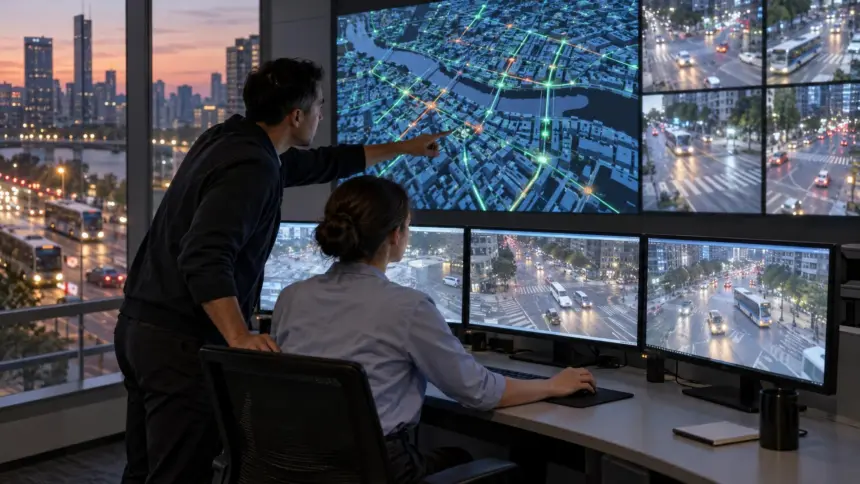
Beyond public-facing desks, municipal authorities are directing visual models at existing transport networks. Rather than installing entirely new sensory hardware, these deployments connect video reasoning models directly to existing street and junction cameras.
In Malaysia, smart city infrastructure firm ITMAX provides managed AI services for municipal traffic systems. The company is scaling its SamurAI V2 vision agents on local Nvidia RTX PRO 6000 servers to monitor more than 17,000 public cameras by 2027. ITMAX connects the video streams to an open-source traffic simulation platform called TeraSim, developed by Laplace Intelligence.
By running live visual feeds against simulated signal changes, the system adjusts junction timings across major transport arteries. Field testing reported by the company demonstrated reductions in peak travel times of up to 26 per cent along monitored road corridors. These high-density vision pipelines mirror technical patterns seen in transport logistics, where companies deploy large-scale AI agent tool integration to balance computing loads across municipal edge servers.

In Poland, system builder K2K has established shared computing infrastructure for the city of Wrocław. The setup uses the Nvidia Metropolis blueprint for video search and summarisation alongside Cosmos reasoning models. Municipal staff use the pipeline across multiple emergency and transit services, searching real-time video feeds to identify road hazards, monitor public gatherings and coordinate dispatchers during disruptions.
Simulating urban infrastructure with digital twins
The expansion also targets long-term civic planning through high-fidelity simulations. Municipal planners are constructing spatial models to evaluate building projects, flood mitigations and heat-reduction plans before ground is broken.
In Taiwan, spatial analytics specialist Linker Vision released its Linker AI Nexa system to connect city sensors directly to municipal standard operating procedures. The platform processes inputs through four stages: sensing conditions, predicting developments, deciding actions and triggering connected systems.
Working alongside Dutch architecture firm MVRDV, Linker Vision developed environmental planning models for Taipei using Omniverse digital twin libraries and Nemotron reasoning engines. The system simulates 15-year growth cycles of urban tree canopies, projecting shade cover and ambient ground temperatures within 10 minutes. The automated simulation cut design review cycles from roughly two weeks to under an hour. The companies have begun exploring similar municipal deployments across Berlin, Dublin and cities in the Netherlands.
Industrial operators are adopting the same simulation architecture to protect energy assets adjacent to urban populations. At the Dangote Lekki refinery in Nigeria, Honeywell Technologies is deploying its Forge Plant Cognition system on Dell PowerEdge servers equipped with Nvidia RTX PRO accelerators. The platform uses Nemotron agents to parse sensory operational data and flag bottlenecks, while an Omniverse-based operational twin runs training simulations for facility managers.
Shared computing and local data control
A recurring priority across these city contracts is sovereign data management. Local authorities face strict statutory limits on exporting citizen surveillance, facial imagery or transit patterns to commercial cloud providers operating outside their legal jurisdictions.
To address those restrictions, cities are installing shared on-premises computing clusters rather than routing feeds to distant facilities. In Morocco, technology provider Cires Technologies is expanding a sovereign AI installation at the Tanger Med port. The local cluster hosts dedicated applications for port worker safety, container freight routing and access gate congestion, while providing compute capacity for nearby municipal developers.
In Spain, the Barcelona Supercomputing Center has expanded its AI Factory Accelerator Programme from an initial pilot to full operation. The project provides European startups with access to sovereign high-performance computing, technical validation and training datasets for civic applications covering agriculture, healthcare and speech processing.
As autonomous vehicles and commercial robotaxi networks expand across major metropolitan areas, city administrators face mounting pressure to standardise the data models that interpret street-level traffic. Nvidia plans to demonstrate its urban digital twin workflows through 5 November at the Smart City Expo World Congress, where company executives will present technical reference architectures to regional municipal directors.