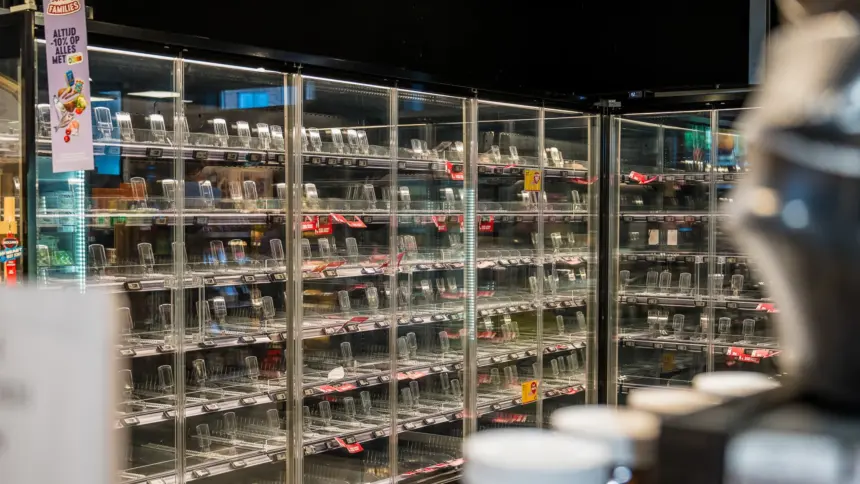
Refrigeration cyberattacks have disrupted Britain’s meat processing industry, a senior cyber security official confirmed on Tuesday, marking an escalation in industrial tampering that has already spoiled food across mainland Europe. Intruders remotely manipulated commercial temperature settings, leaving chillers running hot and forcing food operators to scrap perishable inventory.
Key points
- A senior UK cyber security official confirmed that digital intrusions have targeted domestic meat processing facilities.
- The incident follows widespread refrigeration disruptions across supermarket chains in Belgium, France, Sweden, Ireland, Finland, Luxembourg and Estonia.
- Attackers raised chillers to temperatures as high as 50°C by abusing exposed remote-management controls on the public internet.
- Security specialists believe the absence of ransom notes points to deliberate disruption rather than financial extortion.
UK meat processors hit by cooling sabotage
The campaign against European food distribution has moved up the supply chain. Sky News reported on Tuesday that Britain’s meat processing sector suffered cyber attacks, shifting the threat from grocery retail aisles directly into wholesale production centres.
A top cyber security official verified the incidents to the broadcaster. The disclosure confirms that the sabotage is no longer restricted to consumer-facing shops, threatening production lines where bulk meat requires continuous, strict climate controls.
Industrial cold storage units in processing abattoirs and packaging plants operate under narrow safety margins. Any sudden loss of chilling capacity ruins raw product rapidly, creating acute supply delays and heavy commercial write-offs for processors.

The British incident follows earlier disruptions in which a refrigeration cyberattack spread across European grocery chains. It signals that industrial control systems across the entire supply chain share identical digital vulnerabilities.
Supermarket freezers heated to 50°C
The extension into British processing follows days of chaos in Continental supermarkets, where hackers repeatedly took control of commercial chillers. Intruders altered settings to raise internal temperatures sharply, with at least one shop recording heat levels reaching 50°C.
Dutch supermarket group Ahold Delhaize reported disruptions across dozens of its Delhaize branches in Belgium and Luxembourg on Monday. The company had to throw away large amounts of spoiled fresh and frozen goods before restoring normal operations.
Belgian group Colruyt confirmed that five of its Spar shops suffered intrusions. French grocery giant Carrefour told the BBC that 15 of its Belgian branches were hit, while competitor Intermarché reported that 15 of its 153 Belgian locations experienced system interference.

An Intermarché spokesperson told CNBC that rapid containment measures prevented severe damage at most of its stores. However, the spokesperson said a few locations lost stock, adding that the bulk of Monday’s activity targeted larger rivals such as Carrefour and Delhaize.
Furniture retailer IKEA also suffered an intrusion at its Mons store in Belgium between Sunday and Monday. The company inspected refrigerators and freezers across its Swedish Food Market and in-store restaurant while auditing systems at other Belgian branches.
The pattern quickly widened beyond Central Europe. Sweden’s largest supermarket operator, ICA, confirmed incidents at a limited number of shops operating on networks separated from the company’s central systems. Disruptions also hit Finnish retailer Kesko, Irish grocer Supervalu, and Estonian food chain One Selver, echoing earlier breaches when attacks struck six European nations.
From US military commissaries to French stores
The wave of cooling failures began months earlier in military infrastructure. In late August, commissaries at six United States military bases suffered severe freezer malfunctions.
The Pentagon opened an investigation into those incidents as suspected digital sabotage, coordinating its inquiry with French authorities. In one American military commissary, intruders forced temperatures up overnight, leaving large stores of frozen food melted and inedible by the morning.
By mid-October, the sabotage hit civilian retail in France. Hundreds of French supermarkets suffered remote thermostat resets that triggered spoiled stock and occasional electrical fires. Intermarché’s parent group, Les Mousquetaires, estimated its financial damages reached several million euros.
The French incidents raised alarms at the highest levels of European policy. European Commissioner for Agriculture and Food Christophe Hansen said on X that “the weaponization of food has become a reality.”
The widening attacks showed how automated tools allow intruders to strike multiple targets simultaneously. Bjorn R. Watne, the global chief information security officer at Interpol, told CNBC that “it’s an evolution and not a revolution” as automation widens the reach and speed of hostile campaigns against distributed infrastructure.
Exposed control units left unpatched
Security researchers trace the intrusions to basic security lapses in commercial cooling hardware rather than novel software exploits. Many refrigeration units rely on external controllers connected directly to the open internet for remote servicing.
Fredrik Blix, a strategic cybersecurity advisor at Visente AB, said the attacks relied on simple methods. Control hardware sat on public networks with default or easily discovered manufacturer logins that researchers had documented publicly as early as August.
Although the hardware vendor issued a security patch in August, thousands of industrial chillers never received the firmware update. Older control hardware cannot receive software patches at all, leaving operators with permanently insecure internet connections.
France’s national cyber agency, CERT-FR, advised industrial operators three weeks ago to isolate refrigeration control systems from the public web. Blix pointed out that many service suppliers and maintenance firms failed to take those systems offline following the French alerts, leaving facilities exposed.
Similar administrative oversights occurred during earlier cooling breaches in Belgium and Sweden, where stores on isolated regional network setups lacked centralised security oversight.
Absence of ransom points to political motives
Unlike standard criminal cyber operations, the attackers made no ransom demands and published no extortion messages. Investigators say the lack of financial demands distinguishes this campaign from typical ransomware crews.
Cyber security analysts consider two main motivations. Perpetrators may be testing offensive capabilities against critical food infrastructure, or attempting to cause logistical friction and public anxiety across European countries that support Ukraine.
Digital safety agencies are now urging all food storage operators, abattoirs, and retail chains to audit their physical plant controls immediately. Engineers are disconnecting remote cooling management units from external networks to prevent automated scripts from locating remaining vulnerable chillers.