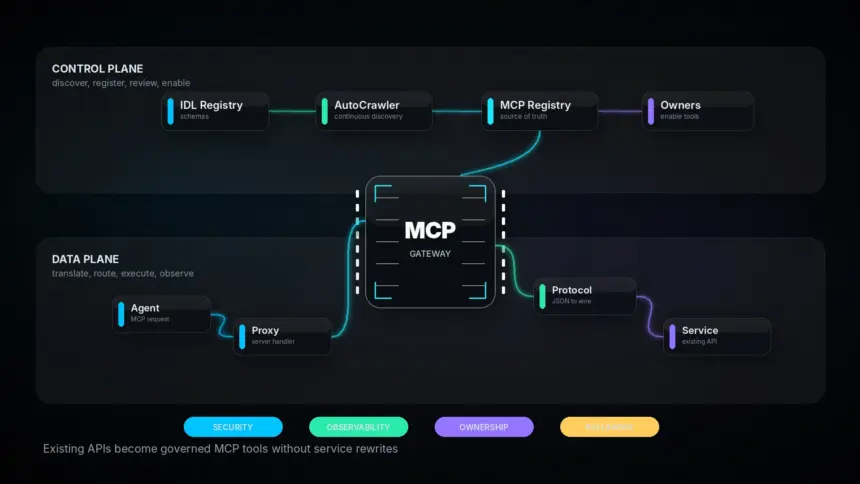
Uber has deployed an internal platform named the Uber MCP Gateway to govern how automated AI agents interact with corporate software infrastructure across its network. Introduced in November 2026, the technology connects autonomous models to more than 800 Model Context Protocol servers and 5,000 engineering tools without altering existing backend microservices.
Key points
- Uber deployed an internal gateway linking autonomous AI agents to over 800 MCP servers and 5,000 corporate software tools.
- The system decouples control-plane registry functions from runtime data translation across gRPC, TChannel and HTTP protocols.
- An automated crawler extracts API schemas to generate tool definitions, employing language models to draft plain-text descriptions.
- Selective search and field projection mechanisms prevent oversized tool catalogs from overwhelming model context windows.
Bridging agents and internal microservices
As engineering organisations deploy autonomous models to write code, triage infrastructure alerts and update database records, integrating those models into legacy networks creates acute operational friction. Individual development teams often write custom communication scripts, build duplicate service connectors, and apply inconsistent access controls. Uber designed its gateway layer to solve those discrepancies by funneling model requests through a single governed entry point.
The system builds on Anthropic’s open Model Context Protocol, widely known as MCP, which creates a standardised format for language models to retrieve external information and trigger programmatic actions. Rather than forcing service owners to modify existing codebases to support this format, Uber built an intermediary architecture that converts standard application programming interfaces into tools that reasoning models can read and execute. Similar patterns have emerged across large infrastructure providers, such as systems where Tencent Cloud AI agents create thousands of databases to absorb rapid operational expansion.
Uber separated the platform into two primary components: the MCP Registry and the Proxy Gateway. The registry functions as the control plane. It holds tool definitions, schema data, ownership records and enablement statuses. The proxy gateway operates as the data plane, managing live traffic between calling software agents and internal infrastructure. When an AI agent submits an action request using MCP JSON-RPC conventions, the proxy converts that payload into HTTP, gRPC or Uber’s internal TChannel protocol before directing it to the correct destination.

After the target microservice processes the call, the proxy converts the output back into an MCP-compliant response and returns it to the agent. This design ensures that product teams do not need to rebuild or redeploy production services to make their capabilities available to machine agents.
Automating tool discovery with AutoCrawler
Cataloguing thousands of internal services by hand would require unsustainable engineering labour. To populate the registry automatically, Uber built an ingestion tool called AutoCrawler on top of the open-source Cadence orchestration engine. The crawler systematically reviews internal interface definition language repositories, extracting existing API declarations written in Protocol Buffers and Apache Thrift.
After parsing those schema files, AutoCrawler converts them into structured tool definitions compatible with the Model Context Protocol. Raw code signatures frequently lack the descriptive context that neural networks need to select appropriate commands, so the crawler passes each definition to a large language model. This model writes plain-text documentation explaining the tool’s purpose, its required parameters, and the circumstances under which an agent should call it.
To prevent unintended system modifications or security lapses, new tools do not go live automatically. AutoCrawler creates them in a disabled state. Owning teams must review the generated explanations and schemas, confirm security compliance, and explicitly enable the tool. When an owner updates permissions or activates a tool, the registry propagates those configuration changes directly to the data plane, avoiding proxy restarts or system downtime.

Managing token consumption and context windows
While access to 5,000 distinct tools expands what software agents can do, providing every definition in a single prompt creates immediate technical limits. Loading thousands of schemas into a model’s context window consumes tens of thousands of tokens before reasoning begins. That overhead inflates operating costs, slows inference latency, and degrades tool selection accuracy.
Uber addressed this constraint with an incremental discovery pattern called Omni MCP. Instead of receiving the full catalog, an agent starts with a lightweight discovery tool. The agent queries the registry for specific tasks, retrieves detailed schemas only for the tools relevant to that task, and invokes those operations as needed.
Payload volumes present an additional challenge. Enterprise APIs often return expansive JSON payloads containing metadata that an agent does not need. To prevent context saturation, Uber built a feature called Response Projection. When calling an endpoint, an agent can specify the exact data fields it needs. The proxy strips out all unrequested data before returning the result to the model.
For programming tasks, developers use the aifx command-line interface to integrate coding agents with the gateway. The utility enables software agents to discover and invoke internal endpoints during local workflows, saving intermediate outputs directly to files where engineers can inspect them.
Security controls and token exchange
Connecting autonomous software directly to production services introduces operational hazards if permissions are not strictly enforced. As corporate oversight frameworks evolve to monitor autonomous software, including proposals where autonomous AI agents could run companies under legal oversight, technical infrastructure must enforce clear boundaries.
Uber routes all gateway traffic through its established internal authorisation infrastructure. Access rules operate at two distinct tiers: the server level and the individual tool level. An agent must hold valid permissions at both tiers before the proxy gateway forwards an invocation to a backend service.
The proxy also runs automatic redaction checks on all outgoing payloads. If an API output contains personally identifiable information or other restricted data, the system filters those values before sending the response to the model. For external services such as Google platforms and Atlassian Jira, the gateway directs traffic through an authentication service that trades internal user credentials for third-party OAuth tokens, ensuring models never interact with raw external secrets directly.
Why the design mirrors traditional API gateways
Software architects across the industry noted that managing autonomous agents relies on established distributed computing principles rather than fundamentally new networking concepts. Uber applied proven API management methods to handle the communication requirements of neural networks.
Ajay Sharma, a principal software engineer at Microsoft CoreAI, wrote on LinkedIn that “Azure API Gateways has been doing this for a while now. It’s a recipe for order to the chaos that LLMs come with.” Kelly Goetsch, president at Pipe17, also drew comparisons with existing distributed architecture, noting on LinkedIn that “Uber’s new MCP gateway looks identical to gateways we’ve built over the decades for APIs and later GraphQL.”
Tamir Dresher, another software architect commenting on the release, pointed out that the setup reflects longstanding distributed systems requirements, including observability, security enforcement, service discovery and operational governance. By implementing the protocol through a translation proxy, Uber showed that companies can support machine agents without abandoning existing production safeguards, as detailed in the company’s technical breakdown of the gateway architecture.
Uber plans to refine its gateway routing rules as internal teams assemble multi-agent automated workflows across its global engineering division.