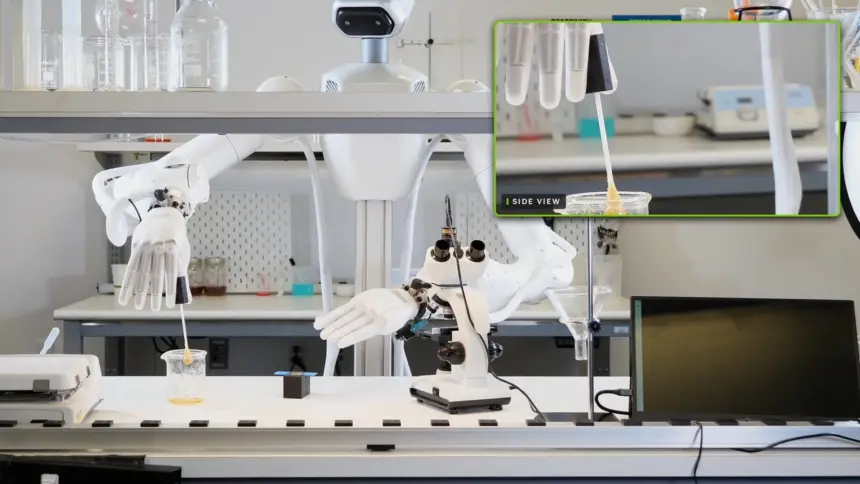
Nvidia introduced the Nvidia GR00T 2 foundation model on 9 November 2026 at the Conference on Robot Learning in Austin, Texas, creating a system that teaches robots delicate manipulation skills from human video. Built on a 2-billion-parameter transformer, the model predicts visual changes before moving and transfers skills across arms, hands and humanoids.
The model operates as what Nvidia terms a world action model. It pairs recent camera frames, internal robot states and plain-language instructions to predict what the scene will look like next while generating coordinated joint actions. Rather than training separate networks for different machine bodies, a single pretrained checkpoint controls parallel-gripper arms, multi-fingered dexterous hands and full humanoid robots.
Nvidia framed the project as an open release, though the GR00T 2 research page states that model code will not arrive until December 2026. Alongside the model announcement, Nvidia published the Human-1M-100K dataset on Hugging Face under a CC BY 4.0 licence, making 100,000 hours of first-person human video, motion tracking and text descriptions available for commercial and non-commercial use.
How the model learns from human video
The model’s pretraining dataset draws on three distinct pools of activity. Along with 23,500 hours of teleoperated robot control, Nvidia assembled 10,184 hours showing handheld grippers completing 2,897 tasks, backed by 402,730 hours of video filmed from a first-person human perspective. Unite.AI reported that the architecture builds on Cosmos-Predict2.5-2B, an underlying predictive transformer.
Capturing human movement allows robots to learn motor behaviours without engineers manually scripting trajectories or running tens of thousands of hours of hardware teleoperation for each task. Outside Nvidia, commercial data collectors have adopted similar recording pipelines. Startups such as Maxinsights now pay individuals to film everyday household chores from wearable cameras to build training corpuses for robotics companies, according to The Next Web.
Nvidia reported that cross-embodiment training allows skills to jump between distinct mechanical designs. In laboratory trials, GR00T 2 achieved a 65% success rate setting up laboratory filter paper after studying human demonstrations alone, without any robot teleoperation for that specific job. When transferring a toy dump-truck assembly skill from a handheld gripper to an automated YAM robotic arm, the system completed the assembly in 60% of test runs.

Benchmarking success and adaptation
In zero-shot evaluations across 50 tasks absent from the target robot’s pretraining data, GR00T 2 achieved a 40% success rate and completed at least one successful run on 40 of those tasks. Performance improved when operators provided brief demonstration data. On the Dexter benchmark, the model scored a 71% average success rate with one physical demonstration per task, rising to 95% when given five demonstrations.
Those five demonstration runs represent less than three minutes of robot teleoperation data per task. Adapting the model to the new job required roughly 30 minutes of adapter fine-tuning on a single Nvidia RTX 5090 graphics card.
The company’s technical whitepaper qualifies that 95% figure. Researchers chose the evaluated tasks specifically from a pool that the model was already capable of learning with five episodes at an 80% or higher success rate. The authors noted that the reported average is high partly by construction rather than a guarantee across any random factory chore.
To manage extended assembly jobs, GR00T 2 pairs its physical manipulation network with a higher-level reasoning agent. The agent tracks overall workflow progress, sequences individual skills and calls recovery routines if components slip or jam.
In tests assembling toy aeroplanes, toy tractors and Hot Wheels cars from randomly scattered parts, the combined agent and fine-tuned model completed 98, 97 and 97 successful builds out of 100 attempts, respectively. Supervised fine-tuning without the reasoning agent yielded 69, 51 and 23 successful assemblies.
This supervision introduces operational delays. The whitepaper recorded that on long-horizon post-training benchmarks, the system averaged roughly 70% success. In a visually guided trash-sorting task, the robot spent a median 38% of each episode waiting for the reasoning agent to process instructions and confirm scene states before executing the next physical move.
Simulation tools and fine-tuning
Nvidia paired the foundation model with updates to its robotics simulation stack, centring on Isaac Lab 3.0, released on 20 October 2026. The Isaac Lab 3.0 release notes outline a unified programming interface across physics, rendering and visualisation backends. Its Newton engine models rigid bodies, deformables and particles, allowing training runs without launching the full Isaac Sim application.
In benchmark tests of vision-based dexterous hand manipulation, Nvidia reported that Isaac Lab 3.0 with Newton ran training runs up to 2.5 times faster than Isaac Lab 2.3 operating on the PhysX physics engine.
To solve tight-tolerance industrial assembly in software, Nvidia and the University of Washington created Success-Guided Sampling. The algorithm directs simulation toward mechanical states where a policy succeeds about half the time, focusing practice on the machine’s capability boundary. Researchers scaled the method across more than one million simulated environments, transferring vision-based assembly policies directly to physical UR5e robot arms without real-world training.
That method underpins AlphaNIST, a simulation experiment covering 20 tasks from the National Institute of Standards and Technology Assembly Task Board, featuring components as small as four millimetres. A single shared policy trained using only binary success rewards reached 98.2% training success in simulation, compared with 81.4% for separate per-task policies, while consuming roughly 39 times less GPU compute time.
Academic partners presented complementary control architectures. Researchers from UC Berkeley demonstrated the Graph-as-Policy project documentation, which constructs directed graphs of robot skills, tests them in simulation and repairs failed execution branches. Rehearsing a popcorn-making routine through ten simulation cycles lifted task success from 33% to 94% in simulation and 90% across 20 trials on physical hardware.
Ken Goldberg, who teaches robotics at UC Berkeley and collaborated with Nvidia on two of the initiatives, said: “To me, agentic robotics is the most exciting technological development since the internet in 1995.”
Standardised benchmark suites presented at the conference measure these systems across messy commercial environments. Isaac Lab-Arena previewed version 0.4 for GPU-accelerated evaluation, while DexBench 1.0 introduced 15 tasks across retail, logistics and hotel hospitality. Another joint benchmark from UC Berkeley and Nvidia, named VABAR, evaluates tool sorting, gear meshing and cable routing across 33 base skills, with researchers preparing a harder evaluation set for future release.
What are companies testing with GR00T 2?
Industrial manufacturers have begun running pilot evaluations with the software. Contract manufacturer Foxconn, which now generates most of its revenue from assembling artificial intelligence servers, is testing GR00T 2 to automate steps on its electronics assembly lines.
Engineering conglomerate Siemens is evaluating the model across industrial manufacturing workflows. Siemens previously ran an eight-hour factory shift test using an earlier Nvidia-powered humanoid platform. Separately, robotics firm Nexuni is testing the model for automated commercial laundry handling.
Simulation tooling has also drawn venture-backed robotics builders. Walden Robotics, which launched with $300 million in funding in July 2026, has partnered with Nvidia to use Isaac Lab 3.0. Earlier versions of the GR00T architecture already support several hardware programmes underway, including a commercial humanoid robot that LG plans to release in 2027.
None of the corporate partners has deployed GR00T 2 in live commercial production. Nvidia and its pilot users described the current phase as technical validation, with developers monitoring whether the model can sustain its laboratory reliability when adapting to bespoke factory floors and overcoming processing delays.